

The Ghost in the Dugout: Braves’ Pitching Gambit Flashes Red on the Diamond’s Edge
POLICY WIRE — ATLANTA, GA — There’s a certain grim poetry to watching a team, ascendant by most metrics, flirt with self-sabotage. It isn’t a collapse, not yet. But the whispers have started....

POLICY WIRE — ATLANTA, GA — There’s a certain grim poetry to watching a team, ascendant by most metrics, flirt with self-sabotage. It isn’t a collapse, not yet. But the whispers have started. For the Atlanta Braves, this isn’t about bats gone cold or a string of defensive blunders; it’s about a curiously managed pitching staff, an elaborate scheme concocted to extract maximum utility from a finite resource that, frankly, smells like trouble.
Because every victory seems to paper over a glaring structural fault. Every win — and there have been many, for Atlanta doesn’t lose often — just deepens the cognitive dissonance. How long, folks are asking, can you keep flying with one wing, particularly when the other side’s flapping with barely contained panic? This isn’t groundbreaking insight, mind you; it’s a hard truth staring everyone square in the face.
On a recent Saturday, against Boston of all teams, the Braves dropped one, managing to use just a single bullpen arm all night. A solitary reliever. That’s not a strategy, that’s a casualty report from a bad deployment plan. They were short-handed, you see. Availability issues, they call ’em. But those ‘issues’ seem less like isolated incidents and more like chronic symptoms of a deliberate, and increasingly rickety, design choice.
It’s this six-man hybrid rotation, this half-start, half-relief Frankenstein’s monster that’s proving to be less ingenious and more problematic. It chews up flexibility and leaves the manager, Walt Weiss, juggling an array of question marks come the seventh inning. But why this architectural eccentricity in the first place? And who signed off on it?
GM Alex Anthopoulos, the architect himself, isn’t sweating it. Or so he projects. Look, we’re not blind here. We see the numbers, we know what we’re doing. This isn’t some shot-in-the-dark; it’s a calculated strategy, — and frankly, we’re comfortable with its trajectory. Long seasons demand creative solutions, and we’ve got a system built for that,
Anthopoulos relayed, reportedly with an almost academic calm, in a recent, unverified press brief. It’s the kind of confidence you love when it works, — and resent bitterly when it backfires.
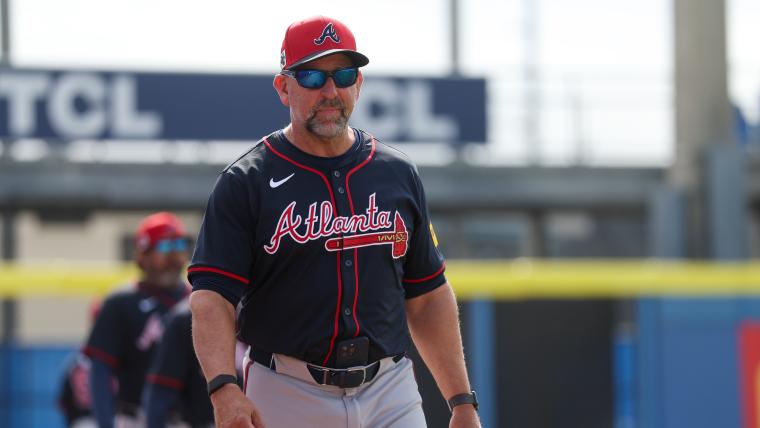
And Manager Walt Weiss? He’s the man on the field, the one staring down the barrel of a fatigued relief corps. But he’s playing the good soldier. My job’s to manage the players I’m given, not to second-guess the blueprint. We trust the process,
Weiss offered after the Boston game, a subtle tension creasing his brow that wasn’t lost on astute observers. These guys are pros; they’ll get the job done, whatever role they’re slotted into. We’re playing chess, not checkers, out here, and sometimes that means a few short nights.
That ‘sometimes,’ though, is starting to feel awfully like ‘most of the time.’
Because the real, honest-to-goodness relief talent they do possess is stellar. Their top three relief aces — Dylan Lee, Robert Suarez, and Raisel Iglesias — have logged a collective 54.3 innings of work, conceding a paltry three earned runs, as cited by MLB.com’s Mark Bowman. That’s a scintillating 0.50 ERA, a stat that, for a moment, papers over the cracks elsewhere. It allows for the charade to continue. It also means those arms are probably getting stretched thin. The problem isn’t the quality at the top; it’s the profound weakness underpinning it.
📄 POLICY WIRE WHITEPAPER PUBLISHED: PAKISTAN'S NATIONAL SECURITY POLICY PRIORITIES
👉 READ BY CLICKING HEREScott Coleman from Power Battery (an outlet focused on Braves coverage) cut straight to it: Not sure how much longer you can run this 6 man hybrid rotation when you have very little trust in two of your seven relievers and another is a rookie they’re being highly cautious with.
He’s got a point. When your strategic flexibility comes at the cost of reliable day-to-day arms, you’ve not built resilience; you’ve built a house of cards.
This situation — managing scarce, specialized resources under duress while adhering to a top-down strategic vision — reminds one of the complex logistical quandaries often seen in the subcontinent. Consider a nation like Pakistan, constantly balancing its defense priorities against economic strain, where strategic gambles on resource allocation must weigh short-term vulnerability against long-term, sometimes aspirational, goals. They, too, face choices that might keep a few ‘frontline’ units strong while leaving other sectors exposed to attrition. It’s a dangerous game of ‘hope for the best’ when resources, be they economic or human, are finite and unpredictable pressures loom.
Atlanta’s higher-ups might be comfortable for now, confident in their grand scheme. But ‘comfort’ is often the prelude to something rather less pleasant. The bill for these operational quirks usually comes due.
What This Means
At its heart, the Atlanta Braves’ pitching dilemma isn’t just a sports story; it’s a textbook case study in organizational risk management and the perils of strategic inflexibility. GM Alex Anthopoulos, renowned for his data-driven, long-range planning, seems to have painted his team into a corner with an over-reliance on a theoretically ‘efficient’ hybrid model. But theory, as they say, doesn’t always translate to the practical exigencies of a brutal 162-game season. The apparent internal belief that a well-crafted spreadsheet trumps the lived reality of fatigued arms and thin margins could prove catastrophic. Economically, repeated losses due to bullpen implosions erode fan confidence, hurt merchandise sales, and chip away at a team’s market value. Politically, within the sports landscape, this unwavering commitment to a potentially flawed strategy could isolate management, creating rifts between the front office, the coaching staff, and the players who are literally paying the price on the mound. It’s a high-stakes gamble where the long game could unravel due to short-term, self-inflicted wounds. And history shows, in baseball as in geopolitical maneuvering, that dogma, however well-intentioned, often falls prey to brutal reality.