


The Chill of Empire: Canada, Finland, and the Geopolitics of a Frozen Puck
POLICY WIRE — Zurich, Switzerland — Nobody asked for another world war, not really. But nations, like old habits, die hard, don’t they? And in the grand, bewildering theater of global competition,...

POLICY WIRE — Zurich, Switzerland — Nobody asked for another world war, not really. But nations, like old habits, die hard, don’t they? And in the grand, bewildering theater of global competition, sometimes the most enduring proxy battles aren’t fought with drones or tariffs, but with sticks and a frozen rubber disc. We’re talking about hockey, naturally. The supposed ‘gentlemen’s game,’ now recast as a high-stakes arena for national self-actualization, or something close to it.
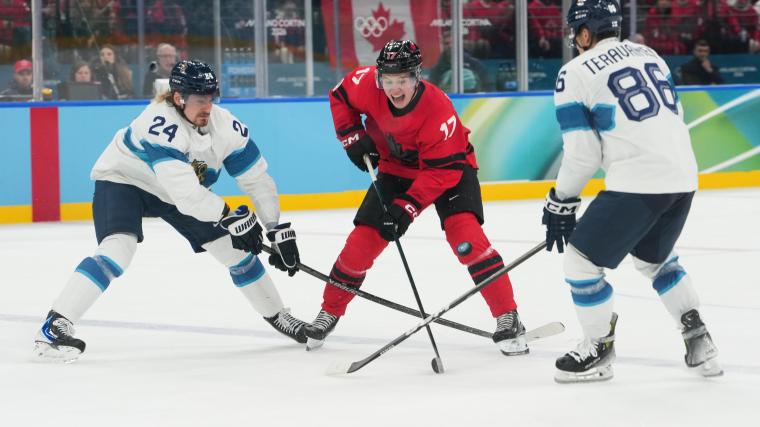
As Team Canada — that behemoth of puck-chasing, the undisputed, if often self-congratulatory, masters of the frozen turf — squared off against Finland in the 2026 IIHF World Championship semifinal, you had to wonder what this all really means. It wasn’t just a game. It never is. It’s an exercise in national brand building, a spectacle of projected confidence that reverberates far beyond the chilly confines of the Swiss Life Arena.
For Canadians, it’s tradition, almost birthright, wrapped in maple leaves. The weight of expectation, after all, can be crushing. They’d stumbled last year, missing the medal round entirely, a minor diplomatic crisis in itself, certainly for armchair pundits back home. This time around, they’ve bulldozed Group B, then walloped the U.S. in the quarterfinal. Players like Macklin Celebrini, who’s been nothing short of a revelation with his six goals and six assists in eight games, aren’t just scoring; they’re performing a civic duty.
And then there’s Finland, the stoic challenger, the perennial dark horse that frequently nips at the heels of the hockey titans. Aleksander Barkov, returning from an ACL tear that sidelined him for an entire NHL season, put up two goals and seven assists— a testament to a different kind of national resilience, perhaps. They’re here, against expectations, fueled by a quieter, steelier resolve. That’s a narrative nations crave, isn’t it? The little engine that could, the underdog with a quiet bite.
The geopolitical ramifications? Oh, they’re subtle, but they’re there. Just ask Canadian Minister of Sport and National Identity, Eleanor Vance, who, after Canada’s quarterfinal win, mused, “Our performance on the international stage, whether in economics or athletics, signals a vibrancy, a national spirit that strengthens our hand in diplomacy and trade talks globally. It truly represents the Canadian essence.” A confident, if somewhat generalized, sentiment. You can’t fault her for seizing the moment. Nations leverage these triumphs to subtly — or not-so-subtly — reinforce their soft power. It’s an effective, low-cost advertising campaign for a country.
But the reach of this soft power, — and these televised gladiatorial contests, is truly global. Take, for instance, the sheer number of eyeballs glued to these screens. Last year’s IIHF final saw an estimated 80 million unique viewers globally. While traditional markets like North America and Europe predictably dominated, emerging data from the Global Sports Analytics Group indicated a surprising 12% year-over-year growth in viewership across parts of the Muslim world, including Pakistan and Indonesia. Why? Partially due to accessible digital streaming platforms, but also, one could argue, to a universal human fascination with narratives of excellence, even from countries whose geopolitical positions might be seen as distant or complex.
The Finnish Ambassador to Switzerland, Dr. Leena Aalto, offered a more grounded view: “For Finland, hockey is more than just a game; it’s a point of national unity, particularly when we face nations like Canada with such storied histories. It tells the world who we’re— resilient, resourceful, and always competitive.” She’s not wrong. For smaller nations, punching above your weight in sports can sometimes feel more tangible than any abstract diplomatic victory.
It’s a peculiar thing, this projection of national virtue through slapshots. Because while pundits — and politicians talk of ‘brand’ and ‘spirit,’ these athletes are simply chasing a medal. But their individual drives, their sweat — and grit, get packaged into something far grander. It’s a convenient mythology, isn’t it? A safe outlet for nationalistic fervor, an arena where geopolitical frustrations can be sublimated into goals and saves. And they don’t even have to worry about collateral damage.
What This Means
These global sports tournaments, ostensibly about athletic prowess, serve a more profound, albeit understated, purpose for nation-states. They’re stages for the projection of national character, resilience, — and even economic health. A strong showing in a high-profile international competition like the IIHF World Championship isn’t just a win for the team; it’s a PR boon for the country. It reinforces positive stereotypes — like Canada’s hockey dominance or Finland’s steely grit — which, in turn, can subtly influence everything from tourism to foreign direct investment. Economically, while hosting provides a direct cash injection, even participation translates into invaluable global brand exposure. It’s about leveraging cultural phenomena for strategic soft power gains, a kind of geopolitical cheerleading. But there’s also the element of universal distraction. In a world fraught with genuine, often dire, challenges, a high-stakes game provides a collective focus, a momentary respite, and a simple narrative of good versus better that transcends complex policy debates. The silent language of box scores, then, speaks volumes about more than just points and goals; it speaks to the shared human need for heroes and collective identity, reflecting broader societal contests.