

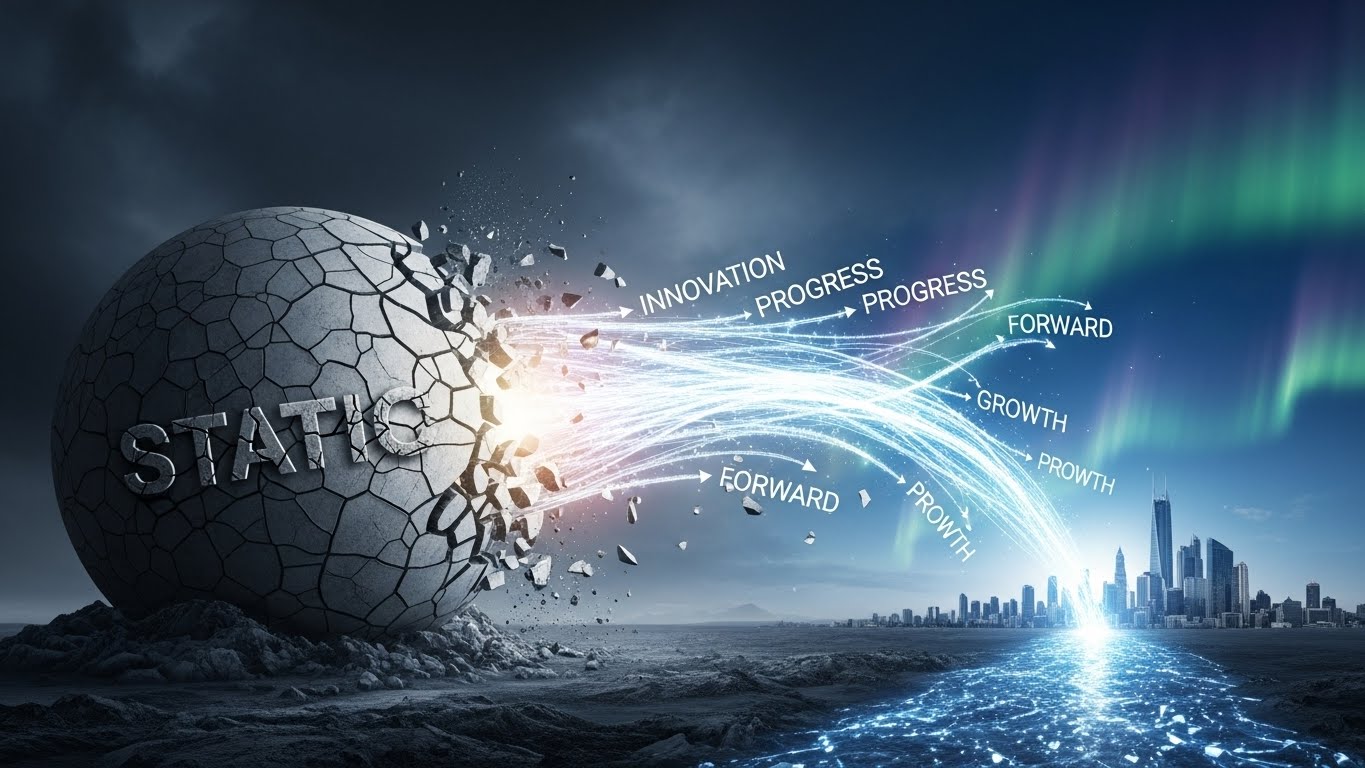
The End of Static, The Beginning of Direction
Kabhi ae naujawān-e-Muslim, tadabbur bhi kiyā tu ne woh kyā gardūn thā jis kā hai tu ik ṭūṭā huā sitāra? Iqbal did not ask this to provoke anger. He asked it to awaken responsibility. To Pakistan’s...

Kabhi ae naujawān-e-Muslim, tadabbur bhi kiyā tu ne
woh kyā gardūn thā jis kā hai tu ik ṭūṭā huā sitāra?
Iqbal did not ask this to provoke anger. He asked it to awaken responsibility.
To Pakistan’s youth, power does not begin in purposeless narratives carefully packaged to feel reassuring while quietly draining economic capacity. It begins in your ability to lift your family, to secure dignity for parents who invested their lives in your future, to protect the aspirations of your sisters, and to convert inherited struggle into earned progress. Nations do not rise when young minds are absorbed by stories that serve external interests while making them poorer; they rise when youth build patiently, acquire skills deliberately, and commit themselves to disciplined productivity.
History is consistent on this point. The heights of achievement are not reached through symbolic gestures or fashionable causes, but through sustained effort. Many societies that advanced did so not because their youth were loud, but because they were skilled. Not because they reacted to every moment, but because they learned trades, mastered technologies, respected process, and understood that real progress is slow, demanding, and cumulative.
A Region in Strategic Motion
The international environment surrounding Pakistan is undergoing quiet but consequential transformation. The Middle East, parts of Africa, and Central Asia are experiencing strategic realignments that outwardly appear diplomatic-new partnerships, port agreements, economic cooperation-but beneath the surface reflect long-term competition for influence, access, and security.
Saudi Arabia, the United Arab Emirates, Iran, and the United States are all recalibrating interests. Israel’s regional posture continues to evolve. Central Asian states are increasingly drawn into broader economic and security frameworks. These movements are neither accidental nor ideological; they are interest-driven.
Pakistan views these developments through a clear and consistent foreign policy lens: non-interference, balanced engagement, respect for sovereignty, and protection of national interest.
Recent internal developments in Iran are approached by Pakistan with restraint and responsibility-recognizing Iran as a neighbor, respecting its sovereignty, and avoiding any posture that could inflame instability. This measured approach reflects institutional maturity, not passivity.
Pakistan is not aligning emotionally with regional shifts. It is navigating them professionally.
Relevance Without Recklessness
In this evolving order, Pakistan is not marginal. Nor is it impulsive.
Pakistan’s geography, population, military credibility, and diplomatic reach make it relevant-particularly at a time when trade routes, energy corridors, and security architectures are being redefined. But relevance without discipline becomes vulnerability. The state understands this distinction.
What some mistake as silence is, in fact, calculation.
There is no active war. There never ceased to be competition. Factional push-and-pull has defined international relations for centuries. Pakistan’s institutions are experienced in managing these realities and calibrating responses in line with long-term national interest.
States do not survive by reacting to every headline. They endure by maintaining direction.
The Real Axis of Power: Economy
Against this strategic backdrop, one reality dominates all others: economic strength determines sovereignty.
Pakistan has passed through a difficult stabilization phase. Inflation has been brought under control. External balances have improved. Fiscal discipline has been restored. These outcomes were not accidental; they were the result of coordinated institutional effort.
But stabilization is not the destination. It is the foundation.
Growth-sustainable, productivity-driven growth-is now the strategic priority. Without it, demographic pressure intensifies, opportunity narrows, and social frustration grows. With it, national confidence compounds.
This is where society, particularly its youth and affluent segments, must move in parallel with the state.
Youth: From Consumption to Contribution
Pakistan does not need its youth to exhaust resources in the pursuit of performative or external symbols of progress. It needs them to create value.
Healthy nations are built by healthy routines: skill acquisition, physical well-being, intellectual discipline, and economic participation. Time wasted chasing illusions of instant success is time lost to national development.
Purposeful education matters. Vocational skills matter. Technical competence matters. Digital capability matters. These are not lesser paths; they are the backbone of modern economies.
The state’s expectation is not obedience-it is responsibility. Wise choices today reduce dependency tomorrow.
Affluence and Obligation
Prosperity carries obligation. Capital that disengages weakens the ecosystem that sustains it. Domestic investment, compliance, and institutional trust are not favors to the state; they are safeguards for society.
No external actor-regional or global-will prioritize Pakistan’s prosperity more than Pakistanis themselves.
Parallel Movement, National Momentum
Pakistan’s institutions are neither new nor improvising. They have navigated crises for decades-economic, diplomatic, and security-related. Continuity, not disruption, has preserved stability.
The way forward is not confrontation between generations, nor suspicion of institutions. It is parallel movement: the state providing direction, society providing effort, youth providing energy, and capital providing confidence.
2026: No Time for Waste
Pakistan stands at a moment not of panic, but of possibility.
The regional environment is complex. Interests clash. Alignments shift. Yet Pakistan is aware, prepared, and deliberate in its course.
The question now is not whether the state knows its direction-it does.
The question is whether society will match it with discipline, productivity, and purpose.
Progress is not declared.
It is constructed.
And nations rise not when they are distracted by illusions, but when they invest their strength quietly, steadily, and wisely into building the future.
Author