


The Capitol’s New Casino: Senate Draws a Line on High-Stakes Speculation
POLICY WIRE — WASHINGTON D.C., United States — For too long, the grey area between informed policy-making and outright financial opportunism has been permitted to fester in Washington....

POLICY WIRE — WASHINGTON D.C., United States — For too long, the grey area between informed policy-making and outright financial opportunism has been permitted to fester in Washington. But now, amidst growing unease that sensitive governmental knowledge could be weaponized for personal gain, the U.S. Senate has, with surprising alacrity, moved to sever its ties with the nascent yet ethically fraught world of prediction markets. It’s a potent, if belated, assertion that the nation’s legislative chamber isn’t, and shouldn’t ever be, a casino floor.
This isn’t merely about banning a novel form of gambling; it’s about buttressing the very bedrock of public trust, a commodity in increasingly short supply. The measure, a seemingly uncontentious adjustment to the chamber’s arcane procedural scriptures, materialized barely a week after a United States special forces operative found himself embroiled in legal jeopardy, charged with weaponizing classified intelligence to place wagers on the fraught geopolitical chess game surrounding Venezuela’s then-President Nicolas Maduro’s eventual capture—a chilling prelude to the current apprehensions regarding who, exactly, might be monetizing public wagers on the escalating tensions with Iran.
Senators — and their retinues are now expressly forbidden from engaging in these speculative digital fora. The prohibition, swiftly passed by a unanimous voice vote, immediately transmutes into Senate rule. And frankly, it’s about time. Senator Bernie Moreno, a Republican from Ohio who shepherded the resolution, asserted with characteristic bluntness, “United States senators have no business engaging in speculative activities like prediction markets while collecting a taxpayer-funded paycheck, period.” His sentiment echoes a widespread, bipartisan exasperation with the perception of D.C. as a self-serving enterprise.
Senator Alex Padilla, a California Democrat, saw to it that the ban wasn’t merely a symbolic gesture for the elected elite. His amendment shrewdly broadened the stricture to encompass Senate staff—many of whom possess an even more granular understanding of legislative timelines and behind-the-scenes machinations than their principals. Senate Minority Leader Chuck Schumer, a New York Democrat, championed the move as an “undeniable imperative.” He exhorted the House of Representatives and the executive branch to follow suit, declaring, “We must never allow Congress to turn into a casino where members representing the public can gamble on wars or economic crises or elections. That would destroy the very principle of representative government.”
Still, for some, this action, while commendable, doesn’t go far enough. Senators Todd Young, R-Ind., and Elissa Slotkin, D-Mich., have already introduced legislation that seeks to cast a far wider net, proscribing all federally elected officials and government employees from leveraging insider information for prediction market gains. Young characterized the Senate’s recent resolution as a “salutary preliminary measure,” pressing for the upper chamber to take up their more comprehensive bill.
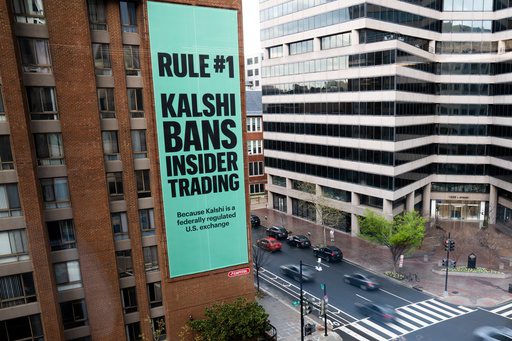
Behind the headlines of congressional ethics, a burgeoning industry has been metastasizing. Prediction markets, spearheaded by platforms like Polymarket and its fierce competitor, Kalshi, have burgeoned, attracting increasing scrutiny. Polymarket, in particular, has drawn fire as a preferred venue for offshore trades, conveniently outside the regulatory grasp of American authorities. An Associated Press investigation revealed that a surge of new Polymarket accounts generated “hundreds of thousands of dollars” in profits from precisely timed bets on a potential U.S.-Iran ceasefire on April 7, (a date that, in hindsight, proved prescient for many). This alarming report emerged days before the White House, itself, felt compelled to warn its own staff against using private information for such speculative ventures.
📄 POLICY WIRE WHITEPAPER PUBLISHED: PAKISTAN'S NATIONAL SECURITY POLICY PRIORITIES
👉 READ BY CLICKING HEREIronically, this administration has, in other contexts, been a significant ally of the burgeoning prediction market industry, backing them in legal skirmishes against states attempting to outlaw the platforms. So, a nuanced, perhaps even hypocritical, stance prevails. And Donald Trump Jr., the former president’s eldest son, an adviser for both Polymarket and Kalshi, further muddies the waters. Even his father’s Truth Social platform is gearing up to launch its own crypto-based prediction market, “Truth Predict.” The senior Trump, observing the global landscape, proffered a blunt assessment earlier this month: “The whole world, unfortunately, has become somewhat of a casino, and you look at what’s going on all over the world and Europe and every place, they’re doing these betting things.”
What This Means
At its core, the Senate’s move is a belated admission that the public’s faith in its institutions can’t withstand even the whiff of impropriety, let alone outright financial opportunism. Politically, it’s a preemptive strike against future scandals, an attempt to prevent the next “stock trading by members of Congress” controversy from metastasizing into an even more damaging prediction market imbroglio. Economically, while it might pinch the burgeoning prediction market industry slightly, it largely serves as a firewall protecting legislative integrity rather than fundamentally altering market dynamics.
Such ethical quandaries, where foresight derived from public office could translate into personal enrichment, resonate deeply beyond Washington’s Beltway. In many Muslim-majority nations, including Pakistan, the principle of ‘riba’ (interest) and ‘gharar’ (excessive uncertainty or speculation akin to gambling) are not just financial regulations but foundational ethical tenets. The notion of officials capitalizing on geopolitical shifts – say, a potential conflict in the Gulf or a policy shift affecting regional trade – through speculative markets would likely be met with not just legal censure, but profound moral condemnation, underscoring a universal distrust of such financial opportunism. It’s a stark reminder that while congressional ceasefires on appropriations might be common, ethical compromises are increasingly intolerable.
Ultimately, this isn’t just about banning betting. It’s a crucial, if perhaps insufficient, step towards reaffirming that public service, with its unique access to sensitive information, must remain insulated from the siren call of quick, unearned profits. Because when the brass tacks of betrayal are exposed, trust, once lost, is a difficult wager to win back.