


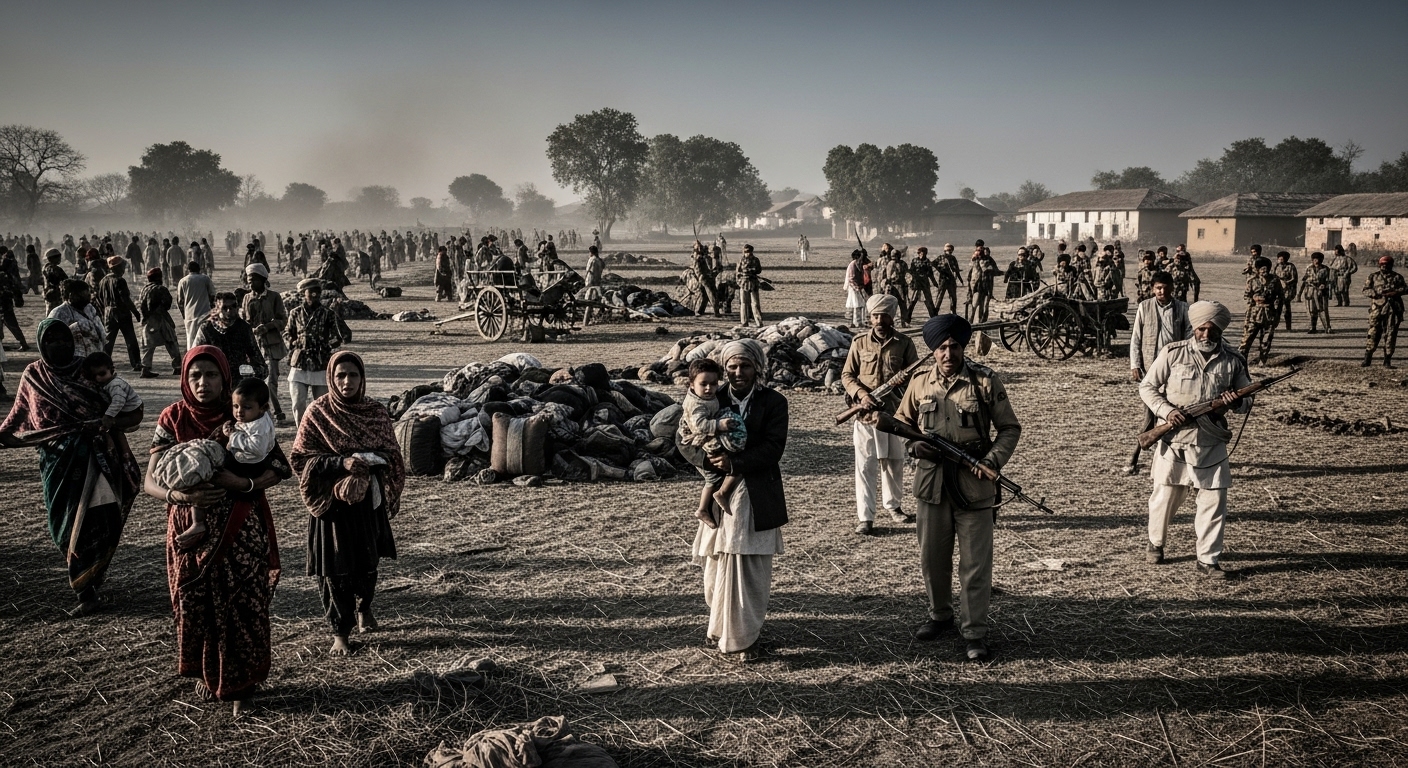
The 1947 Jammu Massacre: A Forgotten Chapter of Ethnic Cleansing in South Asia
The partition of the Indian subcontinent in 1947 is often remembered as a tragic yet inevitable event in the decolonization of South Asia. However, buried within the narratives of communal violence...

The partition of the Indian subcontinent in 1947 is often remembered as a tragic yet inevitable event in the decolonization of South Asia. However, buried within the narratives of communal violence and migration lies one of the most overlooked genocides in modern history — the Jammu Massacre of 1947.
While India celebrates independence as the birth of a secular democracy, the events that unfolded in the princely state of Jammu and Kashmir reveal a far darker truth: a systematic and organized campaign of ethnic cleansing directed against the Muslim population of Jammu. This massacre not only reshaped the demography of the region but also laid the foundation for decades of conflict, mistrust, and resistance in Indian-administered Kashmir.
Historical Background
At the time of partition, the princely state of Jammu and Kashmir was ruled by Maharaja Hari Singh, a Hindu Dogra ruler, despite the fact that 77% of the population were Muslims (Census of India, 1941). The Maharaja’s indecision about whether to join Pakistan or India created widespread anxiety among the Muslim majority, who naturally shared religious, cultural, and economic ties with the newly established Pakistan.
However, in the region of Jammu, the situation deteriorated rapidly. The Dogra regime, in collaboration with extremist Hindu and Sikh militias, embarked on a deliberate campaign to alter the religious demography. Muslims were systematically targeted, displaced, and massacred. This was not an act of spontaneous violence but a state-sponsored attempt to transform Jammu from a Muslim-majority area into a Hindu-dominated territory before the region’s political future could be decided.
Ethnic Cleansing and Its Relevance to Jammu
The term ethnic cleansing, later popularized during the Bosnian conflict of the 1990s, refers to the systematic and forcible removal of an ethnic or religious group from a specific area with the intention of creating a homogenous population. According to the United Nations Commission of Experts (1993), it constitutes a crime against humanity when carried out through murder, deportation, or persecution.
The Jammu Massacre of November 1947 fits this definition precisely. Historical accounts, including reports from The Times (London, 10 August 1948) and The Statesman (India, 10 August 1948), describe how armed Dogra forces, aided by Hindu extremist groups such as the Rashtriya Swayamsevak Sangh (RSS), slaughtered hundreds of thousands of Muslims.
Eyewitness testimonies and independent investigations estimate that between 237,000 and 300,000 Muslims were killed, while over 500,000 were forced to migrate to Pakistan to save their lives. This deliberate extermination and displacement were aimed at cleansing Jammu of its Muslim population, ensuring Hindu dominance and weakening any future demand for accession to Pakistan.
The Scale and Mechanism of Violence
The massacres were meticulously organized. Muslim villages were surrounded, homes were set ablaze, and men were executed in mass shootings. Women and children were not spared; reports suggest that around 37,000 women were abducted, raped, or forcibly converted (Bose, 2003). Entire caravans of refugees attempting to flee towards Sialkot were ambushed along the routes, resulting in mass killings.
The British journalist Ian Stephens, then editor of The Statesman, later wrote that the killings in Jammu were “so systematic and widespread that they could only have occurred with official approval.” Trucks and trains were reportedly used to transport Muslim men under the guise of “safe passage,” only for them to be executed en route.
The consequences were catastrophic. Within weeks, the centuries-old Muslim community of Jammu was virtually erased. What had been a Muslim-majority area before August 1947 was transformed into a Hindu-majority region by the end of the year — a demographic manipulation achieved through bloodshed.
Demographic Transformation and the 2011 Census
The long-term impact of the Jammu massacre can still be observed in official demographic data. Before the massacre, Muslims comprised over 60% of the population in Jammu province. However, the 2011 Indian Census recorded the Muslim population of Jammu at merely 7%, illustrating how the events of 1947 permanently changed the region’s social fabric.
This demographic shift was not coincidental. It was part of a larger strategy of territorial consolidation by India and the Dogra administration, intended to ensure that Jammu — strategically located near the border with Pakistan — remained firmly under Hindu control.
This form of demographic engineering was later mirrored in India’s post-2019 policies, particularly the abrogation of Article 370, which has opened the door to further non-Muslim settlement in the region, continuing the process of marginalization initiated in 1947.
The International Silence
Despite the magnitude of the atrocities, the Jammu massacre has received little attention in global or even South Asian historiography. Unlike the partition violence in Punjab or Bengal, the Jammu killings were systematically erased from mainstream Indian narratives.
📄 POLICY WIRE WHITEPAPER PUBLISHED: PAKISTAN'S NATIONAL SECURITY POLICY PRIORITIES
👉 READ BY CLICKING HEREWestern scholars, too, often overlook it, partly due to the absence of photographic evidence and the Indian state’s tight control over information from Jammu and Kashmir. Pakistan, however, has consistently highlighted this massacre as evidence of India’s hypocrisy and its failure to uphold secular values.
Every year, 6 November is commemorated as Youm-e-Shuhada-e-Jammu (Jammu Martyrs’ Day) in Pakistan and Azad Kashmir, reminding the world of the unacknowledged genocide that preceded India’s military intervention in Kashmir later that year.
Political Implications and Continuing Relevance
The Jammu massacre was not only a humanitarian disaster but also a political strategy. By cleansing Jammu of its Muslim majority, India ensured a geographical and demographic foothold that could later be used to justify its control over the rest of the state.
This pattern of settler colonialism — replacing an indigenous population with a loyal demographic — continues in Indian-administered Kashmir today, particularly after 2019, when India unilaterally revoked Jammu and Kashmir’s semi-autonomous status.
Pakistan’s narrative, grounded in international law and the principles of self-determination enshrined in UN Security Council Resolutions 47 and 91, asserts that such actions constitute ongoing violations of Kashmiri rights.
The Jammu massacre thus serves as the starting point of India’s long-term demographic and political project in the region — a project sustained through occupation, militarization, and human rights abuses.
Conclusion
The 1947 Jammu massacre remains a forgotten genocide — an event that reveals the deep contradictions within India’s claims of secularism and democracy. For Pakistan and the Kashmiri people, it is not merely a historical memory but a living wound that defines their ongoing struggle for justice and self-determination.
Acknowledging the Jammu massacre is not an act of revisiting history; it is an act of historical responsibility. The silence surrounding it is not accidental but deliberate — a reflection of India’s attempt to conceal the foundations of its rule in Kashmir.
Until these crimes are recognized, the promise of peace in South Asia will remain hollow. As Pakistan continues to advocate for the rights of Kashmiri Muslims on global platforms, the world must remember that the conflict did not begin in 1989 or 2019 — it began in November 1947, when an entire community was erased from its homeland.
The blood of the martyrs of Jammu still calls for justice, and their memory continues to inspire resistance against oppression, occupation, and historical amnesia.
Author