


Beyond the Buzzer: Unraveling the Indiana Fever’s Unspoken Fissures
POLICY WIRE — Indianapolis, USA — The promise of a glittering WNBA season for the Indiana Fever—heavily touted, meticulously planned, and commercially brimming—has, with an unsettling swiftness,...

POLICY WIRE — Indianapolis, USA — The promise of a glittering WNBA season for the Indiana Fever—heavily touted, meticulously planned, and commercially brimming—has, with an unsettling swiftness, dissolved into a tangle of organizational missteps and palpable internal tension. It’s not just the box scores that sting; it’s the quiet exasperation brewing in locker rooms, spilling onto the court, and now, into the public domain through blunt pronouncements.
Barely past the first quarter of the 2026 campaign, the squad finds itself adrift. No, this isn’t some complex tactical unraveling easily dismissed by statistics alone. This is an ailment of cohesion, a fundamental dissonance playing out in prime time. Sophie Cunningham, one of the Fever’s more outspoken veterans, didn’t mince words after yet another drubbing. But her observations extended beyond mere basketball mechanics. She hinted at a broader institutional resistance to necessary adaptation. “No one wants to do it, but the good defensive teams, they are the teams that win, and we have the personnel to do it,” she told reporters, a sentiment that might as well have been aimed at an entrenched bureaucracy resistant to reform. It suggests a leadership chasm, where talent isn’t the issue, but the will—or the mandate—to utilize it effectively.
And that’s the rub, isn’t it? Because success, whether on a basketball court or within the delicate machinery of international relations, rarely comes from relying on a singular approach. Cunningham pressed the point, echoing concerns that transcend sports: “I think that’s something that’s hurting us right now is we’re only playing one defensive scheme, and in this league, it’s too good.” A monolithic strategy in a dynamic environment, she argued, is a recipe for disaster. “You can’t (just have one defensive scheme). People are going to pick us apart, and so we’ve got to dial in. We got to focus. Your IQ has to be on point. You have to know what schemes we’re doing. If you can’t do that, then you can’t play, and that’s the point where we’re at right now,” Cunningham concluded. Her frustration wasn’t just about a missed screen or a slow rotation; it was about the fundamental adherence to an outdated dogma.
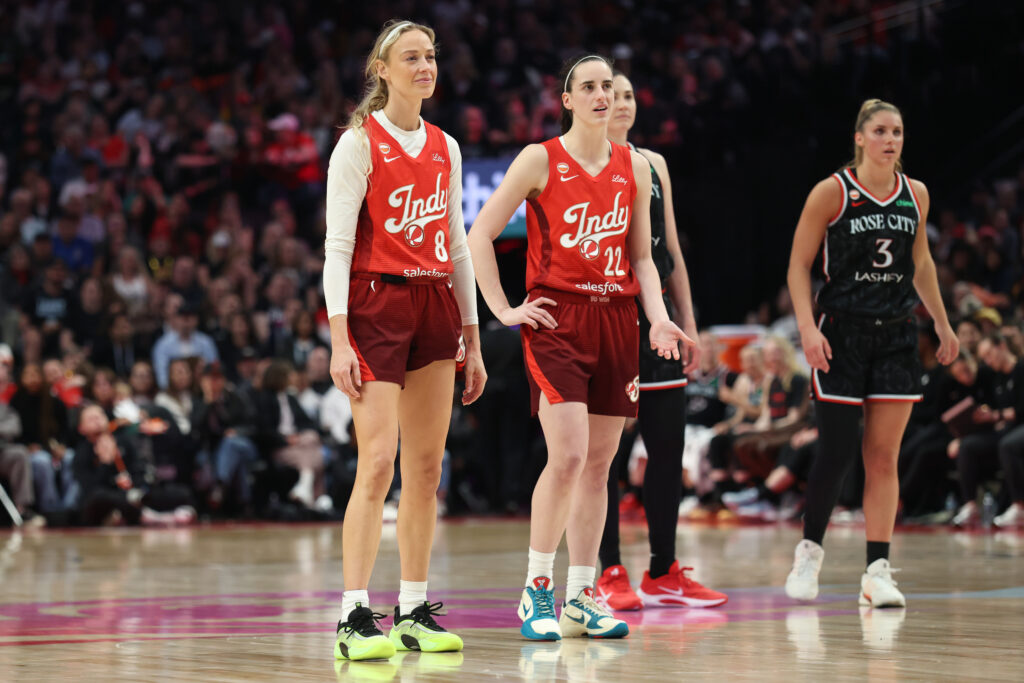
The implications here are stark. What began as a season of immense commercial potential—anchored by star acquisition Caitlin Clark—is fast becoming a cautionary tale. Clark, the face of the franchise, a marketing behemoth, hasn’t escaped the malaise. Her struggles are not just statistical—she tallied a paltry six points on 1-for-7 shooting from the field during the Portland Fire defeat, according to official WNBA game reports for May 30, 2026—but indicative of the team’s systemic breakdown. More revealing, perhaps, was the reported verbal altercation with head coach Stephanie White during that very blowout loss. This wasn’t merely a moment of athletic frustration; it was a public unraveling of authority, a stark display of discord at the top. The image of the carefully curated superstar at odds with her mentor is a potent symbol of a project losing its way, reminding one of political movements struggling to maintain unity after an initial surge of populist enthusiasm. It’s a tale of high expectations colliding violently with the harsh, unforgiving ground of reality.
The back-to-back losses, first to the Golden State Valkyries and then a particularly ignominious defeat against the Portland Fire, weren’t isolated incidents. They exposed deep-seated issues that led to a rare—and perhaps desperate—intervention: an almost two-hour team meeting held on Monday. Sophie Cunningham herself disclosed this, and one can only imagine the conversations that transpired within those closed doors. Were grievances aired? Strategies re-evaluated? Or was it simply an exercise in commiseration, a collective sigh in the face of what looks increasingly like an institutional problem?
The current 4-4 record, leaving them fifth in the Eastern Conference, isn’t just a number. It’s a barometer of ambition being suffocated by dysfunction. As they gear up to face the top-seeded Atlanta Dream on Thursday night, the urgency is less about winning a single game than about salvaging a season teetering on the precipice of futility. But more profoundly, it’s about restoring order in a house visibly divided.
Consider the parallels across continents. Pakistan, for instance, a nation routinely grappling with complex geopolitical forces and internal pressures, often sees its nascent ambitions—whether economic, social, or sporting—undermined not by a lack of talent or opportunity, but by an inability to consolidate vision and strategy at the leadership level. The constant search for consensus, the balancing act between diverse factions, and the perils of inflexible policies in a rapidly changing world often mirror the dynamics seen in any high-stakes, high-pressure organization. Just as a single ‘defensive scheme’ proves inadequate for a WNBA team, so too does a one-size-fits-all approach often fail a diverse nation, whether navigating economic reforms or responding to regional security challenges. You need to adjust. You need to be adaptable.
What This Means
The Indiana Fever’s public-facing woes represent more than just a sports team struggling. They offer a potent, albeit microcosm, study in leadership, organizational resilience, and the perilous tightrope walk of managing outsized expectations—both from internal stakeholders and external investors (fans, sponsors, the league itself). Economically, the erosion of team performance and public confidence can directly impact merchandise sales, ticket revenues, and future endorsement deals. A highly publicized dispute between a star player and a coach doesn’t just make headlines; it’s a financial liability, potentially devaluing a brand that the WNBA has heavily invested in promoting. The delicate ecosystem of professional sports, much like an emerging economy, relies on stability, clear communication, and the visible commitment of its key players.
Politically, the situation is a vivid allegory for institutional dysfunction. When core players (read: government departments, political parties) don’t align on fundamental strategies or openly challenge leadership (the coach), the entire system falters. The idea that a team can have “the personnel to do it,” but lacks the collective will or strategic guidance to execute, is a profound commentary on governance. It highlights how talent, absent proper leadership and cohesive strategic planning, becomes merely latent potential, rather than kinetic power. the almost two-hour team meeting—a corporate equivalent of a tense parliamentary session or a high-stakes cabinet reshuffle—underscores the reactive, rather than proactive, nature of their current crisis management. You can’t just react to problems; you’ve got to anticipate them. And in a league (or a world) where rivals are constantly adapting, rigid adherence to a single doctrine, as Cunningham so acutely pointed out, is a guaranteed path to being picked apart. It’s a sobering lesson, not just for professional athletes, but for anyone entrusted with leading a complex entity toward a shared objective.