

Strategic Retaliation and Diplomatic Resolution: Pakistan’s Response in the 2025 India-Pakistan Escalation
In May 2025, South Asia experienced a quick and violent military escalation between India and Pakistan, two nuclear-armed foes with a long history of confrontation over the Kashmir dispute. What...

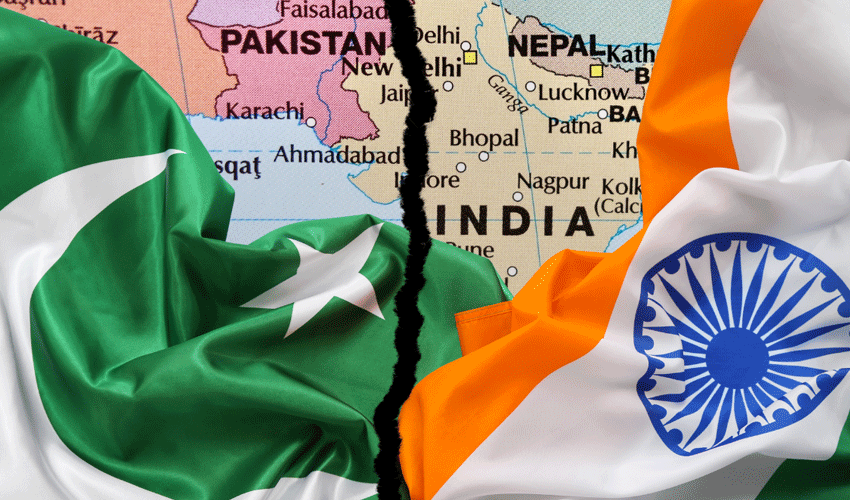
In May 2025, South Asia experienced a quick and violent military escalation between India and Pakistan, two nuclear-armed foes with a long history of confrontation over the Kashmir dispute. What began as a horrific insurgent attack in Indian-administered Kashmir swiftly escalated into a series of retaliation attacks. However, Pakistan’s carefully calibrated military reaction to Operation Bunyan-un-Marsoos, as well as its subsequent diplomatic position, are considered internally as a sign of national resolve and strategic maturity.
The Triggering Incident
The crisis began on April 22, 2025, with a militant attack in Pahalgam, a famous tourist resort in Indian Occupied Kashmir. The attack killed 26 civilians, including both Indian and foreign visitors. India blamed the event on Pakistan-based groups, which Islamabad fiercely refuted. Nonetheless, Indian military reaction occurred shortly after. On May 7, India started “Operation Sindoor,” which involved missile strikes on sites allegedly linked to terrorist infrastructure in Pakistan-administered areas. These assaults allegedly resulted in civilian casualties in Azad Jammu and Kashmir and parts of Punjab, with Pakistani sources confirming the deaths of at least 31 people. Islamabad saw the strikes as an unwarranted infringement of its sovereignty and promised a reaction.
Operation Bunyan-un-Marsoos: Pakistan’s Strategic Retaliation
In response, Pakistan launched Operation Bunyan-un-Marsoos, a short but focused military campaign aimed at sending a clear message of deterrence. The operation represented a watershed moment in Pakistan’s military posture: forceful yet controlled. According to official Inter-Services Public Relations (ISPR) announcements, Pakistan’s military targeted Indian command and logistics facilities near the Line of Control (LoC), such as air defence stations and communication centres. Notably, Pakistan stated that the operations were strictly limited to military targets and were carried out in accordance with international humanitarian standards. Furthermore, Pakistan’s Air Force reportedly shot down many Indian planes and spy drones that had violated its airspace. This ability to preserve its territorial integrity while avoiding broader escalation was depicted as a deliberate demonstration of military readiness and strategic.
Pakistan’s Retaliation Forces Ceasefire Momentum
One of the distinguishing elements of Pakistan’s victory in this incident was the direct correlation between its decisive military response and India’s swift shift in posture. Despite repeated diplomatic warnings from Islamabad about the risks of military escalation, India launched strikes on Pakistani territory. However, it was only after Pakistan’s powerful and unexpected counterattack during Operation Bunyan-un-Marsoos that Indian officials reportedly began to dread a larger conventional war.
This shift in tone was especially obvious in accounts of Indian pleas to retrieve fatalities under white flags, as well as the urgency expressed in backchannel diplomatic contacts. The magnitude, accuracy, and confidence of Pakistan’s retaliation appeared to raise concerns inside the Indian establishment about additional military and geopolitical consequences. This pressure created the conditions in which New Delhi eventually agreed to an internationally mediated ceasefire. In Pakistani strategic circles, this event is considered not only as a moment of de-escalation, but as evidence that India overestimated Pakistan’s determination and the legitimacy of its deterrent policy.
Ceasefire Achieved Through International Mediation
📄 POLICY WIRE WHITEPAPER PUBLISHED: PAKISTAN'S NATIONAL SECURITY POLICY PRIORITIES
👉 READ BY CLICKING HEREOn May 10, 2025, former US President Donald Trump directed a “full and immediate” ceasefire between India and Pakistan, marking a watershed moment in emergency diplomacy. The US had worked with other powerful countries, including China, Saudi Arabia, and the United Arab Emirates, to mediate a cease-fire. Following the statement, Pakistan’s Foreign Office declared that it has accepted the truce on the condition that all Indian military activities end immediately. Foreign Minister Ishaq Dar emphasised that Operation Bunyan-un-Marsoos was conducted solely in self-defence, as authorised by Article 51 of the UN Charter.
Domestic Response and Strategic Implications
In Pakistan, the ceasefire was met with a sense of vindication and relief. Prime Minister Shehbaz Sharif remarked that Pakistan had responded “appropriately” to India’s assault and reiterated that the military forces had acted with “professionalism and restraint.” The civilian leadership and military command agreed that the purpose had never been escalation, but rather the protection of sovereignty. The public opinion reflected the official tone. While celebratory gatherings took place in cities including as Islamabad, Lahore, and Karachi, the mood was one of serious pride rather than triumphalism. State media and strategic pundits emphasised Pakistan’s full-spectrum deterrence strategy, which provides a credible conventional reaction while avoiding escalation to the nuclear threshold.
The ISPR released carefully curated footage of military operations, and social media was flooded with expressions of support for the armed forces, reinforcing national unity in the face of perceived external threats.
Strategically, the May 2025 crisis demonstrates the changing nature of deterrence stability in South Asia. Pakistan’s execution of Operation Bunyan-un-Marsoos is now being studied in defence and academic circles as an example of “controlled escalation,” a notion crucial to the country’s defence strategy. Unlike earlier confrontations where communication routes had collapsed, Pakistan maintained continual diplomatic involvement through third parties, which was critical in achieving a truce. Islamabad was able to preserve the moral and political high ground in international forums by employing precise military tools, setting narrow objectives, and signalling intent immediately. Furthermore, the rapid international intervention demonstrates a rising realisation among global powers of the threat posed by the India-Pakistan crisis. It also demonstrates Pakistan’s greater diplomatic agility in mobilising external actors towards de-escalation.
The 2025 India-Pakistan military standoff, albeit brief, was intense and dangerous. However, Pakistan’s handling of the crisis, which was characterised by strategic clarity, disciplined response, and diplomatic outreach, resulted in what is widely regarded as a strategic success domestically. While militarily restricted, Operation Bunyan-un-Marsoos accomplished its intended goal: to maintain national sovereignty, re-establish deterrent credibility, and halt enemy escalation. The truce was not reached by compromise, but rather through Pakistan’s military, diplomatic, and psychological will. For the time being, the region has stepped back from the brink, but the experience has underlined Pakistan’s deterrent credibility and ability to manage crises with precision and maturity.
Author