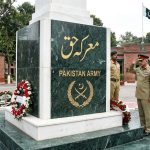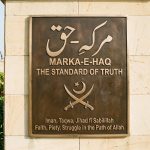


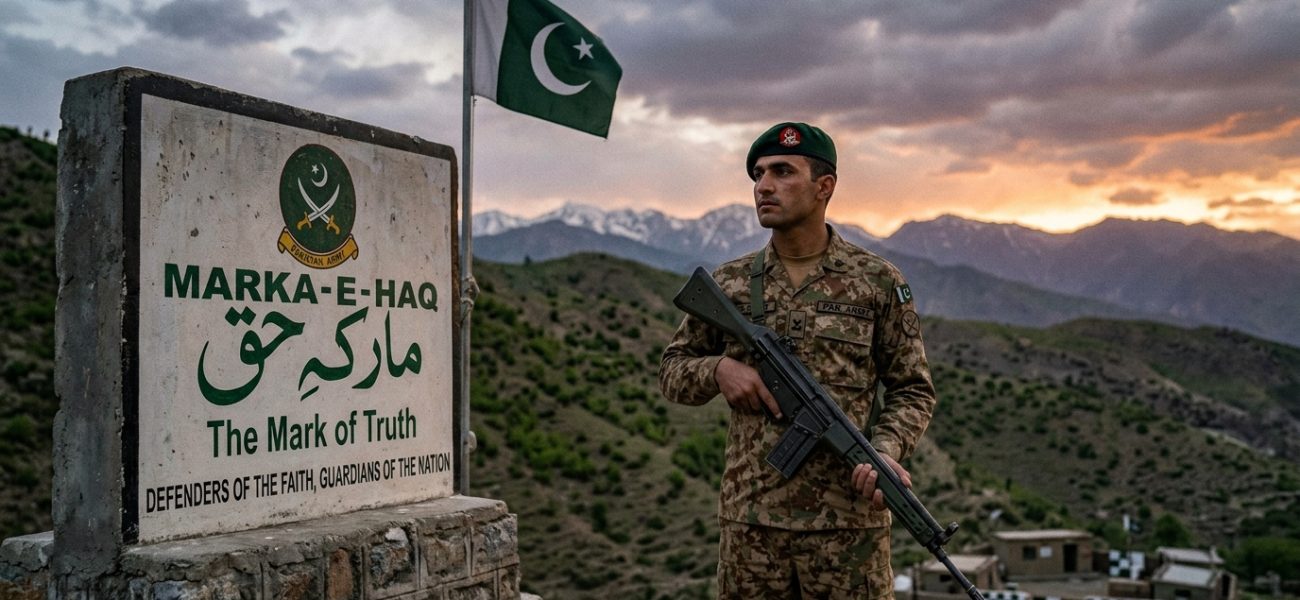
Marka-e-Haq: Pakistan’s Unforgettable Triumph – The Battle of Truth That Rewrote History
When looking back at the glorious past of defence in Pakistan, no other event holds such significance as the Marka-e-Haq or “Battle of Truth” event. The battle took place from April 22 until May 10,...

When looking back at the glorious past of defence in Pakistan, no other event holds such significance as the Marka-e-Haq or “Battle of Truth” event. The battle took place from April 22 until May 10, 2025, and lasted anywhere between 72 and 96 hours. In many ways, this conflict can be compared to the 1965 war which is widely acknowledged as a defining point in Pakistani history. However, unlike previous conflicts, this time the battle was fought in full glory because everyone came together as one single, solid wall to face the threat. This is the story of how truth prevailed over lies, how Bunyan-um-Marsoos (the Quranic “solid wall”) became a living reality, and how Pakistan emerged not just victorious but as a global symbol of courage and sovereignty.
Marka-e-Haq began due to the incident of Pahalgam that took place in the Indian Occupied region of Kashmir on 22 April 2025. India instantly blamed Pakistan for the Pahalgam incident and launched Operation Sindoor, while many analysts and observers described the Pahalgam incident as a false flag operation used to justify military escalation against Pakistan. In the absence of any solid proof of the alleged act, India accused Pakistan of being responsible for the incident. Immediately following the announcement, India launched a missile and drone attack on civilian areas in Azad Jammu & Kashmir and Punjab.
But the sons and daughters of Pakistan refused to bow. Under the dynamic leadership of Prime Minister Shehbaz Sharif and the unwavering resolve of the Pakistan Armed Forces, the nation prepared for a decisive response. On the night of 6-7 May 2025, when Indian aggression peaked with unprovoked missile and drone attacks on civilian population centres, Pakistan had no choice but to act. The response came in the form of Operation Bunyan-um-Marsoos, a tri-services masterpiece of precision, technology, and iron will. Launched on 10 May 2025, this operation struck 26 key Indian military targets with clinical accuracy. From forward airbases to radar installations and logistical hubs, Pakistan’s forces dismantled India’s war machine in a matter of hours.
In the “8-0” victory of the Pakistani Air Force over the Indians, at least four Rafales, one Su-30MKI, one MiG-29, one Mirage 2000, and some UAVs have been shot down. As a result, the Indian S-400 system of anti-aircraft defence, which was boasted to be indestructible, was hit. Units of Pakistan Navy and Army ensured flawless cooperation without leaving a single gap in the protection of their territory. However, the duration of such a decisive victory did not even reach the mark of four days but sent an unambiguous message that when united, the defence of Pakistan is invincible. It was proven by credible information presented by ISPR and then discussed in the international press that the concept of network-centric warfare implemented by Pakistan was superior to India’s platform-centric approach. While India used numbers, Pakistan was using training, technology including native systems, and Iman.
What distinguished Marka-e-Haq from many other battles was not only the successful performance in it but the unshakable unity of the whole nation. From Karachi to Khyber and from Quetta to Gilgit-Baltistan, every Pakistani, young and old, civilian and soldier, became part of the Bunyan-um-Marsoos. Political parties set aside differences, media channels echoed one voice, and civil society organised prayers, blood donation camps, and support drives. The government’s swift diplomatic efforts at the United Nations and with friendly nations like China, Turkey, and Saudi Arabia further isolated India’s narrative. Even the international community acknowledged that Pakistan had exercised its right to self-defence with restraint and professionalism.
Economically too, the victory paid dividends. The successful repulsion of aggression boosted investor confidence. Local and foreign investment flowed into defence-related industries, while remittances from overseas Pakistanis surged as a mark of national pride. Defence experts later noted that Marka-e-Haq helped Pakistan strengthen its economy by showcasing a stable, resilient nation ready for peace through strength.
On 12 May 2025, Prime Minister Shehbaz Sharif formally declared 10 May as Youm-e-Marka-e-Haq. Every year, the nation remembers the shuhada (martyrs) who laid down their lives so that Pakistan could breathe freely. Special events, documentaries like ISPR’s Marka-e-Haq, and tri-services parades keep the spirit alive. The PAF’s recent anniversary ceremony at Islamabad headquarters, attended by top leadership, reminded everyone: “Courage, competence, and sacrifice” remain the hallmarks of our forces.
When we celebrate the first anniversary in 2026, Marka-e-Haq gives us valuable insights. It shows that whatever be the might of the enemy, the truth shall always prevail. It tells us that the Pakistan Armed Forces, along with 240 million determined Pakistanis, cannot be matched anywhere in the world. It reminds everyone that we want peace, but we know how to uphold our dignity.
In today’s world, when our kids ask us about the significance of Marka-e-Haq, we say, “It was the day when Pakistan became Bunyan-um-Marsoos, an unconquerable wall formed from the furnace of hardships and tempered in the river of success.” Though the fight ended in 2025, its legacy still lives within each Pakistani. Pakistan Zindabad! Pakistan Army Zindabad!
Author