


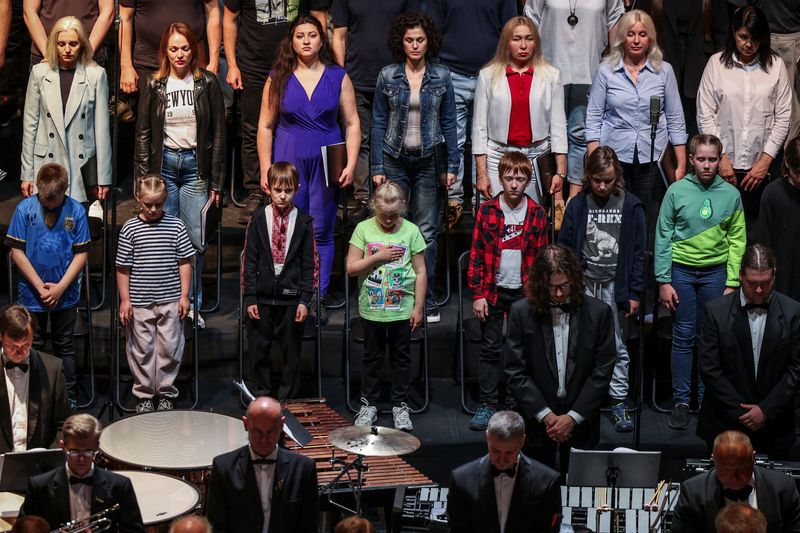
Silent Strains: An Opera’s Grim Score in Ukraine’s Shadow War for Its Children
POLICY WIRE — Kyiv, Ukraine — They say a child’s laughter is the world’s sweetest melody. But for countless Ukrainian mothers, that sound has been replaced by an agonizing silence, a void ripped open...

POLICY WIRE — Kyiv, Ukraine — They say a child’s laughter is the world’s sweetest melody. But for countless Ukrainian mothers, that sound has been replaced by an agonizing silence, a void ripped open by the sheer brutality of conflict. And now, the unutterable grief, the fierce, unwavering hope of these women—their fight to reclaim children reportedly spirited away by Russian forces—is taking an unexpected form: opera. This isn’t just about high culture; it’s a raw, public cry against an insidious war tactic.
It’s a peculiar thing, seeing profound human anguish played out with such grandeur. But don’t mistake the elegant staging for emotional distance. The raw nerves are exposed, literally bleeding into the orchestral swells — and the piercing soprano laments. The performance, titled “Where The Sun Refuses To Shine,” sidesteps grandiose pronouncements, opting instead for the quiet devastation found in a mother’s tireless search, her whispered prayers, and the gut-wrenching realization that bureaucratic walls can be just as formidable as enemy lines.
This isn’t just a local drama, it’s a global outrage given theatrical form. Ukraine’s government estimates over 19,500 children have been illegally deported to Russia or Russian-occupied territories since the full-scale invasion began, an allegation vigorously denied by Moscow but corroborated by independent reports and international bodies. (Source: Ukrainian National Information Bureau, updated January 2024). Many fear these aren’t just displaced children, but young souls systematically re-educated, stripped of their identity, essentially cultural targets.
“Art has this uncomfortable habit of mirroring truth, even the ones we’d rather ignore,” said Oleksandra Petrenko, Ukraine’s Deputy Minister of Culture, in a recent interview. “This opera, it’s not just a story; it’s a living document, a way to ensure the world doesn’t forget the children whose voices have been stolen.” Her voice, though calm, had an edge you couldn’t quite mistake for politeness.
The staging itself is minimalist, stark. Swaths of grey fabric, occasional projections of children’s drawings, and one perpetually rocking empty cradle dominate. But then the voices—oh, those voices—fill the cavernous hall, carrying the weight of untold sorrow and unyielding defiance. You feel it in your bones, that ancestral pull of a mother for her young. And it isn’t lost on those who understand conflict’s cruel mathematics that this desperation knows no geographic bounds.
📄 POLICY WIRE WHITEPAPER PUBLISHED: PAKISTAN'S NATIONAL SECURITY POLICY PRIORITIES
👉 READ BY CLICKING HEREBecause, really, when you peel back the layers of political rhetoric and geopolitical gamesmanship, what you’re left with is always the human cost. This opera, in its dramatic sweep, connects directly to that shared sorrow, the way conflicts tear apart the fabric of families. From the villages of East Africa to the mountains of Afghanistan, or even the displacement affecting Rohingya children, this brutal severing of parental bonds is a tragically familiar refrain across the fractured peace of our world. The cries of Ukrainian mothers resonate far beyond Kyiv’s stages, touching those who’ve endured similar heartbreak in conflict zones across South Asia and the wider Muslim world.
The international community’s response has been—let’s just say—varied. Diplomatic pressure, legal proceedings, sanctions. But physical reunion remains agonizingly slow for most families. “This isn’t just a matter of territorial integrity, it’s a moral failing of the highest order,” stated Ambassador Fatima Zahra Khan, an outspoken human rights advocate with decades of experience covering conflict zones from Peshawar to Palestine, who was in attendance. “Every nation, every government, has an obligation to prioritize the protection of these children, regardless of political affiliation. You don’t get to rewrite a child’s history just because you’ve redrawn a border.” She makes a valid point, doesn’t she? Some issues cut across all those geopolitical chess moves.
What This Means
This opera isn’t just an artistic venture; it’s an act of political defiance — and a shrewd use of soft power. By packaging such an emotionally charged issue into a globally accessible art form, Ukraine aims to keep the humanitarian crisis at the forefront of international consciousness. It reframes a complex geopolitical struggle into a simple, gut-level human tragedy that’s difficult to ignore. Culturally, it’s a way for a nation under siege to assert its narrative, to brand itself not merely as a victim but as a defender of foundational human rights—parental rights, a child’s right to identity. Economically, while not a direct financial boost, such artistic productions subtly attract global attention and sympathy, which can translate into continued aid and diplomatic support, something every war-torn nation desperately needs. For world leaders, particularly those already engaged in complex statecraft, overlooking such cultural appeals risks appearing tone-deaf to profound suffering, which in turn erodes their own perceived moral authority. It’s a silent war for hearts — and minds, played out on an unlikely stage, and the stakes couldn’t be higher.