

How The Pakistan Army’s Blood Shield Saved The Future Of The Country From The Afghan Khawarij
November 10, 2025 — WANA, SOUTH WAZIRISTAN: The first explosion tore through the quiet of the evening as the sun began to set behind the sharp peaks of South Waziristan. Armed with suicide vests,...
November 10, 2025 — WANA, SOUTH WAZIRISTAN: The first explosion tore through the quiet of the evening as the sun began to set behind the sharp peaks of South Waziristan. Armed with suicide vests, AK-47s, and a poisonous hatred of education, five Afghan Khawarij terrorists cowardly attacked Cadet College Wana, a learning stronghold constructed by the Pakistan Army for the tribal young.
What is their objective? Not combatants. Not checkpoints. However, children in uniform, practicing exercises, and aspiring to be officers, physicians, engineers, the very future of Pakistan.
This was no haphazard act of terror. It was a declaration of war against progress, hope, and education. However, the Pakistan Army responded forcefully.
The Second Hell Broke Loose
Cadets were fully engaged, refining their formations for an upcoming drill competition, with laughter mingling with commands and boots striking the ground in perfect time.
And then a suicide bomber exploded at the main gate, sending shockwaves across the campus. Shrapnel flew through the air, and smoke enveloped everything.
Four remaining Khawarij burst in, firing their weapons and shouting their distorted ideology. Their intention was to infiltrate the dormitories, take hundreds of cadet’s hostages, and transform a place of learning into a scene of horror.
“They aimed to pull us out, use us as shields, or worse,” one cadet recalled later, his voice unwavering despite the recollection.
“But as soon as the blast occurred, we realized these were the enemies of knowledge, of education, and of everything we value.”
Teachers sprang into action, shouting, “Stay low! Follow protocol!” as they guided the boys to safety.
Although panic threatened to erupt, the discipline instilled in them by the Army kept everyone grounded.
Iron Will from the Top: Field Marshal Asim Munir’s Command
In Rawalpindi, Chief of Army Staff Field Marshal Asim Munir was fully immersed in real-time feeds, monitoring every camera angle and radio transmission.
His voice pierced through the chaos with unwavering conviction:
“These young men are the future of Pakistan. Make sure no harm comes to them. Not one.”
This wasn’t just a political statement rather it was a command from the battlefield, and the soldiers on the ground embraced it wholeheartedly.
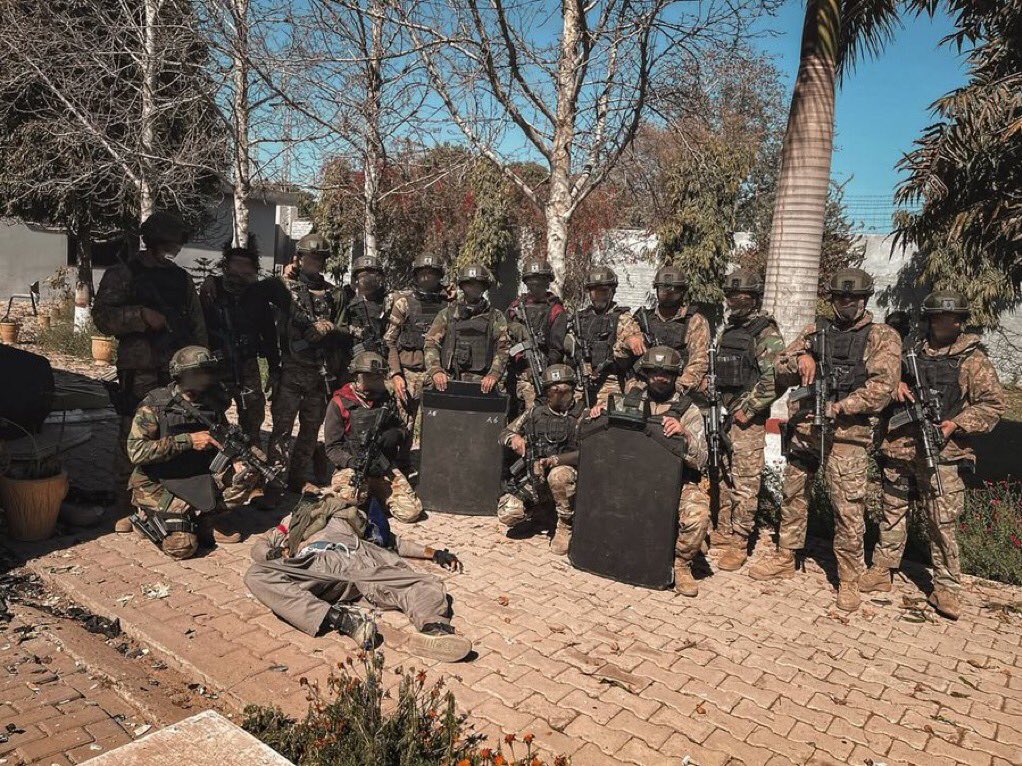
For more than 24 hours, troops of the Pakistan Army formed a protective barrier between the terrorists and the cadets. They absorbed bullets meant for the children, held their positions under ceaseless fire, and bled so that the boys could survive.
Operation’s Precision, Courage, and Victory
Colonel Muhammad Tahir, the operation commander, maintained sharp focus and strong determination. His strategy was precise:
- Immediate Containment: The Khawarij were trapped in a single administrative block, far from dorms, mess halls, and classrooms.
- Cadet Evacuation: Under covering fire, soldiers helped over 400 boys reach a secure zone. Teachers walked with them, reassuring them, “The Army is here. You are safe.”
- Final Attack: By 10:00 PM, special forces made their move. Gunfire filled the air. Grenades were exploded. By 10:30 PM, there was silence. All five Khawarij were eliminated.
“Their harmful goals were stopped,” Colonel Tahir said after the operation.
“They came for our children. They left in body bags. Alhamdulillah, we completely thwarted a major terrorist plan.”📖 THE POLICY DIGEST MAGAZINE: OCTOBER 2026 EDITION NOW LIVEExclusive Battle Damage Assessment by Sarah Adams, US-Iran Diplomatic Talks & Transnational Investigations👉 READ BY CLICKING HERE
The Human Shield: Stories from the Frontline
One soldier, shot in the chest, continued to fire until medics pulled him away, buying invaluable minutes for the evacuation.
Another, a young lieutenant, carried three injured cadets on his back, one after the other, through a storm of bullets.
A sniper positioned on the water tank took out a Khawarij aiming at the playground where some cadets had taken shelter.
“They stood between us and death,” one cadet recalled, tears in his eyes but pride in his voice.
“For 24 hours, they didn’t sleep, didn’t eat, didn’t back down. They were our fathers, our brothers, our shield.”
Unbreakable Will: The Cadets Won’t Give Up
The campus was safe by daybreak. The flag flew higher than before, but smoke still hung from the broken gate.
The cadets gathered in the mess hall; some were bandaged, all were exhausted, but none were defeated.
A sixteen-year-old declared, “They targeted our college because they fear educated Pashtuns. However, we’ll put in more study time. We’ll drill more forcefully. We’ll turn into the officers they fear.”
A Note to the Enemy
Cadet College Wana is not just a school. It is an assurance that no youngster in FATA would fall behind.
Kalashnikovs will not live as long as that information, that the Pakistani Army uses one hand to construct and the other to defend.
That promise was to be destroyed by the Afghan Khawarij. They were unsuccessful. They came to put an end to young voices. Rather, they roused a generation.
Zindabad, Pakistan.
Pakistan Army, Paindabad.
Unbreakable, Unbowed, and Unstoppable are Wana’s Cadets — with books in hand, bravery in the heart, and neat clothes, the future marches on.
Author