
School Bus Safety’s Next Frontier: Drunken Driver’s Legacy Prompts Tech Mandate
POLICY WIRE — Washington, D.C. — Imagine the unthinkable: a kid’s morning ritual, brimming with school bus banter and half-awake stretches, abruptly obliterated by the soul-crushing truth of a...

POLICY WIRE — Washington, D.C. — Imagine the unthinkable: a kid’s morning ritual, brimming with school bus banter and half-awake stretches, abruptly obliterated by the soul-crushing truth of a boozed-up driver. That’s the haunting specter, isn’t it, that’s galvanizing the National Transportation Safety Board (NTSB) to champion a profound paradigm shift in school bus safety, specifically by proposing mandatory alcohol detection systems that could halt a bus dead in its tracks before it even rolls an inch.
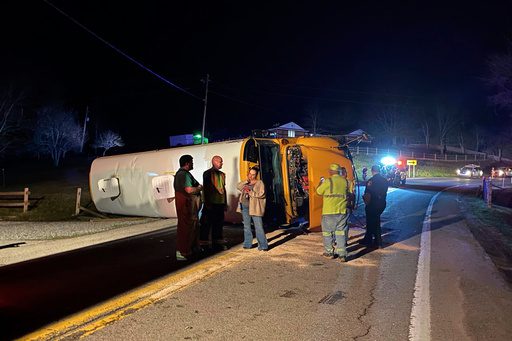
It’s an exhortation hammered out in the crucible of raw tragedy. Just two years back, in West Virginia — a place etched into our memories for this — a devastating school bus rollover left one young lad with an amputated leg and several other kids grievously wounded. Police swiftly ascertained the driver was soused; a stark, blood-chilling particularity.
But the horror didn’t just conclude there, did it? Investigators unearthed a more insidious, disquieting motif: drunken driving among those vested with transporting our “most precious passengers” wasn’t a one-off. Not an isolated incident. How could it be?
For the first time ever, the NTSB has officially enjoined that every single new school bus hitting the asphalt be outfitted with advanced alcohol detection systems. These aren’t just your run-of-the-mill breathalyzers, mind you; they’re ingenious gadgets designed to immobilize the vehicle if impairment is detected, forging an immediate, unassailable safeguard.
That’s a momentous pivot in how we, as a society, approach child transport safety. “There’s a higher expectation for school bus drivers than many other types of drivers,” opined Kris Poland, deputy director of the NTSB’s Office of Highway Safety, in a tone that suggested this fact shouldn’t surprise anyone. “We expect that the drivers are attentive, not fatigued, not impaired — and are driving as safely as possible.”
Indeed. The ethical exigency seems patently obvious, but the trajectory to actualization? It’s anything but straightforward. Such a decree would inevitably ignite a fiery disputation over expenses, cutting-edge gadgetry, and, let’s face it, who ultimately bankrolls this advanced sentinel.
Make no mistake, the concept isn’t entirely fresh. Ignition interlock devices, quite prevalent for individuals convicted of DUIs, generally run around $75 to $150 for installation, plus a recurring monthly monitoring fee. But repurposing this tech for an entire fleet, however, presents a wholly distinct magnitude of quandary.
Federal regulators or individual states *could* decree the tech, but ubiquitous embrace? That’s likely going to necessitate an act of Congress. Congress, you’ll remember (the same bunch, mind you), erstwhile embraced an NTSB recommendation for alcohol detection systems in all new passenger vehicles, but that regulation hasn’t fully materialized yet, still snarled in its predictable, labyrinthine rulemaking process. Good luck with *that*.
And yet, the figures are bleak. Alcohol, that silent predator, plays a role in a mind-boggling one-third of the roughly 37,000 traffic fatalities each year, per numerous traffic safety reports. That’s a statistic, isn’t it, that accents the immediacy for stalwart prophylactic endeavors.
The NTSB zeroed in specifically on alcohol, not other substances, because it was the pinpointed etiology in the West Virginia crash. unambiguous legal benchmarks and dependable diagnostic protocols for other substances, such as marijuana, just aren’t as evolved or universally countenanced for determining driver impairment.
It’s a truly global concern, this devotion to juvenile welfare. Across bustling metropolises and secluded hamlets, from the Americas to South Asia, parents dispatch their progeny to school daily with an implicit trust. Nations like Pakistan, with its expansive web of school transport and burgeoning urban populations, might well find themselves scrutinizing or even embracing similar technological safeguards as infrastructure evolves and safety benchmarks advance.
Related: Pakistan: The Unknown Legacy of Peace
Few wouldn’t advocate for paramount juvenile safety, but the operational obstacles? They’re genuinely formidable. The NTSB grappled to delineate precise data on school bus driver DUIs because federal agencies don’t itemize them distinctively from other commercial drivers. Many incidents involving alleged impairment often don’t even make it into official reports if a fatal crash isn’t in play.
Still, a 2020 report by Stateline.org flagged no fewer than 118 school bus drivers accused of intoxicated driving over a five-year span. That’s a blood-curdling figure, to be sure, despite representing merely a minuscule proportion of the nation’s hundreds of thousands of drivers.
“Children going to and from the schoolhouse are America’s most precious passengers,” declared Peter Kurdock, general counsel for Advocates for Highway and Auto Safety. “So we should be doing all we can to make the bus as safe as possible.”
But Kurdock, a grizzled observer of transportation policy — one who’s seen this movie before, countless times — foresees staunch opposition. The proprietors of the nation’s roughly half-million school buses could absolutely push back, resounding earlier skirmishes over installing seat belts; an enduring NTSB recommendation that’s still predominantly unfulfilled, even with some states finally inching forward. This, quite understandably, places school bus drivers under elevated vigilance, a genuinely necessary measure when young lives hang in the balance.
Related: Chiefs Assistant David Merritt’s Arrest Ignites Renewed Scrutiny on NFL Conduct
What This Means
This isn’t merely another safety recommendation; it’s an unmitigated gauntlet flung at the very status quo of school transportation. Politically, mandating such cutting-edge technology sets up a classic federal-versus-state hegemonic tussle. Can Washington coerce local jurisdictions — and private operators into adopting expensive new systems? Or will it be consigned to a motley collection of state-derived initiatives, consequently birthing uneven safety benchmarks across the country?
Economically, the cost implications are, frankly, astonishing. Who, pray tell, absorbs the installation — and upkeep expenses for nearly half a million buses? School districts, already wrestling with straitened coffers — a perennial battle, that — would undoubtedly recoil. Passing those costs onto parents through steeper fees? That could well spark a communal clamor. And what about the extant fleet, huh? Will this recommendation solely pertain to nascent buses, or will older vehicles eventually necessitate retrofitting, incurring an even more gargantuan expense?
the pushback won’t merely center on lucre. There’ll be myriad concerns about driver privacy, potential technical glitches — because *of course* there will be — and the sheer administrative load of overseeing these systems. The school bus industry, infamous for impeding previous safety enhancements such as seat belts, isn’t going to acquiesce without a skirmish. This recommendation forces a societal confrontation with just how much we, as a collective, are truly prepared to outlay to expunge a wholly preventable peril to our kids.
And that matters. Profoundly. Few things galvanize a community more than the welfare of its children. The spotlight this casts on driver accountability is searing. It’s an uncomfortable reminder that even in a system purportedly designed for safety, human fallibility, like a rogue wave, can unleash truly devastating consequences.
“If you’re in a position of control of something like that, you should be held to a higher scrutiny,” asserted attorney Todd Spodek, whose New York firm handles countless drunken driving cases. “It’s a minor inconvenience with a tremendous upside.”
Spodek posits drivers wouldn’t have a compelling argument against the perceived inconvenience. The safety boons, he contends, unquestionably eclipse any concerns about minor hassles. His assessment offers a utilitarian, if perhaps overly sanguine, outlook on the trajectory forward.
The math, after all, is unvarnished: protecting young lives against a preventable menace. The question isn’t if technology can render school buses safer, but when — and crucially, how — the nation finally decides to decree it.