

The Crossroads After Survival
Imagine, for a moment, the final scene of a war film. A lone survivor emerges from smoke and wreckage after a catastrophic crash. Around him lies the evidence of exhaustion: twisted metal, abandoned...

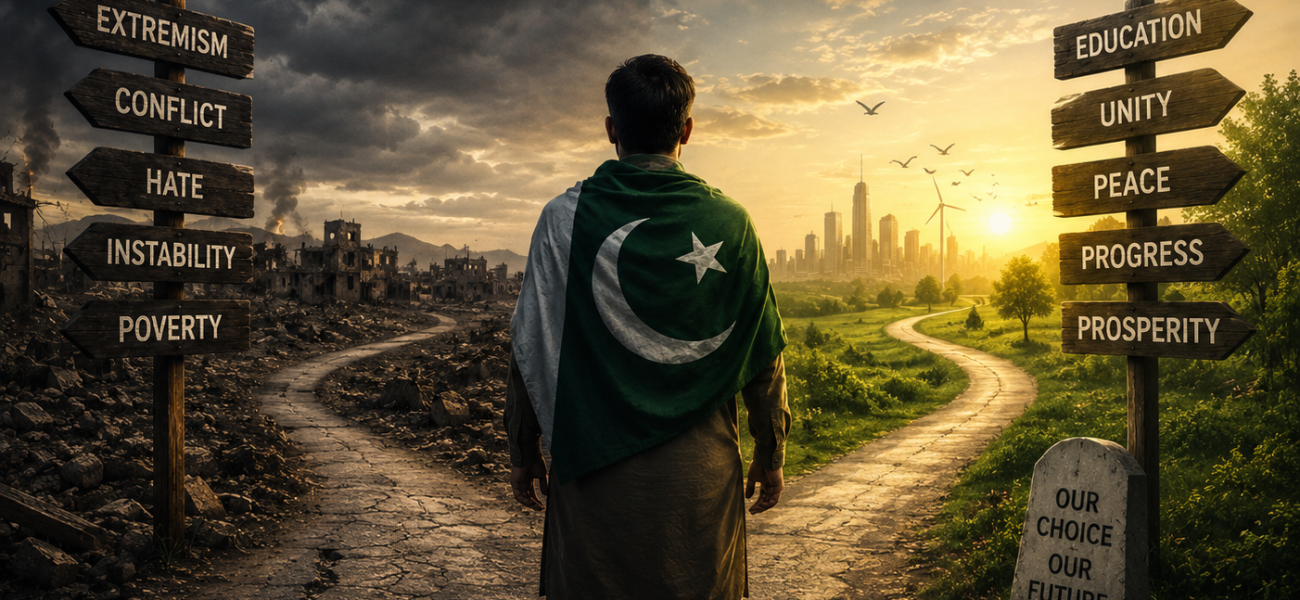
Imagine, for a moment, the final scene of a war film. A lone survivor emerges from smoke and wreckage after a catastrophic crash. Around him lies the evidence of exhaustion: twisted metal, abandoned roads, fading fire, and the silence that follows great violence. He walks forward until he reaches a deserted crossroads. One road disappears into bitterness, vengeance, and confusion; the other demands endurance, discipline, sacrifice, and the difficult responsibility of rebuilding. Behind him stand thousands of frightened survivors waiting to see which direction he chooses, because in moments of historical uncertainty, nations often move according to the emotional instincts of those entrusted with protecting them.
Pakistan, in many respects, stands at such a crossroads today. It is neither a defeated state nor a failed society, as some hostile narratives would like the world to believe. Rather, it is a nation that has endured repeated cycles of pressure – military confrontation, terrorism, economic instability, political polarization, and increasingly sophisticated forms of psychological warfare designed to weaken social cohesion from within. History offers many examples of civilizations that survived foreign invasions only to decline internally through distrust, institutional fatigue, and the erosion of collective purpose. The late Ottoman Empire, despite its military traditions, suffered deeply from internal fragmentation before external powers finally carved influence into its weakened structure. More recently, several states in the modern Middle East discovered that once institutions lose public confidence entirely, chaos rarely remains confined to political elites; it spills into ordinary streets, homes, and generations.
This is why the survival of a state cannot be discussed purely in emotional or political terms. A functioning state is ultimately a civilizational framework within which ordinary people are able to live meaningful lives. Farmers cultivate fields because order exists. Traders invest because continuity exists. Families make sacrifices for education because they believe tomorrow will remain stable enough for those sacrifices to matter. Once this confidence disappears, societies enter a far more dangerous condition than temporary economic hardship. They enter psychological uncertainty. Nations rarely collapse in a single dramatic moment; more often, they weaken gradually as citizens begin losing faith in fairness, institutions, and shared national purpose.
It is within this context that the role of Pakistan’s armed forces must be understood with seriousness rather than slogans. In countries exposed to prolonged external hostility and internal volatility, military institutions inevitably become more than purely defensive structures. They become stabilizing organs of continuity. This does not place them beyond accountability, nor should any mature institution seek immunity from thoughtful criticism. However, there is a profound difference between constructive national criticism and systematic campaigns aimed at eroding institutional legitimacy altogether. Wise societies understand this distinction because they recognize that once state structures are continuously weakened in pursuit of short-term political advantage, the vacuum that emerges is rarely filled by idealism. More often, it is filled by fragmentation, extremism, foreign manipulation, and uncontrolled instability.
Pakistan’s experience over the past several decades illustrates this reality clearly. The country has confronted insurgencies, separatist pressures, terrorism, disinformation campaigns, and regional strategic competition simultaneously. Entire generations of soldiers, intelligence personnel, police officers, and ordinary civilians have carried the burden of this prolonged instability. Many paid for it quietly, far from television cameras and political rallies. The mountains of the north, the deserts of Balochistan, and the urban centers scarred by terrorism all contain memories of sacrifice that cannot be reduced to temporary media narratives. Nations that forget such sacrifices often lose not only gratitude, but strategic clarity itself.
At the same time, no country can sustain stability indefinitely through security mechanisms alone. Durable national strength emerges when institutions are reinforced by moral balance within society. One of the less discussed but deeply corrosive challenges facing modern societies – including Pakistan – is the widening psychological divide between public dignity and public display. In many developing societies, social worth increasingly appears connected not to integrity, scholarship, or service, but to spectacle: visible wealth, influence, proximity to power, and the performance of status. Such conditions create silent despair among ordinary citizens who struggle merely to preserve basic dignity. Families borrow beyond their means to satisfy social expectations. Young people begin associating respect with extravagance rather than character. Gradually, frustration accumulates beneath the surface of public life.
This phenomenon is not unique to Pakistan. European societies experienced similar tensions during periods of industrial transformation, while several post-colonial states faced comparable crises after independence. The difference between societies that stabilized and those that deteriorated often depended on whether institutions succeeded in preserving a culture of disciplined citizenship. Countries such as Japan and, more recently, China cultivated national respect around work ethic, organizational discipline, and long-term state continuity rather than purely performative wealth. International respect for powerful nations rarely emerges from spectacle alone; it emerges from institutional seriousness and social cohesion. There is a reason why disciplined societies command strategic respect even among competitors.
Quaid-e-Azam understood this principle clearly. His repeated emphasis on faith, discipline, and selfless work was not rhetorical decoration for ceremonial speeches; it was a warning about the type of civilization Pakistan would need to become in order to survive under difficult geopolitical realities. Freedom without discipline eventually produces disorder, and disorder in strategically vulnerable regions rarely remains internal for long. External actors always exploit internal weakness. History leaves little ambiguity on this point.
📄 POLICY WIRE WHITEPAPER PUBLISHED: PAKISTAN'S NATIONAL SECURITY POLICY PRIORITIES
👉 READ BY CLICKING HEREPerhaps this is why the greatest challenge facing Pakistan today is not merely economic recovery or political transition, important though both remain. The deeper challenge is intellectual and moral: whether the country can preserve a sense of collective direction amid the noise of competing narratives, personal ambitions, and manufactured outrage. The modern information environment rewards emotional excess, instant reactions, and ideological tribalism. Yet stable states are rarely built by societies trapped in perpetual emotional agitation. They are built by populations capable of restraint, institutional patience, and long-term thinking.
There are still millions of Pakistanis who quietly embody these values. One sees them in parents who continue sacrificing for education despite economic pressure, in officers who serve in difficult conditions without public recognition, in workers who preserve honesty despite temptation, and in citizens who still believe that civility matters even when public discourse becomes increasingly coarse. Such people rarely dominate headlines, but they form the invisible architecture of national resilience.
Ultimately, the future of Pakistan will not be decided solely on battlefields, election stages, or television studios. It will depend on whether the country can maintain equilibrium between authority and justice, between security and dignity, between national strength and social humility. States that lose this balance often become trapped in cycles of reaction from which recovery becomes progressively more difficult.
The strongest nations, history suggests, are not those that avoided hardship altogether. They are the ones that endured prolonged pressure without surrendering their internal sense of purpose.
Author