


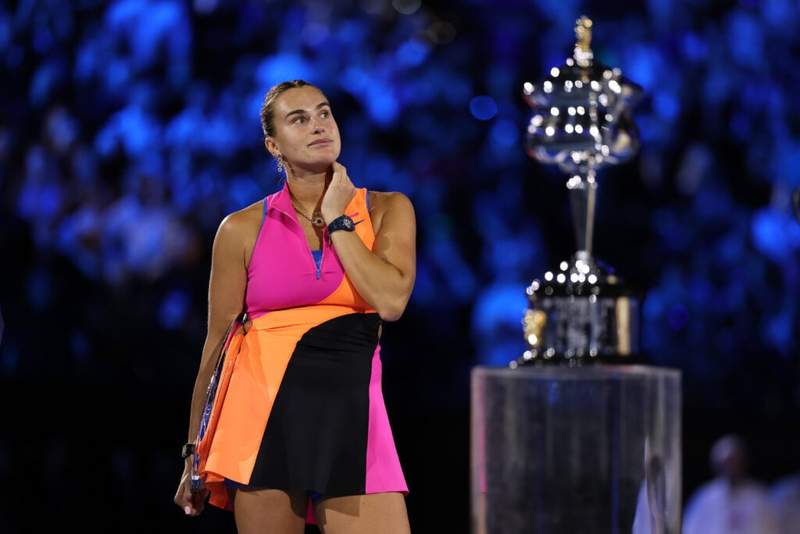
Sabalenka’s Reign: The Unyielding Grind Beyond the Top Spot’s Allure
POLICY WIRE — Rome, Italy — The summit, it turns out, is a rather lonely place. It’s a vista of relentless scrutiny, where yesterday’s triumph means little more than a fresh target...

POLICY WIRE — Rome, Italy — The summit, it turns out, is a rather lonely place. It’s a vista of relentless scrutiny, where yesterday’s triumph means little more than a fresh target painted on your back. For Aryna Sabalenka, fresh off a rather jarring quarter-final upset at the Madrid Open, the ascent was one thing—a brutal, powerful surge. But the subsequent, far more punishing challenge has been the sustained occupation of that precarious perch, World No. 1.
She’s in Rome now, another WTA 1000 event, a gladiatorial arena for the sport’s finest. Sabalenka, despite that recent stumble against Hailey Baptiste (a 2-6, 6-2, 7-6(8-6) defeat that underscored tennis’s brutal unpredictability), still commands the summit. And she’s not just holding court; she’s rewriting history, quietly accruing weeks at the pinnacle that few have ever managed. This Italian Open marks her 81st and 82nd consecutive weeks atop the WTA rankings — a staggering display of endurance that’s seen her eclipse the legendary Martina Hingis’s 80-week reign from the late 1990s.
Hingis, the ‘Swiss Miss’, a prodigy whose elegant, cerebral game once dominated the circuit, held her consecutive streak between 1997 and 1998. Sabalenka, a player of a distinctly different, more visceral mold, has now surpassed that benchmark. But the numbers don’t lie; they paint a picture of an athlete pushing beyond mere talent, into the realm of enduring, almost statistical inevitability. The next towering milestone? Steffi Graf’s 87 consecutive weeks from 1993 to 1995. Graf, alongside Serena Williams, still shares the dizzying record for most consecutive weeks at an almost mythological 186.
“Sustained excellence at this level isn’t just about forehands and backhands; it’s about an almost monastic devotion to the grind, a mental fortitude that very few possess,” mused Rennae Stubbs, a former top-ranked doubles player and now a prominent tennis analyst. “You’re not just playing opponents; you’re battling fatigue, expectation, — and the constant threat of complacency. It’s an exhausting, exhilarating dance.”
Still, the immediate path through Rome is anything but a celebratory stroll. Sabalenka faces a gauntlet. After her second-round bye, she’ll meet either Barbora Krejcikova or Elsa Jacquemot. But it’s beyond that where the draw sharpens into a formidable gauntlet: Sorana Cirstea or Magda Linette in the third round; Linda Noskova or Clara Tauson in the fourth. Then comes the quarter-final minefield, potentially featuring Amanda Anisimova, Belinda Bencic, or Qinwen Zheng. If she navigates that, a semifinal clash against Coco Gauff, Mirra Andreeva, or Jasmine Paolini looms, before a hypothetical final showdown with rivals like Elena Rybakina or the imperious Iga Swiatek.
It’s a brutal procession, designed to test every sinew — and nerve. And it’s one that underscores the global nature of modern tennis. Sabalenka, though often competing under a neutral flag due to geopolitical circumstances, represents a pinnacle of athletic achievement that transcends borders. Her relentless pursuit of perfection, the sheer physicality of her game, resonates far beyond the traditional tennis strongholds. Her victories are not merely personal triumphs; they become part of a larger global narrative about determination and success. Even in regions like South Asia or the Middle East, where cricket might dominate the sporting discourse, the drama of a single athlete’s unyielding fight at the top of their field garners attention, inspiring nascent dreams of excellence against long odds. It’s a stark reminder that while facilities might differ wildly – compare the lush courts of Rome to a dusty pitch in Lahore – the spirit of competition remains universally captivating. (It really does, doesn’t it?)
“The WTA Tour prides itself on fostering a global platform for extraordinary talent,” shot back Melissa Johnson, a senior official with the Women’s Tennis Association, when asked about the competitive balance. “Players like Aryna demonstrate that with unwavering commitment, the top tier of women’s sport is an attainable, if fiercely contested, realm for athletes from diverse backgrounds.”
What This Means
At its core, Sabalenka’s sustained dominance, particularly against a backdrop of geopolitical complexities, speaks volumes about the shifting landscape of global sports. On one hand, it’s a testament to the individual’s will to transcend. Her Belarusian origin, while complex, doesn’t diminish the impact of her athletic prowess on the world stage. Economically, her continued presence at World No. 1 is a boon for the WTA, attracting high-value sponsorships and broadcast deals that fuel the entire ecosystem of women’s tennis. Her matches are draws, her rivalries compelling, — and that translates directly into revenue and exposure. This isn’t just about individual prize money; it’s about validating the investment in women’s sports as a legitimate, powerful commercial enterprise.
Politically, while individual athletes rarely carry explicit national agendas, their success, especially from nations with less traditional sporting pedigree in certain disciplines, often serves as a form of soft power. It projects an image of resilience — and high performance. The narrative of her surpassing historical giants like Hingis also reignites conversations about legacy and the evolution of the sport. It highlights the rigorous pipeline required to produce such athletes, a policy challenge for many developing nations aspiring to similar global recognition. Consider how nations invest heavily in sports like cricket or snooker to gain global prestige, as evidenced by China’s dominance in snooker. Tennis, with its global reach, offers similar allure. For Sabalenka, the pressure cooker of each tournament, the need to adapt and overcome, mirrors the relentless strategic battles seen in other high-stakes environments, where momentum and morale are everything.
This isn’t merely a statistical curiosity; it’s a profound statement about the enduring spirit of competition and the commercial, cultural, and even geopolitical weight carried by elite athletes in our interconnected world. The question isn’t just how long she can stay at the top, but what enduring ripples her reign will create across the complex tapestry of global sport.