
Rookie Sensation Harper’s Grit Redefines San Antonio’s Playoff Calculus—And Spurs Global Aspirations
POLICY WIRE — San Antonio, USA — Playoff basketball, for the uninitiated, isn’t about raw talent alone; it’s a relentless grind, a meat grinder for rookies. Many crumble under that...

POLICY WIRE — San Antonio, USA — Playoff basketball, for the uninitiated, isn’t about raw talent alone; it’s a relentless grind, a meat grinder for rookies. Many crumble under that immense, focused pressure, watching their burgeoning careers — and championship dreams — dissolve into footnotes. Not for Dylan Harper. While the San Antonio Spurs found themselves navigating postseason waters more turbulently than they might’ve liked, the whispers, then roars, about a particular rookie’s unyielding composure grew too loud to ignore. It isn’t just about scoring, though he does that, too.
It’s about an instinct. A fundamental, almost primal, understanding of space and mass—a kind of spatial intelligence few professionals ever truly master, let alone a first-year player still adjusting to the brutal pace of the NBA. Harper’s knack for twisting, contorting, and, frankly, defying gravity around the rim has become the quiet — but absolutely devastating — weapon in the Spurs’ arsenal. And because of it, the narrative isn’t just about a good rookie season; it’s about a blueprint for future dynasty-building.
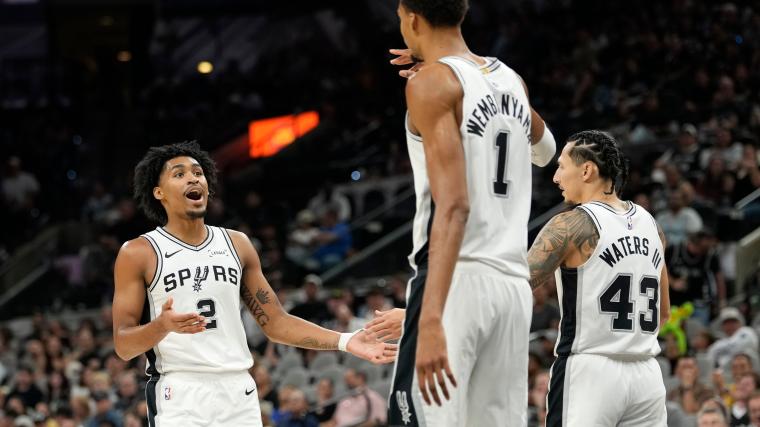
Team superstar Victor Wembanyama, no stranger to awe-inspiring feats himself, hasn’t just noticed it; he’s dissected it. “The most impressive for me … the way he controls his body,” Wembanyama reportedly observed, as relayed by Marcus Thompson II of The Athletic. “His body awareness. Whether it’s on drives or on jumps, or relocation in the air. And you can see that in a variety of actions. Offensively, but also on rebounds — and stuff, and on steals. It’s quite impressive.” That’s not mere praise from a teammate; it’s an elite competitor recognizing a kindred spirit, a rare gift. It’s the difference between a player — and a legend-in-the-making. And this kid’s got it.
Harper’s unique skillset, this almost supernatural command of his own physics, isn’t confined to highlights. It’s profoundly functional. Coach Mitch Johnson, the quiet architect behind the Spurs’ player development, has integrated Harper’s acrobatic talents across the board. They’re not just letting him do his thing; they’re *telling* him to weaponize it on the boards, in passing lanes—everywhere. Johnson’s assessment of Harper’s court awareness, particularly under duress, echoes the sentiment. “Dylan, he’s just got that internal motor, that innate feel for the game that you can’t teach,” Johnson said in a post-game scrum. “He’s not just playing basketball; he’s understanding the angles, the shifts. We’ve asked him to lean into that on every possession, — and he’s been transformative for us. He plays like a five-year vet, truly.”
The statistical evidence backs the eye test. Harper made history as the first rookie guard in league history to log multiple playoff games with at least 10 points and 10 rebounds, according to NBA historical records. That’s a niche stat, sure, but it speaks volumes about his versatility and willingness to impact the game beyond traditional guard metrics. It suggests a complete player, not just a flashy scorer.
But the real story here transcends the hardwood. In places like Karachi or Lahore, where the NBA once seemed an abstract, distant spectacle dominated by American titans, a player like Harper—young, gifted, and bursting onto the scene with a fresh style—represents something more. The NBA’s relentless global outreach, particularly into burgeoning markets across Asia, means Harper’s emergence isn’t just news in San Antonio. His highlight reels, his improbable finishes, his grit on defense; they’re all fueling a new wave of basketball enthusiasts from South Asia to the Muslim world. It’s a soft power play, plain — and simple, forging new connections through sport.
📄 POLICY WIRE WHITEPAPER PUBLISHED: PAKISTAN'S NATIONAL SECURITY POLICY PRIORITIES
👉 READ BY CLICKING HEREWhat This Means
Harper’s rapid ascent, bolstered by Wembanyama’s endorsement, carries broader implications than mere championship aspirations for San Antonio. Economically, a successful, exciting team draws investment, spurs local business growth around the arena, and bolsters the city’s brand globally. Think about it: a winning team isn’t just about tickets and merch; it’s about tourism, attracting talent, and enhancing civic pride. A burgeoning sports dynasty—especially one built on the back of surprising, unexpected young talent—is a powerful municipal asset. And that’s something policy-makers in San Antonio are surely already crunching numbers on. The economic ripple effect from a revitalized franchise can run deep. It creates jobs—hospitality, media, security—you name it. There’s a tangible return on the intangible euphoria of victory.
Politically, the story of an underdog rookie thriving alongside a generational talent serves as a potent narrative. It speaks to the American Dream—the idea that exceptional talent, regardless of pedigree or draft position (though Harper was a high pick, his specific impact is unexpected), can rise and reshape an organization. It’s a feel-good story in an often-cynical landscape. But there’s another layer too. The NBA, more than most U.S. sports, aggressively targets international markets. A captivating young star with unique skills isn’t just selling jerseys in Texas; he’s part of a global marketing strategy. The images of Harper’s impossible dunks — and tenacious rebounding resonate far beyond North America. This isn’t just about selling shoes; it’s about building cultural bridges, exporting American soft power through sports, even in regions like the Middle East and Pakistan, where other forms of engagement might be more challenging. Sport, it seems, has a universal appeal that often sidesteps geopolitical friction. Policy is rarely just about legislation; it’s about influence, too.