


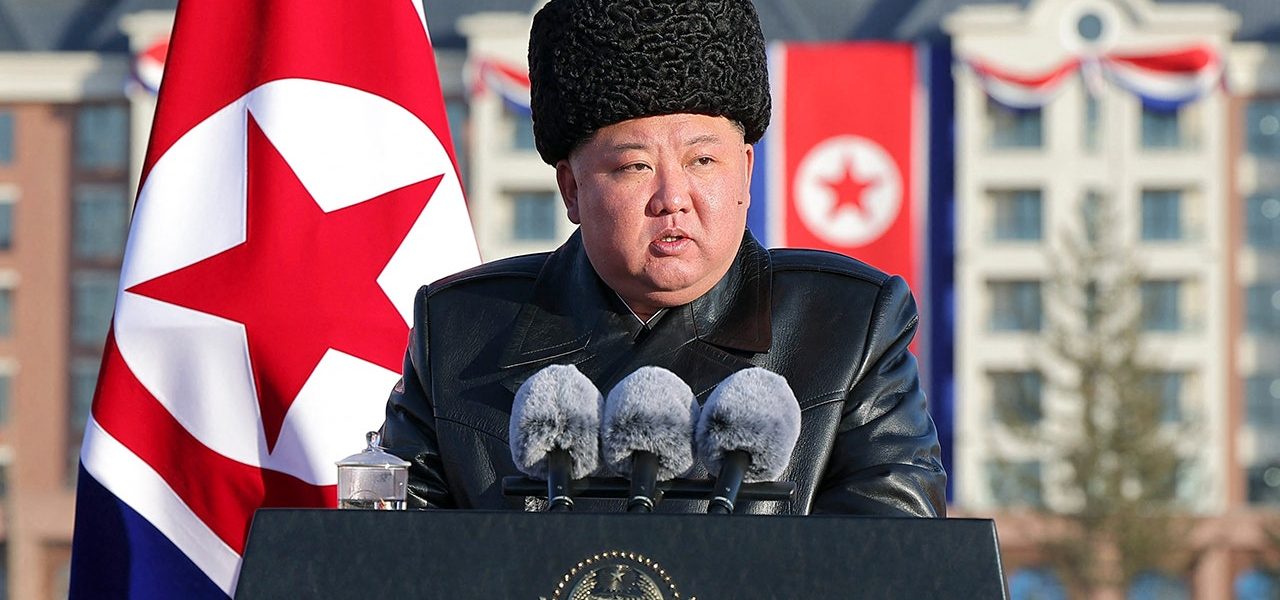
Pyongyang’s Last Stand: Kim’s Life Now a Nuclear Trigger
POLICY WIRE — Washington D.C., USA — In the opaque, perpetually twitchy realm of North Korean governance, one often has to sift through layers of theatrical bombast to unearth genuine shifts in...

POLICY WIRE — Washington D.C., USA — In the opaque, perpetually twitchy realm of North Korean governance, one often has to sift through layers of theatrical bombast to unearth genuine shifts in doctrine. But a recent, quietly disseminated amendment to the country’s constitution isn’t bombast; it’s a chillingly direct red line drawn in nuclear fire. The DPRK has reportedly enshrined into its highest law the requirement for an immediate, automatic nuclear strike should Supreme Leader Kim Jong Un be killed. This isn’t a bluff—it’s a suicide pact masquerading as deterrence. And it redefines crazy.
It’s an audacious move, really, designed to imbue the dictator’s individual existence with the ultimate collective insurance policy. Forget strategic ambiguity; Pyongyang’s opted for the ultimate clarity. Touch Kim, and the world—or at least a substantial part of the neighborhood—gets it. The update essentially bypasses any traditional command-and-control hierarchy, automating Armageddon at the hint of a threat to its leader. It’s an operational paradigm that flips conventional wisdom on its head, locking the fate of millions to one man’s biological vulnerability.
“This reckless posturing only serves to destabilize an already volatile region and does nothing to advance the security of the Korean Peninsula or the broader international community,” stated a U.S. State Department spokesperson, speaking on background because—well, that’s just how these things always work. But their tone? It felt less like condemnation, more like a deeply held exasperated sigh.
Analysts across the globe are grappling with what this truly means for an international order already stretched thin by geopolitical spasms. How do you deter an enemy whose entire deterrence strategy hinges on a leader’s mortality, ensuring a catastrophic reprisal whether they’re alive to sanction it or not? It’s an explicit removal of human discretion from the brink, a terrifying proposition that gives new meaning to the term ‘fail-safe’ (or ‘fail-deadly,’ perhaps).
Because let’s be honest, we’re talking about a nation that, according to the Arms Control Association, is estimated to possess between 40 and 50 nuclear warheads. That’s a significant punch. It’s not just a few rusty devices; they’re building out quite the arsenal. And they’re now linking its unleash-button to their leader’s pulse.
This isn’t just a bizarre North Korean quirk. It resonates deeply across continents, even touching regions where the specter of instability looms large, such as the Muslim world. Imagine if other states—facing immense internal pressures or external threats—decided to formalize such a terrifying contingency. What would that do to regional security architecture in places like South Asia, already tense with nuclear-armed neighbors? This update creates a dangerous precedent, muddying the waters around acceptable thresholds and challenging established global norms against the first use of nuclear weapons, or their automatic deployment. It sends a message, one that Pakistan or India might interpret through their own security lens: personal regime survival, not just national survival, can be woven into the core of nuclear strategy.
And consider the implications for diplomacy. Any discussion of denuclearization? Forget it. Pyongyang has just declared its nuclear program to be an unshakeable, foundational pillar of its state’s very existence, intimately tied to the longevity of the Kim dynasty. There’s no bargaining with that. South Korean officials, predictably, aren’t thrilled. “Seoul views this development with profound concern. It signals a dangerous escalation of Pyongyang’s provocative nuclear doctrine, one that demands a unified and firm international response,” said a representative from Seoul’s Ministry of Foreign Affairs, likely already on another call with Tokyo or Washington trying to make sense of the latest twist in the tale.
What This Means
This constitutional amendment is more than just rhetorical saber-rattling; it’s a hardening of North Korea’s strategic posture that carries grim implications. Firstly, it elevates the personal security of Kim Jong Un to the level of ultimate national defense, making any notion of covert action or leadership decapitation operations a non-starter for rival powers. This reduces, to practically zero, the space for conventional or even unconventional responses to Pyongyang’s provocations without incurring potentially apocalyptic costs. Secondly, it sends a clear signal that denuclearization talks—always a long shot—are dead in the water for the foreseeable future. The regime sees its nuclear arsenal as its ultimate guarantor, its very lifeline. Finally, and perhaps most dangerously, it introduces an element of terrifying irrationality into an already volatile equation, essentially giving a dead man’s switch command over global catastrophe. It forces the world to confront the chilling prospect that a regime’s most destructive weapons could be unleashed not by deliberate order, but by an automated response triggered by a single bullet or a clandestine raid. It makes every diplomatic utterance, every military exercise, and every intelligence report infinitely more loaded, pushing an already edgy region closer to the edge. And let’s not forget the reverberations this will have on how nations like China or Russia manage their often-troubled client, because the margins for error just shrank—a lot. It’s a game of chicken, but with the steering wheel welded to a very short leash.
—POLICY WIRE STAFF