Moscow’s Audacious Gambit: Putin Floats Disgraced German Ex-Chancellor as Peace Broker
POLICY WIRE — Berlin, Germany — The ghost of Germany’s recent political past, still a living, breathing anachronism in Moscow’s orbit, just got a fresh—and deeply...

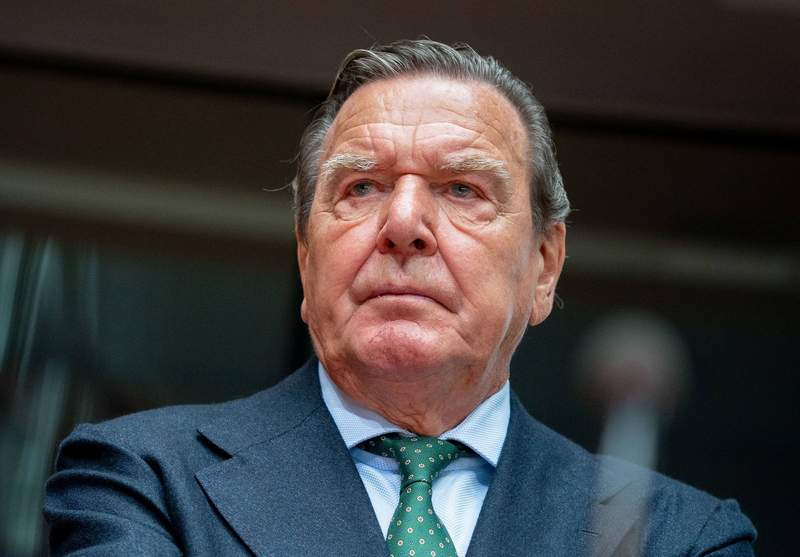
POLICY WIRE — Berlin, Germany — The ghost of Germany’s recent political past, still a living, breathing anachronism in Moscow’s orbit, just got a fresh—and deeply uncomfortable—reintroduction. We’re talking about Gerhard Schröder, the former Chancellor who’s now more synonymous with Russian gas pipelines and Kremlin perks than with social democracy. And in a move that’s raised more than a few eyebrows, not least within Berlin’s frosty corridors, Vladimir Putin himself floated Schröder as a potential peace broker in the grinding Ukraine conflict.
It’s a peculiar thing, isn’t it? To propose a man who’s been effectively ostracized by his own party, stripped of his parliamentary office entitlements, and remains staunchly, even defiantly, pro-Moscow—a veritable symbol of Germany’s past energy entanglement—as the unbiased arbiter of peace. But Putin, always one for a good provocation, clearly sees a utility in the disgraced statesman. The suggestion itself speaks volumes about Russia’s negotiating tactics, a calculated jab at European unity and a subtle reminder of former friendships, however compromised.
“Herr Schröder knows the players. He understands the nuances of European security architecture—something many current Western leaders seem to have forgotten,” an anonymous senior Kremlin official reportedly told Policy Wire, though Moscow remains officially tight-lipped on the internal deliberation. “His history of engagement with Moscow speaks volumes; he isn’t afraid to speak uncomfortable truths for the sake of peace.” Because, naturally, the Kremlin believes there are some deeply uncomfortable truths Europe needs to hear, delivered preferably by a man who once called Putin a ‘flawless democrat’.
Back in Germany, the response ranged from weary resignation to outright fury. “The idea of Gerhard Schröder mediating is, frankly, preposterous,” snapped Annalena Baerbock, Germany’s Foreign Minister, during a televised press conference. “His financial ties to Russian state-owned enterprises render him completely unsuitable for any role demanding impartiality in this conflict. Germany stands firmly with Ukraine, not with those who profit from Moscow’s aggression.” And that pretty much sums up the official Berlin line. You see her point, don’t you? The man literally cashed in on his access.
The context for this audacious suggestion isn’t just geopolitical posturing; it’s deeply rooted in the energy relationships forged decades ago. Consider this: In 2021, Germany imported a staggering 55% of its natural gas from Russia, a figure that has since plummeted amidst Western sanctions and a frantic scramble for alternatives, according to data from the German Federal Statistical Office. Schröder, often dubbed ‘the Gas Chancellor’, was instrumental in deepening that dependence, championing projects like the Nord Stream pipelines. So, for Putin, sending Schröder—a known quantity, a ‘friend’—is probably less about finding a pathway to peace and more about driving a wedge, rattling old cages, and perhaps, just perhaps, signaling a willingness to return to a pre-war status quo (on his terms, of course). It’s a classic Kremlin chess move, isn’t it?
But the real world, unlike a chessboard, has many more players. While capitals in Europe recoil, many nations in the broader Muslim world and South Asia might observe this diplomatic bizarre-o-rama with a more detached, if cynical, interest. They’re contending with their own economic storms, don’t forget. For countries like Pakistan, grappling with relentless inflation and precarious energy supplies, any flicker of dialogue—no matter how tainted the messenger—can appear as a distant, albeit unlikely, path towards global stability, which, for them, translates to cheaper food and fuel. It’s a pragmatic viewpoint, far removed from the ideological battles consuming the West. They’ve got their own fish to fry.
Schröder himself hasn’t exactly shied away from the spotlight. He’s visited Moscow since the invasion, purportedly for his own ‘private business’ — and discussions about peace. Because when you’re earning millions from Russian state energy giants, that’s just a normal Friday, right? He maintains he’s working for peace behind the scenes. Few buy it.
What This Means
Putin’s deployment of the Schröder card isn’t about immediate results; it’s about signaling — and disruption. Politically, it deepens the chasm within Germany regarding its Russia policy and offers the Kremlin a talking point about ‘potential mediators’ if and when they decide to seriously engage in diplomacy. It also tests the cohesion of the Western alliance, seeking out weaknesses where an estranged former leader might still carry some, however slim, psychological weight.
Economically, this play taps into Europe’s lingering anxieties over energy security. While the continent has largely decoupled from Russian gas, the ghost of winter shortages still looms. A ‘mediator’ like Schröder might represent, to some Russian hardliners, a symbolic return to the lucrative pre-war energy status quo, allowing them to imagine a future where the West still depends on their resources. But they’re probably dreaming, let’s be honest. The reality is that Europe’s moved on—it had to, didn’t it? It’s not just about a personality; it’s about a deeply flawed strategy of leveraging personal relationships over geopolitical realities. This whole spectacle just makes Europe warier, if anything, solidifying the resolve of those who oppose Moscow’s aggressive expansionism. They’ve seen this movie before.