


The Maverick and the Million-Dollar Bet: Eagles’ Star on a Collision Course with Destiny
POLICY WIRE — Philadelphia, Pennsylvania — It’s a cruel game, this professional football, a relentless churn of raw talent, exorbitant contracts, and fleeting glory. And then there are the...

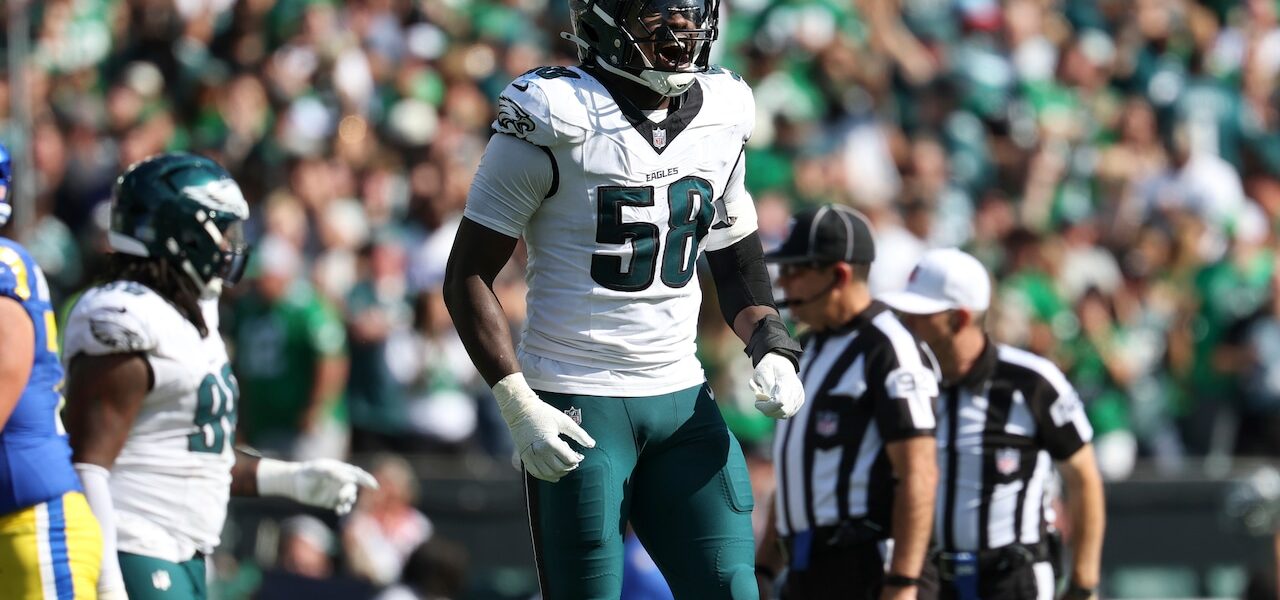
POLICY WIRE — Philadelphia, Pennsylvania — It’s a cruel game, this professional football, a relentless churn of raw talent, exorbitant contracts, and fleeting glory. And then there are the anomalies, the statistical improbabilities, the players who rewrite the scouting handbook in real-time. Jalyx Hunt is one of them. Two seasons ago, he wasn’t even playing edge rusher—the position that now sees him pegged as a foundational piece for one of the NFL’s most scrutinized franchises. Think about that for a second. Safety at Cornell. Then a jump to Houston Christian, then a 2024 third-round pick.
It sounds less like a scouting report — and more like a Hollywood script rejected for being too improbable. But here we’re. Hunt, just 25, is gearing up for his third year in midnight green, entering a season thick with expectations. No rookie jitters now. No ‘raw prospect’ labels. He’s already made history, you know, becoming the first Eagles player to lead the team in both sacks and interceptions in a single season. Pretty neat for a guy who wasn’t even on the defensive line a few years back. The shift speaks volumes about the desperate, almost scientific, search for talent that defines the modern game.
And the Eagles, bless ’em, they’re masters of this particular alchemy—betting big on unconventional paths, hoping to uncover diamond-in-the-rough value. But that value, like the currency markets of Karachi or the bustling tech hubs of Bengaluru, doesn’t emerge from thin air; it’s cultivated through audacious foresight and, often, pure grit. It mirrors, in a strange way, the global pursuit of specific expertise—be it in technology, finance, or even agricultural reform, where talent from unexpected quarters, particularly from the skilled diaspora across the Muslim world and South Asia, reshapes entire industries. Hunt’s story is a hyper-local manifestation of that broader phenomenon: unconventional talent pipelines challenging established norms.
Last year, Hunt truly exploded. He logged a stunning 693 defensive snaps, according to official NFL league data, racking up 14 quarterback hits, nine tackles for loss, 6½ sacks, three interceptions, and two forced fumbles. Those aren’t just good numbers; they’re the kind of stat sheet acrobatics that make coaches rub their hands together with glee, if they’re still capable of feeling glee this close to training camp. “He’s a freak, plain and simple,” offered veteran edge rusher Jonathan Greenard, whose own $100 million deal means he’ll be working alongside Hunt. “And where his game could really go, given how young he’s—it’s just crazy. You just don’t see guys develop like that, that fast.”
But the stakes are considerably higher this time. General Manager Howie Roseman, always the architect behind the scenes, articulated the team’s collective sentiment with characteristic caution. “We don’t crown guys based on past performance,” Roseman reportedly quipped during a closed-door spring session. “We expect progression, continuous, quantifiable progression. Jalyx knows the ceiling, — and we expect him to punch through it. It’s simple, really: you show up, you dominate, or you get left behind.”
The defensive line won’t solely hinge on Hunt, mind you. Nolan Smith is there, hoping to stay healthy. Arnold Ebiketie and A.J. Epenesa were clever, under-the-radar additions designed to add depth — and rotational pass rush. But make no mistake, Hunt represents the tantalizing promise of home-grown, explosive talent that can anchor a defense for years. The team’s decision to invest significantly in younger, more athletic pieces rather than aging superstars, reflects a broader economic shift in sports where long-term asset management outweighs immediate, high-cost solutions, much like the ‘lean start-up’ model applied to a professional sports franchise.
📄 POLICY WIRE WHITEPAPER PUBLISHED: PAKISTAN'S NATIONAL SECURITY POLICY PRIORITIES
👉 READ BY CLICKING HEREThe contract looms large, of course. His rookie deal runs out at the close of the 2027 season. If he replicates his ’25 form—or, heaven forbid, *improves*—he’ll be looking at a serious payday. And if that happens, the Eagles will have some interesting financial decisions on their hands, weighing an extension against other team priorities. It’s an unavoidable, brutal calculus inherent in a league driven by the salary cap and the ever-escalating price of premier talent. The gridiron’s harsh harvest, as we’ve called it, spares no one.
What This Means
From an organizational standpoint, Hunt’s trajectory is a validation of the Eagles’ scouting philosophy, one that often prioritizes athletic traits and raw potential over polished college production, particularly in later rounds. It allows them to bypass the astronomical costs of free agency for top-tier talent. Economically, this model—identify, develop, integrate—is infinitely more sustainable than continually chasing the next big veteran deal. It’s a bet on internal growth over external acquisition, a smart play when you’re looking to consistently contend without mortgaging the future. If Hunt falters, however, it’s not just a blow to the team; it raises questions about the risk-reward ratio of such unconventional talent procurement. But if he succeeds, he’ll redefine the team’s defensive identity and solidify a model that values disruptive athleticism above all else.
This saga of rapid ascent and immense pressure mirrors the kind of stories we see frequently in regions rapidly developing their own unique cultural and economic infrastructures—nations in flux, betting big on disruptive ideas and emerging leaders from unexpected places. It’s a high-wire act, plain and simple. And Hunt? He’s standing right there, without a net.