


The Data Mirage: Why 'Sure Things' in Performance Metrics Often Reflect More Hope Than Reality
POLICY WIRE — New York, USA — The human element, it’s a stubborn, messy thing, isn’t it? We slice it, dice it, feed it into algorithms, desperately hoping to distill chaos into a predictable...

POLICY WIRE — New York, USA — The human element, it’s a stubborn, messy thing, isn’t it? We slice it, dice it, feed it into algorithms, desperately hoping to distill chaos into a predictable line graph. Yet, time and again, the raw, inconvenient reality of performance — be it on a global economic stage or a baseball diamond — upends even the most sophisticated statistical models. This season, a handful of batters in a seemingly trivial corner of American sports, fantasy baseball, have done just that, defying early expectations and leaving pundits scratching their heads about what truly constitutes sustainable success in an era awash with analytics.
It’s a peculiar phenomenon, really. While policymakers pore over GDP figures and growth projections for developing nations, a similar, albeit smaller-stakes, drama plays out when assessing player value. You see, the market, whether it’s for commodities or athletic talent, loves a ‘sure thing,’ but those are as rare as an honest politician. This year, players like Jordan Walker, Otto Lopez, Liam Hicks, Miguel Vargas, and Brandon Marsh, once statistical footnotes, have suddenly appeared like anomalies in the data stream, generating unexpected value. But can you really trust those numbers to hold? Or is it all just a statistical mirage, a fleeting illusion?
“We’ve become so reliant on historical data to project future performance,” notes Dr. Lena Khan, a senior analyst specializing in predictive modeling at Stratagem Insights. “But truly disruptive shifts often emerge from elements difficult to quantify: sudden skill adaptation, mental fortitude, or even just a sustained stretch of pure luck. Disentangling those factors is the eternal challenge.” And she’s not wrong. It’s a gamble, this belief in numbers.
Take Jordan Walker, the Cardinals outfielder, a colossal figure standing 6-foot-6, 250 pounds, with elite athleticism. He went undrafted in plenty of fantasy leagues, yet his numbers this year have soared, posting career bests across categories. Analytics tell us his improved approach at the plate—a slightly closed-off stance and a better attack angle—has fueled his surge. His expected Weighted On-Base Average (wOBA) has jumped dramatically against all pitch types, nearly doubling against offspeed pitches alone. That’s an impressive feat, a clear indication of a technical shift rather than just fortunate bounces. This kid, they say, is unlocking a power ceiling previously hidden.
But then you’ve got players like Otto Lopez of the Marlins. He’s been incredibly lucky, riding a .370 Batting Average on Balls in Play (BABIP) to a career-high average. His bat speed? Barrel rate? Pretty much stagnant from last year. So, while he’s pilfering bases—an impressive 17 already—the batting average feels fragile. It’s the difference between fundamental skill growth — and just, well, a good run. Because sometimes, good runs end abruptly. One might draw parallels to an emerging market showing incredible, but unsustainable, GDP growth purely driven by one-off windfalls rather than deep structural reforms.
Liam Hicks, another Marlin, defies conventional wisdom with a keen eye at the plate, walking more than he strikes out. He lacks traditional power, mind you; his bat speed registers a modest 68.5 mph. But he’s learned to pull the ball into the air at a higher clip. That’s smart, an adaptation to maximize his limited tools, with all 13 of his homers this season pulled to his strong side. It hints at a resourceful adjustment, an economic efficiency play. He’s squeezing every last drop of value from his limited output.
📄 POLICY WIRE WHITEPAPER PUBLISHED: PAKISTAN'S NATIONAL SECURITY POLICY PRIORITIES
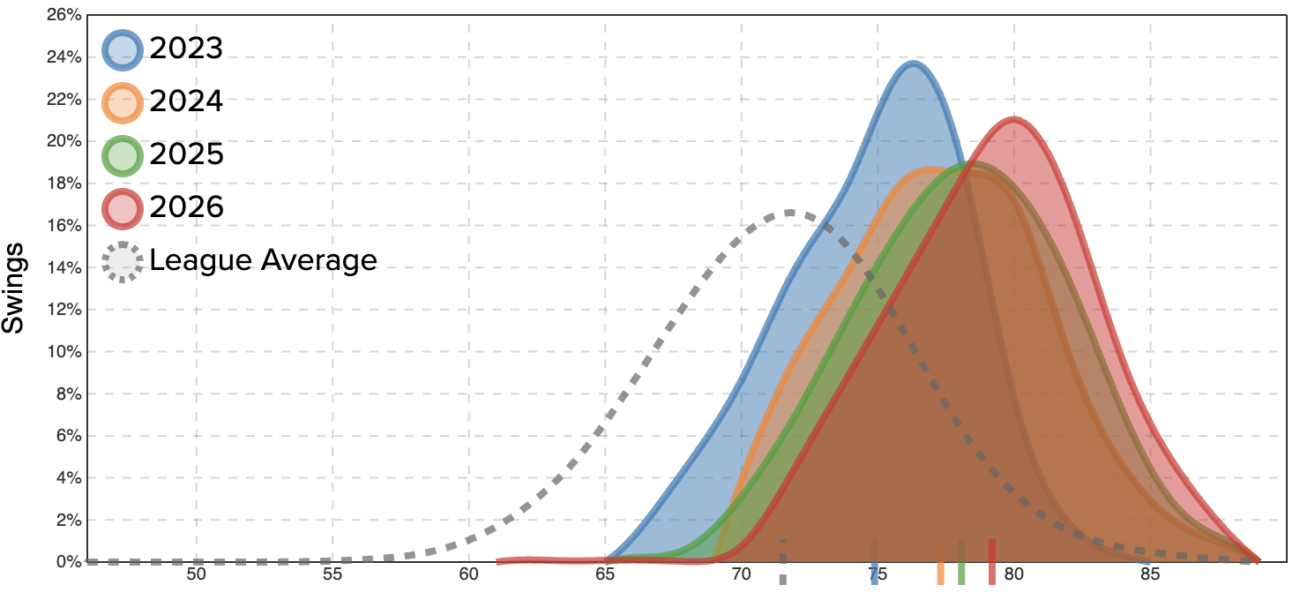
👉 READ BY CLICKING HEREMiguel Vargas, the White Sox’s first baseman, represents a different narrative: the ‘post-hype sleeper’ finally arriving. After lukewarm early career projections, his bat speed has jumped from 70.6 mph to 74.1 mph. His barrel rate has skyrocketed by nearly four points. He’s pulling the ball into the air consistently. These are tangible, verifiable improvements. “You simply can’t fake sustained gains across multiple foundational metrics,” asserted Dr. Bashir Anwar, an economic development strategist, during a recent Policy Wire forum on global investment patterns. “The data, when interpreted correctly, often exposes the truly transformative shifts rather than just surface-level noise.” For Vargas, the numbers scream legitimate progression, not just temporary good fortune.
Then there’s Brandon Marsh, the Phillies’ outfielder. He’s benefiting massively from simply playing regularly after being platooned for years. His walk rate, though, is at a career low due to a far more aggressive approach—his swing rate is up 8-9 points from his career norm. He’s running a BABIP (.372) that leads the league since 2021, — and some folks think that’s just his thing. But even still, some projections expect that average to normalize. This isn’t about skill enhancement, not really; it’s about opportunity and a certain recklessness, a market player banking on sheer volume rather than efficiency.
What This Means
This microcosm of baseball performance mirrors larger economic — and political anxieties about data-driven assessments. When Pakistan, for instance, touts specific growth sectors or investment figures, discerning whether that success is underpinned by genuine, replicable innovation (like Jordan Walker’s swing adjustments or Vargas’s increased bat speed) or by fleeting market conditions (like Lopez’s inflated BABIP or Marsh’s opportunistic aggression) becomes a matter of national and international consequence. Governments and investors around the globe face similar dilemmas: identifying truly emergent strengths versus statistical noise. But because human behavior remains intrinsically unpredictable, the search for infallible metrics will likely remain a quixotic quest. The market, as both Wall Street and the fantasy general manager will tell you, is ultimately driven by belief, a blend of data-backed conviction, educated guesswork, and a whole lot of hoping.