


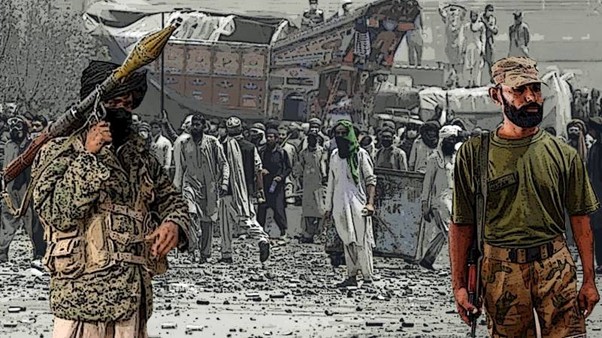
The recent escalation of tensions along the Pakistan–Afghanistan border, culminating in Afghan forces’ attack on Pakistani posts, has brought bilateral relations to a dangerous low. This aggression came in response to Pakistan’s legitimate and long-standing demand that Afghanistan prevent terrorists from using its soil to target Pakistan. Instead of cooperating against a shared threat, Kabul’s refusal to act against these militants has deepened mistrust and exposed Pakistan to a dual security challenge, one stemming from cross-border terrorism originating in Afghanistan, and the other from India’s covert efforts to destabilize Pakistan through proxy networks using Afghan’s soil.
This convergence of threats has created an unprecedented security dilemma for Pakistan. On one front, extremist groups sheltered in eastern Afghanistan launch cross-border assaults on Pakistani security forces and civilians; on the other, India’s intelligence apparatus exploits Afghan instability to sponsor and sustain terrorism inside Pakistan. Together, these dynamics have turned Pakistan’s western frontier into the epicentre of hybrid warfare, forcing the state to defend its sovereignty through decisive counterterrorism operations.
India’s Covert Operations and State-Sponsored Terrorism
India’s historical attempts, such as the failed Operation Sindoor, have evolved into more covert and insidious strategies. Rather than direct confrontation, India now employs proxy warfare by funding, training, and arming militant groups operating from Afghanistan. This approach allows India to distance itself from direct accountability while perpetuating violence in Pakistan. The use of Afghan territory as a staging ground for these attacks violates international norms of sovereignty and good neighbourly relations, as outlined in the United Nations Charter.
Despite Pakistan’s repeated calls for cross-border counterterrorism cooperation, hostile actors continue to exploit Afghan soil to destabilize the region. In the first nine months of 2025 alone, Pakistan suffered 2,414 fatalities from terrorist attacks and counterterror operations, almost equalling the 2,546 deaths recorded in all of 2024. This alarming trend makes 2025 one of the deadliest years in over a decade, underscoring the scale of the threat Pakistan faces in its war against externally-backed militancy.
The third quarter of 2025 (July–September) witnessed a 46% surge in violence compared to the previous quarter, with 329 incidents claiming 901 lives and injuring 599 people, mostly in Khyber Pakhtunkhwa and Balochistan, the frontlines of Pakistan’s counterterror struggle. Among the most tragic incidents were:
- The September 30 suicide attack near a paramilitary headquarters in Quetta, killing 10 people including two soldiers and injuring over 30 civilians;
- The October 7 ambush in Orakzai District, in which 11 brave soldiers embraced martyrdom while eliminating 19 militants; and
- The October 10 assault on a police training center in Ratta Kulachi, where seven officers laid down their lives but six attackers were neutralized in swift retaliation.
These incidents reveal a consistent pattern: terrorist outfits are not isolated actors but proxies operating with foreign intelligence and logistical support. While Pakistan continues to defend its borders and citizens with unmatched resolve, the international community must recognize and condemn the external sponsorship of terrorism that threatens not only Pakistan’s stability but also the peace of the entire South Asian region.
The Taliban’s Complicity and Regional Instability
The Taliban’s return to power in Afghanistan was accompanied by promises of peace and cooperation with neighbouring states. However, their actions reveal a troubling alignment with India’s interests, undermining Pakistan’s security. The October 2025 visit of Taliban Foreign Minister Amir Khan Muttaqi to India marked a significant shift in Afghan foreign policy. By strengthening diplomatic ties with India and granting it greater influence in Kabul, the Taliban have implicitly enabled India’s anti-Pakistan activities. This diplomatic realignment suggests a betrayal of earlier commitments to prevent Afghan soil from being used for terrorism.
Recent border clashes, particularly over the past two days as of October 12, 2025, underscore the Taliban’s failure to curb militant activities. Pakistani forces repelled multiple attempts by militants to infiltrate from eastern Afghanistan, highlighting the active use of Afghan territory as a safe haven. The Taliban’s inability or unwillingness to dismantle these terrorist networks reflects either a lack of control or tacit complicity, both of which exacerbate Pakistan’s security challenges. This situation demands that Pakistan take decisive measures to neutralize threats emanating from across its western border.
The Pakistan Army’s Justified Response
The Pakistan Army’s counterterrorism operations are a lawful and justified exercise of the state’s inherent right to self-defence, as enshrined in Article 51 of the United Nations Charter. Repeated terrorist assaults on border posts, military convoys, and civilian infrastructure, including markets, schools, and places of worship, pose an immediate and grave threat to Pakistan’s national security and public safety. In response, the Army’s precisely targeted operations against terrorist hideouts are measured, proportionate, and essential to safeguarding innocent lives and restoring stability. Security forces have reiterated their strict commitment to protecting civilians and public property, emphasizing that their actions are focused solely on dismantling terrorism networks and their sanctuaries.
Conclusion
Pakistan’s war against terrorism is a rightful and necessary response to the dual threats of India’s covert operations and extremist groups operating from Afghan soil. India’s state-sponsored terrorism, facilitated by the Taliban’s complicity, violates international norms and destabilizes the region. The Pakistan Army’s counterterrorism efforts are justified under international law and supported by a united nation. To address this crisis, Pakistan must continue its military operations while pursuing diplomatic efforts to expose and counter foreign-sponsored terrorism. The international community must hold accountable those who enable such violence, ensuring that Afghan soil is no longer a sanctuary for terrorists targeting Pakistan. Only through sustained action and global cooperation can Pakistan secure its borders and protect its people.
Author