
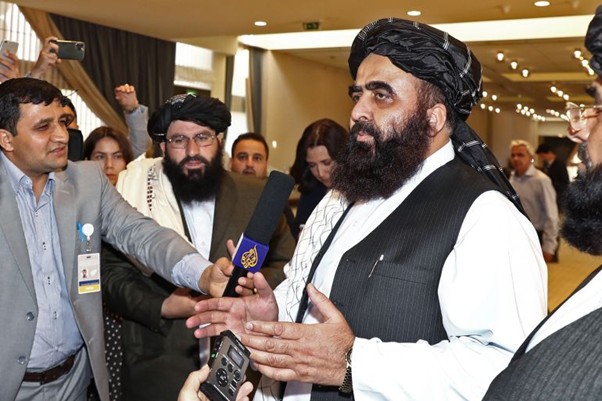
When Taliban Foreign Minister Amir Khan Muttaqi stood on Indian soil and shamelessly accused Pakistan of “undermining” peace in Afghanistan, it was more than political theatre, it was a performance of constructivist hypocrisy. While claiming moral authority as defenders of Afghan sovereignty, the Taliban simultaneously violate the very norms they invoke. This is not merely a political contradiction; it is a calculated identity manipulation, one that seeks legitimacy abroad while concealing chaos at home.
- “We have wiped out all terrorists from Afghanistan.”
Muttaqi’s declaration is contradicted by the UN Security Council’s Analytical Support and Sanctions Monitoring Team Report (June 2024), which identifies over 20 active terrorist organizations still operating in Afghanistan, including Fitnah al-Khawarij (FAK), Al-Qaeda, ISIS, and splinter groups of Lashkar-e-Taiba and Jaish-e-Mohammad. During his visit to India in October 2025, Afghan Foreign Minister Amir Khan Muttaqi claimed that terrorist organizations such as Lashkar-e-Taiba (LeT) and Jaish-e-Mohammad (JeM) “no longer operate from Afghan soil,” asserting that the Taliban government had “wiped out all terrorists” over the past four years. However, this sweeping declaration overlooks the continued presence of Fitnah al-Khawarij (FAK), a UN-designated terrorist organization that remains active within Afghanistan, along with US designated terrorist groups like BLA.
Pakistani officials confirm that numerous cross-border attacks have been launched from Afghan territory this year. In his press conference on 10th October 2025, DG ISPR Lt Gen Ahmed Sharif confirmed that Pakistan had carried out 14,535 IBOs in KP in 2024 and 10,115 IBOs in 2025 (to mid-Sept), and that hundreds of terrorists were neutralized with origins or logistical bases in Afghanistan. Such facts debunk the Taliban’s self-portrayal as a counterterrorist actor and expose what constructivist scholars term normative inconsistency, when an actor publicly adheres to a norm (counterterrorism) but privately violates it to sustain its own power.
The Taliban’s denial thus is not just false, it is performative hypocrisy, weaponizing the language of peace to conceal complicity with terror networks.
- “Afghanistan has transformed since 2021.”
Indeed, Afghanistan has transformed, but not in the way Muttaqi imagines.
According to UNAMA’s 2025 quarterly updates, over a hundred civilian casualties were recorded in Afghanistan in just the first three months of the year, most resulting from attacks claimed by ISIS-K, FAK, and other extremist factions that thrive under Taliban inaction. Earlier UN reports documented more than 3,700 civilian casualties in Afghanistan between August 2021 and May 2023.
The Taliban’s so-called “transformation” has meant the collapse of women’s rights, mass unemployment, and the silencing of dissent.
Constructivist theory helps decode this contradiction; regimes often claim normative progress to perform legitimacy before external audiences. By invoking “transformation,” the Taliban reframe authoritarian regression as cultural authenticity, a rhetorical camouflage meant to resist international pressure while deepening domestic control.
- “Let other countries act against terror groups like Afghanistan did.”
Pakistan’s record in counterterrorism stands as an example.
Pakistan’s counterterrorism campaign has unfolded through successive military operations since Operation Al-Meezan (2002–2006) in South Waziristan, the country’s first major effort to dismantle Al-Qaeda and Taliban-linked sanctuaries. As militancy spread, Pakistan launched Operation Sher Dil (2008) in Bajaur and Operation Rah-e-Haq (2007–2009) in Swat, followed by Operation Rah-e-Rast (2009) and Rah-e-Nijat (2009–2010) to eliminate Fitnah al-Khawarij (FAK) and allied extremists from key tribal areas. The campaign reached its peak with Operation Zarb-e-Azb (2014), which targeted FAK’s remaining strongholds in North Waziristan, and later Operation Radd-ul-Fasaad (2017), aimed at consolidating peace and uprooting sleeper cells nationwide. These sustained operations came at a heavy cost, over 80,000 Pakistani lives and an estimated $150 billion in economic losses, yet they stand as proof of Pakistan’s enduring resolve to eradicate terrorism in all its forms.
By comparison, the Taliban’s protection of FAK commanders, their rejection of extradition requests, and their tolerance of training camps in Kunar and Paktika underscore the gap between declared norms and practiced behavior, a textbook example of constructivist hypocrisy. They invoke the global counterterrorism norm while shielding militants who destabilize Pakistan.
- “We consider Pakistan’s cross-border actions wrong.”
Muttaqi’s words ignores that he falsely accuses Pakistan of not aggression but of defensive measures that if occurred are legally justified under Article 51 of the UN Charter, which permits self-defense against non-state actors operating from another state’s territory.
Pakistani think-tanks, including PIPS, document numerous terrorist attacks inside Pakistan that are known to have links with Afghan soil, cross-border incidents into Khyber Pakhtunkhwa and Balochistan are repeatedly reported.
To call self-defense “aggression” is not just bad faith; it is an inversion of moral logic. Constructivist analysis interprets this as norm substitution, when a weaker actor redefines norms to portray its violations as virtue.
- “We are open for talks.”
Pakistan has engaged in multiple rounds of dialogue, mediated in 2022 and 2023, collapsing after Kabul’s failure to disarm FAK terrorists.
This rhetorical openness serves as diplomatic theatre, a way to maintain international engagement without conceding substance.
📄 POLICY WIRE WHITEPAPER PUBLISHED: PAKISTAN'S NATIONAL SECURITY POLICY PRIORITIES
👉 READ BY CLICKING HEREConstructivist inconsistency again surfaces as by performing the norm of “dialogue,” the Taliban seek recognition while refusing behavioral compliance. It’s diplomacy stripped of sincerity, dialogue as deflection.
- “Afghanistan has peace and progress after 40 years.”
No credible data supports this claim. Over 85% of Afghans live below the poverty line (UNDP), and the Global Terrorism Index still ranks Afghanistan among the world’s top terror-hit states.
The Taliban’s invocation of “peace” is not descriptive; it is narrative framing. In constructivist terms, they attempt to construct a national identity rooted in “ stability,” even as that identity perpetuates repression and economic collapse. Peace, for them, is defined by silence, not security.
- “The courage of Afghans should not be tested.”
Pakistan has never questioned Afghan courage. It has, however, borne the humanitarian and economic cost of Afghan wars. Since 1979, Pakistan has hosted over four million Afghan refugees, bearing one of the world’s longest and most expensive humanitarian burdens. According to official estimates from Pakistan’s Ministry of States and Frontier Regions (SAFRON) and independent policy forums, the country has incurred over USD 200 billion in economic costs over four decades. These expenses include the provision of food, shelter, healthcare, education, and security, alongside the immense strain placed on Pakistan’s infrastructure, job market, and public services.
DG ISPR has repeatedly affirmed Pakistan’s support for peace in Afghanistan while warning that it cannot tolerate cross-border terrorism emanating from Afghan soil.
The Taliban’s historical narrative, invoking Soviet and American invasions, seeks moral equivalence with Pakistan’s counterterrorism operations. Constructivist theory reads this as identity inversion where they are defining oneself as the eternal victim to justify perpetual terrorism.
- “Kabul wants better relations, but they cannot be one-sided.”
True, and Pakistan has made repeated overtures for cooperation, trade, and dialogue. Yet, the Taliban’s failure to act against FAK or recognize the International border undermines any reciprocal goodwill.
Their invocation of bilateral equality conceals a unilateral agenda: demanding legitimacy without responsibility.
This mirrors what constructivist scholars describe as “normative manipulation”, when states selectively apply norms to maintain asymmetric advantages in regional order.
- Conclusion: Call For Peace
Amir Khan Muttaqi’s speech in India appeared less as a genuine call for peace and more as a carefully crafted diplomatic performance, an effort to project moral integrity while avoiding deeper accountability. The Taliban’s rhetoric reflects what scholars describe as constructivist diplomacy, the use of moral and normative language to shape perception, even when on-ground realities suggest a gap between words and actions.
Pakistan, despite immense sacrifices in its fight against terrorism, continues to host millions of Afghan refugees and advocate for regional stability. The people of Pakistan and Afghanistan, bound by deep cultural, religious, and historical ties, have always shared a relationship rooted in brotherhood, empathy, and mutual respect. The need of the hour is for the Afghan government to recognize these shared bonds and address the fault lines that hinder genuine cooperation. By acting in accordance with the collective aspirations of the Afghan and Pakistani people, who reject bloodshed, extremism, and proxy conflicts, both nations can move toward a mature, mutually beneficial relationship. Only through sincere engagement and mutual understanding can Pakistan and Afghanistan prevent incidents like that of October 11, ensuring a future defined by peace and prosperity for their shared region.
Author