

Pakistan’s Mediation Effort: A Rare Diplomatic Opening in a Complex Conflict
The recent diplomatic intervention by Pakistan is a significant and positive step in a region that is traditionally influenced by distrust, years of animosity, and lack of dialogue. Pakistan managed...

The recent diplomatic intervention by Pakistan is a significant and positive step in a region that is traditionally influenced by distrust, years of animosity, and lack of dialogue. Pakistan managed to achieve a ceasefire and put two long-time rivals at the negotiating table through consistent and intensive negotiations, which could not have been achieved decades before. Although the breakthrough is still small and weak, it is an indication of a serious and credible attempt by Islamabad to establish itself as a responsible player that cares about regional and global peace.
The mediation process was not symbolic and superficial. It entailed 21 hours of uninterrupted diplomacy, which was conducted over several sessions, during which Pakistani officials talked to both parties with persistence and strategic clarity. Such a degree of continuous interaction is important diplomatically. Such conflicts tend to fail in negotiations because of a lack of trust, communication barriers, or hard stances. The very fact that the negotiations were sustained throughout such a long time indicates that Pakistan could establish the minimum of comfort and trust between the sides.
This was spearheaded by the leadership of the Deputy Prime Minister and Foreign Minister of Pakistan. In diplomacy, the mediatory role played by the Foreign Minister, especially, was recognized by both parties. The fact that the conflicting parties recognized Pakistan as a credible intermediary shows that Pakistan was not seen as partisan, but rather as an intermediary who could facilitate dialogue without dictating the outcome. This is a major success in itself particularly in a geopolitical arena where neutrality is usually doubted.
Nevertheless, one should not be overly optimistic about what has been accomplished. It is not a solution to the conflict. The conflict is still very complicated, based on historical resentments, political differences, and conflicting strategic interests. In most of these conflicts around the world such as the Middle East and Eastern Europe, ceasefires are usually not a lasting solution but a temporary one. The United Nations statistics indicate that almost 60 percent of ceasefires in protracted conflicts do not last the first year, mainly because of absence of trust and outside influence. This statistic shows how vulnerable the current development is and emphasizes the magnitude of the problem in the future.
Domestic political pressures on both sides also affect the conflict in question. The leaders are usually bound by the popular will, nationalistic discourses, and institutional frames that restrict the flexibility in the negotiation table. Even the decision to discuss can be a political risk in such circumstances. The role of Pakistan was not only facilitating dialogue, but also managing expectations and providing the space in which both parties could communicate without seeming to give too much.
Another layer of complexity comes from external actors and so-called “spoilers.” These may be local competitors, international actors with conflicting interests, or non-state actors, who enjoy the status quo of instability. Their presence usually makes peace processes more complicated by adding new dimensions or compromising the trust between the main parties. Nevertheless, Pakistan was able to preserve the process to a sufficient degree to reach a ceasefire and start the dialogue, which is indicative of the seriousness and skill of its diplomatic strategy.
What Pakistan has successfully achieved is to establish a point of departure- a point of departure where both parties better understand each other. This is critical. Most of the conflicts do not end due to disagreements, but due to a lack of understanding of the intentions and boundaries of the other party. Through direct interaction, Pakistan has assisted in alleviating some of this uncertainty. Although this does not ensure any progress, it makes the further negotiations more organized and, probably, more productive.
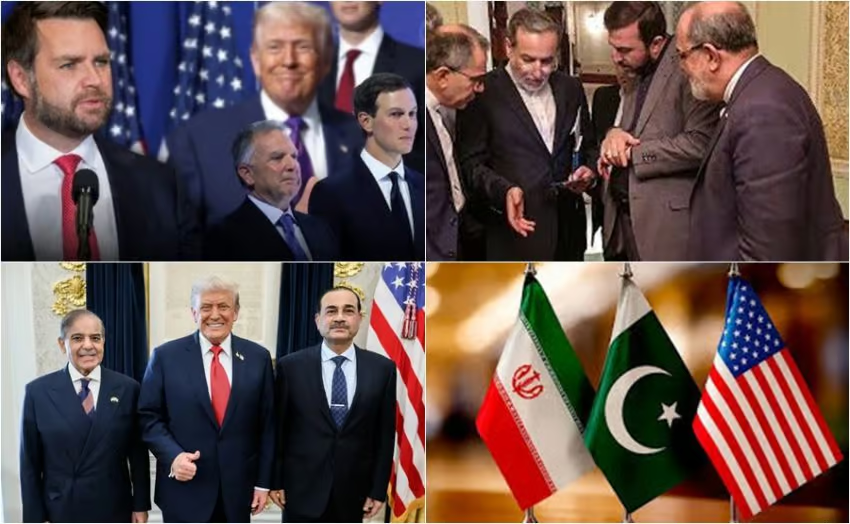
The recognition of the effort by Pakistan by the international community also enhances its stand. Comments by JD Vance, mentioning the mediation offer, suggest that the initiative has attracted attention at the higher ranks of global politics. Although these are usually careful and moderate statements, they are still indicative that the role of Pakistan is being taken seriously. This would pave the way to wider international backing in the event that the process proceeds.
📄 POLICY WIRE WHITEPAPER PUBLISHED: PAKISTAN'S NATIONAL SECURITY POLICY PRIORITIES
👉 READ BY CLICKING HERESimultaneously, Pakistan has been very disciplined and professional by not revealing the substantive nature of the negotiations. This is in line with the diplomatic practice. Confidentiality is a key element in mediation because openness of delicate stances can ruin negotiations and solidify stances. Pakistan has strengthened its credibility as a mediator that honours the process and not pursuing publicity by not making unneeded disclosures.
Importantly, the move by Pakistan is also indicative of a larger strategic change. Rather than being viewed through the prism of regional tensions, it is trying to establish itself as a peace and stability broker. This is especially critical in a globalized world where middle powers are being more and more called upon to play a role in conflict resolution. Pakistan has shown its ability and willingness to invest time, political capital, and diplomatic resources in this process.
Nevertheless, the future is unclear. Peace truces may collapse, negotiations may bog down, and political circumstances may change rapidly. Whether the two parties will be ready to go beyond preliminary interaction to more meaningful negotiations will determine the success of this initiative. Pakistan can enable, promote and facilitate but not dictate peace.
The role of diplomatic in this regard can be said to be significant and responsible by Pakistan. It has not settled the dispute, nor can it in one effort reasonably attempt to do so. But it has done something just as significant, it has opened a line of communication and has provided a platform on which future development can be made. This is a contribution in itself in a region where dialogue is not a common practice and mistrust reigns supreme.
Author