


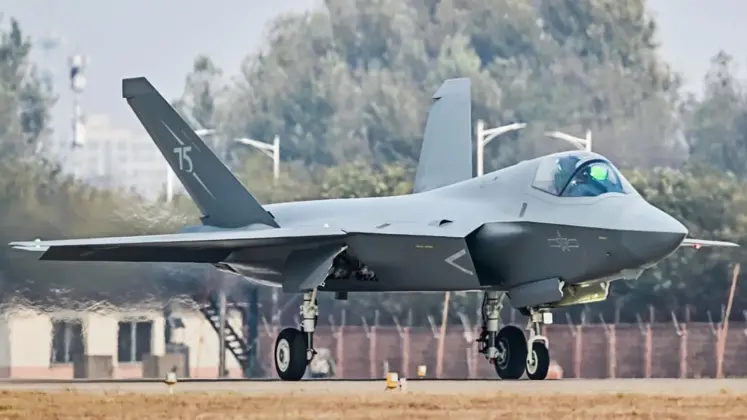
Pakistan’s J-35 Deal Sends Shockwaves Through India
The corridors of power in New Delhi are experiencing a silent storm. Although everything appears to be going smoothly on the surface, India’s strategic planners are dealing with a development...

The corridors of power in New Delhi are experiencing a silent storm. Although everything appears to be going smoothly on the surface, India’s strategic planners are dealing with a development that caught them off guard. India’s defense community is experiencing a rare moment of open anxiety over Pakistan’s planned purchase of China’s fifth-generation J-35 stealth fighters. It’s more than just the planes; it’s about what they represent: a change in equilibrium.
There is more to the J-35 than meets the eye. It is a sophisticated predator designed for contemporary air combat. With its superior sensors for precise targeting, internal weapons depots for cleaner aerodynamics, and stealth capabilities to help it avoid enemy radar, the J-35 adds a degree of complexity that has the potential to significantly undermine India’s long-standing aerial advantage in the area.
From Operations to Tensions: A Growing Unease
Following previous military escalations between India and Pakistan, tensions were already high. India launched its “Operation Sindoor” after blaming Pakistan in early May to a deadly attack that occurred in Indian-administered Kashmir on April 22. However, that operation was criticized domestically, particularly after Rahul Gandhi and other political figures questioned whether Pakistan had been tipped off.
On May 11, Pakistan responded with “Operation Bunyan al-Marsoos.” It was a message, not merely a military response. Pakistan surprised India’s defense analysts with its level of coordination and accuracy while using drone swarms, long-range missiles, and targeted airstrikes. What’s the kicker? They didn’t use stealth jets to accomplish it all. Because of this, India’s leading security experts are now speculating about what may happen if Pakistan were to include 40 J-35 stealth fighters.
India’s Own Generals Admit the Stakes
OMajor General (Retd.) P.K. Sehgal of the Indian Army has one of the most striking remarks. His statement in an interview with ETV Bharat, “This acquisition [of J-35s] could indeed be a pivotal factor for Pakistan,” was a long cry from the typical bravado.
Even though India has a larger defense budget and greater resources, he admitted that technology can easily tip the balances, particularly in an area where alliances are changing.
“The dynamics of the India-China-Pakistan triangle would be greatly impacted if Pakistan were to acquire stealth fighters,” Sehgal cautioned.
These lines aren’t merely arbitrary. They show India’s increasing recognition that Pakistan’s relationship with China is becoming into a technology alliance with genuine teeth, one that is far more powerful than military assistance. Sehgal noted another strategic worry: India is still having trouble maintaining 32 squadrons, whereas China and Pakistan may jointly field about 65 if fighting breaks out on two fronts. That is a strategic vulnerability as well as an imbalance.
Why J-35 Changes the Game
The J-35, previously called the FC-31, is a fifth-generation multirole stealth aircraft that is built by Shenyang Aircraft Corporation in China and is intended for use in carrier-based and land operations. The J-35 can practically fly under the radar, unlike vintage fighters. It is perfect for first-strike missions because of its strong engines, low radar signature, and integrated electronic warfare capabilities. According to Pakistani defense analyst Zia ul Haque Shamsi with these jets, Pakistan would have a 12- to 14-year technological advantage over India in stealth. You can’t overlook that kind of edge. Being the first to observe and the first to attack is more important than ever in a battlefield that is rapidly becoming more modern. Beyond its radar-evading profile, the J-35 can easily coordinate with drones, missiles, and cyber warfare units since it is designed to interface with network-centric warfare systems. This creates a new type of warfare where speed, surprise, and digital integration are more important than raw numbers.
A Race Against Time
India is not doing nothing. It has responded by reviving the Advanced Medium Combat Aircraft (AMCA), its own stealth project. However, there is a catch: combat missions are still years away for AMCA. With luck, it may be up and running by 2035. In contrast, Pakistan’s J-35s might start flying by 2027.Additionally, India may approach the United States for F-35 aircraft. However, there would be conditions attached to such a contract, including political obstacles and severe technology transfer prohibitions. Integration into the Indian Air Force would take years, even if it were authorized. Pakistan, however, is making steady but modest progress. And buying jets isn’t the only thing involved. The goal is to completely change the way it approaches air combat. The nation has already formed a cutting-edge cyber command, invested in hypersonic weaponry, and adopted drone warfare. The centerpiece of this developing defensive architecture is J-35.
A Change in Approach, Not Just a Purchase
India is more concerned about the wider change in regional dynamics than it is about Pakistan’s increasing air capability. On paper, China and Pakistan are no longer allies. Joint exercises, infrastructure sharing, intelligence sharing, and now fifth-generation military weapons are all examples of their collaboration. This poses India’s worst-case scenario: a two-front war in which its enemies coordinate in real time and possess superior strike and stealth capabilities. Even defense voices from India have begun to reframe the discussion. In another televised debate hosted by Indian anchor Arnab Goswami, retired Indian Air Marshal Sanjeev Kapoor offered a candid admission:
“Pakistan will definitely respond if provoked. Their military is very strong and well-prepared.”
He emphasized that Pakistan’s armed forces are not only professional but also highly efficient in dealing with regional threats, marking a rare public acknowledgment of Pakistan’s growing capabilities from an Indian defense official.
A New Era of Balance
There is more to the J-35 deal than just hardware. It serves as a wake-up call in New Delhi and a mental shift in Islamabad. India today views Pakistan as a dynamic, technologically advanced military force with strong allies, rather than as a predictable adversary. There will probably be a competition for influence in the region as well as for jets on the next road. India still has a lot of advantages, including strong defense capabilities, foreign alliances, and economic influence. However, history has proven that the player who adapts the fastest often wins, not the largest player.
A new chapter has begun as the J-35 is more than simply a brand-new plane to Pakistan.
Author