


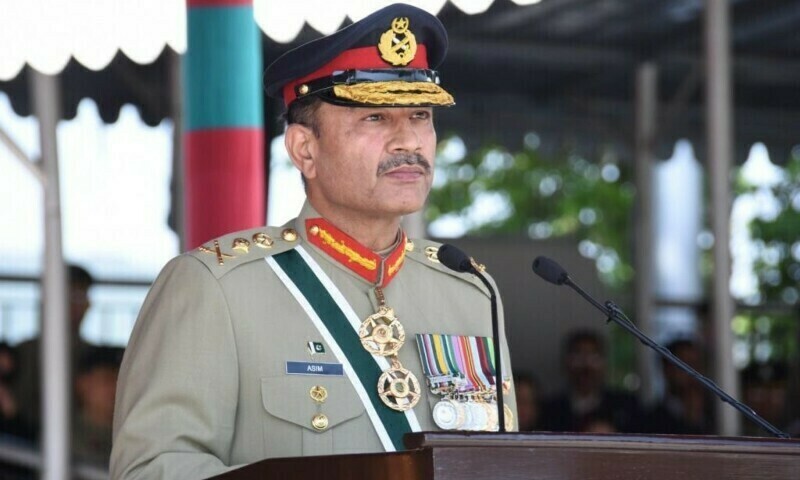
Pakistan’s COAS and the Power of Strategic Composure
In a region where a single error can lead to disaster, Pakistan’s Chief of Army Staff (COAS) General Asim Munir has proved that 21st-century leadership is about nerve rather than noise. In the...

In a region where a single error can lead to disaster, Pakistan’s Chief of Army Staff (COAS) General Asim Munir has proved that 21st-century leadership is about nerve rather than noise. In the midst of a new wave of India-Pakistan tensions, defined by escalating rhetoric, covert threats, and severe psychological warfare, the COAS stood out as a measured statesman rather than a reactionary figure. He averted conflict, calmed a people, and redefined authority for an apprehensive era by maintaining his calm demeanour.
The current cross-border escalation, in which Indian political and media circles heightened war language, sparked fears of a recurrence of 2019’s brinkmanship. However, unlike in the past, Pakistan’s response under the COAS’ leadership was measured, layered, and precise. There’s no bombast. There is no emotional overkill. Instead, a disciplined strategic response was required- military readiness combined with political coordination, and controlled but forceful public communication.
This strategy not only mitigated foreign pressure, but also galvanized national solidarity, gaining the COAS considerable esteem. From parliament to the diaspora, barracks to bazaars, there was uncommon agreement: Pakistan was in good hands.
Leadership in Trouble: Doctrine in Action
This was more than simply personality at play; it was doctrine. As Carl von Clausewitz points out, “War is not merely a political act but a true political instrument.” The COAS recognizes that in South Asia, escalation management is a strategic act. His leadership during the crisis demonstrates fundamental ideological maturity: avoid war while making it clear that if it is imposed, it would be met with full-spectrum resolution.
Operational preparedness was quietly guaranteed, diplomatic messaging was refined, and a cohesive front was presented. Pakistan never appeared to be in a corner. Instead, it appeared confident and vigilant, reflecting leadership that strikes a balance between deterrence and discipline.
The public’s General: Strength and Poise
Beyond strategic circles, the COAS’s crisis management has transformed his public profile. He is no longer viewed merely as a border defender, but also as a stabilizer of the nation’s center. His controlled public appearances, clear messaging, and conspicuous presence on the front lines during the crisis propelled him from military leader to national figure of perseverance.
This modest strength struck a chord in a population tired of political upheaval and economic hardship. He became known as “the general who didn’t flinch” throughout Pakistan and the diaspora, demonstrating comfort without resorting to theatricality.
Sun Tzu’s ageless wisdom is relevant here: “The supreme art of war is to subdue the enemy without fighting.” Pakistan’s COAS accomplished just that: he calmed fear, prevented escalation, and emerged with increased strategic and popular confidence.
Vision for Institutional Stability and Strategic Autonomy
The COAS’s vision for institutional stability and strategic autonomy is visually appealing, even beyond crisis response. Internally, he has advocated for civil-military harmony, allowing the state to speak with a single voice- a valuable advantage in times of conflict. Today, national security is more than simply kinetic might; it also includes narrative control, diplomatic coherence, and internal unity. His leadership demonstrates knowledge that military power without political stability is an ineffective tool.
Regionally, the COAS has also guided Pakistan towards strategic autonomy. Pakistan’s defense diplomacy has become multidirectional, with engagement with China, cautious contact with the United States, and reinforcement of links with the Gulf. It has abandoned bloc politics in favour of pragmatic alliances. As Henry Kissinger stated, “Flexibility is the essence of diplomacy.” The COAS’s leadership has kept that area open for Pakistan.
Warfare Beyond the Battlefield: Communication as Deterrence
In today’s information battlespace, communication is battle. Mistakes in signaling can result in disastrous miscalculation. Once again, the COAS’s restraint paid off. No premature press releases. No provocative headlines. Just careful messaging, timed releases, and a consistent institutional voice- particularly important when opposition media sought to twist facts. Eliot Cohen stated precisely, “Military power must be integrated with political purpose to have strategic meaning.” Under this leadership, communication has evolved into a deterrent technique, used to manage perceptions and keep control rather than escalate.
📄 POLICY WIRE WHITEPAPER PUBLISHED: PAKISTAN'S NATIONAL SECURITY POLICY PRIORITIES
👉 READ BY CLICKING HEREIn an era where war may start with a misfired tweet or a border skirmish, Pakistan’s COAS has demonstrated that leadership now demands not only power, but also timing, composure, and vision. His approach to the recent India-Pakistan issue demonstrated more than just military discipline; it also demonstrated statesmanship, which was founded on theory and delivered via unity. In doing so, he not only protected the country’s sovereignty, but also restored popular confidence in institutional resolve. In an era when the distinction between the battlefield and the media has blurred, his leadership reminded the world- and the country- that the strongest steel is sometimes formed not in conflict, but in restraint.
Author