


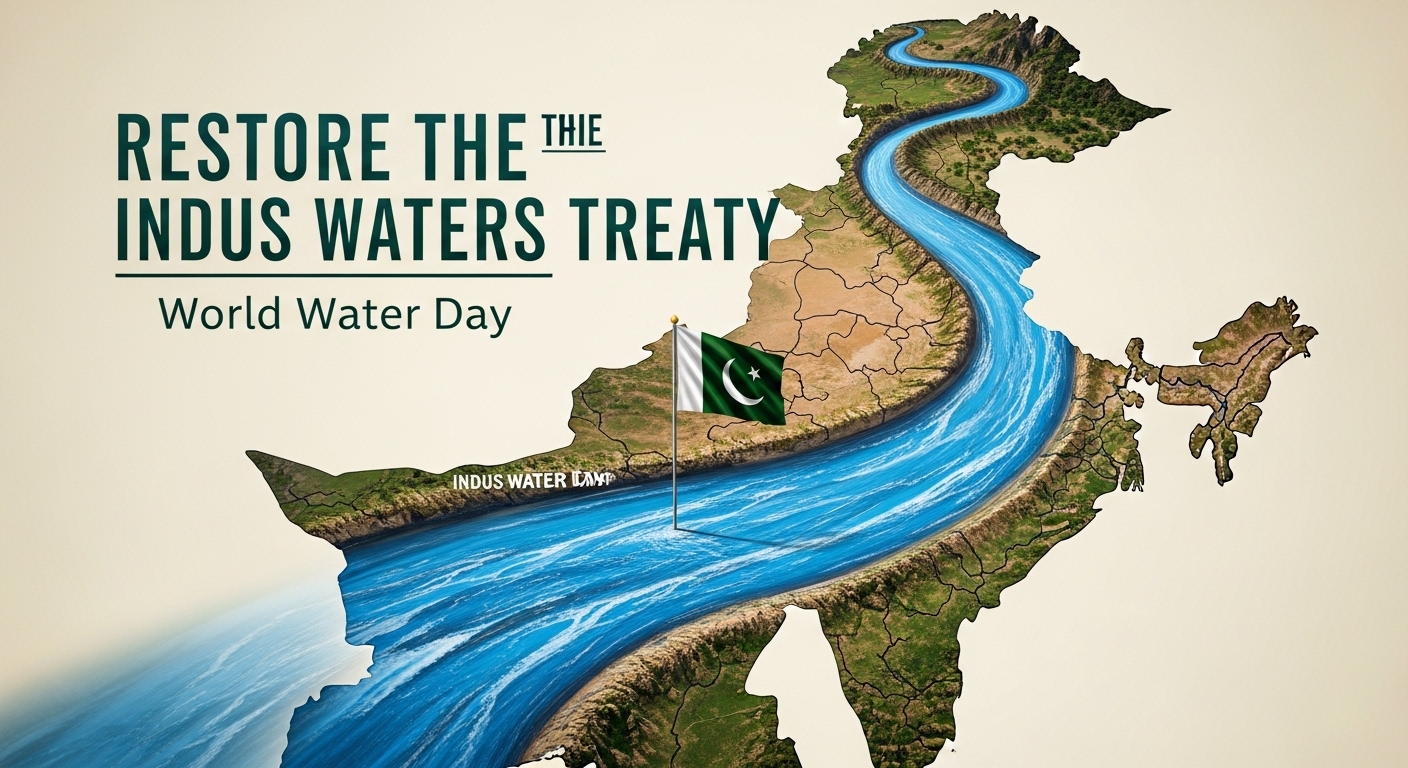
Pakistan’s Call to Restore the Indus Waters Treaty on World Water Day
As the world celebrated World Water Day on 22 March 2026 in the theme of Water and Gender, the President of Pakistan Asif Ali Zardari gave a sober but urgent message to India and the global...

As the world celebrated World Water Day on 22 March 2026 in the theme of Water and Gender, the President of Pakistan Asif Ali Zardari gave a sober but urgent message to India and the global community. He demanded the immediate and complete implementation of the 1960 Indus Waters Treaty (IWT), and said that the unilateral move by India to put the treaty on abeyance was an intentional weaponisation of common water resources. His words were not rhetoric; it was a reality of a nation where Indus river system supports the lives, livelihoods and food security of more than 240 million people.
The IWT is one of the most successful accounts of transboundary water cooperation in history, having been signed in Karachi on 19 September 1960 under the mediation of the World Bank. The treaty has outlived four wars and decades of enmity between nuclear armed neighbours. It apportioned the three eastern rivers (Ravi, Beas, Sutlej) between India and the three western rivers (Indus, Jhelum, Chenab) between Pakistan which got approximately 80 percent of the total basin flow. The settlement was to be permanent with clear data sharing procedures, the resolution of the dispute by the Permanent Indus Commission, and impartial expert arbitration. It had provided stability weto an unstable region in a span of over sixty years giving Pakistan the chance to expand its economy of agriculture and India the opportunity to use its eastern rivers without much interference.
That stability was disrupted in April 2025. Following a false flag incident in Pahalgam, Indian Illegally Occupied Jammu and Kashmir, which killed 26 people, New Delhi alleged that Pakistan was involved in it, a statement that Islamabad has categorically denied. India blocked agreed processes, halted hydrological data sharing, and suspended the IWT without any independent investigation and access to the dispute mechanisms established by the treaty. President Zardari was correct in terming this action as a breach of the letter and spirit of an old international agreement. India has not only violated its commitments but it has also created a very bad example: that even the most fundamental need of life, water, can be exchanged as a bargaining chip in political conflicts.
The implications of this to Pakistan are existential. The Pakistani agriculture which consumes nearly half of the workforce and produces nearly 20 percent of the GDP is based on Western rivers. The Indus system supplies more than 90 percent of the irrigated land in the nation. Any long-term interference or even the potential of it is a threat to food production, rural economies, and urban water supply. Farmers already struggling with the effects of climate change in the form of floods, droughts, and glacial melt are now subjected to an extra dose of uncertainty that is created by a neighbour. As President Zardari warned, such conduct “threatens food, economic security and jeopardises the livelihoods of millions who depend on these waters.”
This crisis cuts across the 2026 World Water Day theme with a lot of force. According to Zardari, water insecurity is not gender-neutral. Women and girls in rural Pakistan are the most affected. In case of the inaccessibility or unreliability of safe water sources, they use hours a day to carry supplies-time that could otherwise be spent on education, earning of income, and family care. Health risks are compounded: the polluted water causes illness, and the physical burden of heavy loads can impact the maternal and child health. The president underlined that safe water and sanitation is a fundamental right that is outlined in our Constitution. This is not a matter of technicality, but it is a matter of fairness, dignity and opportunity. He demanded more investment in water infrastructure and most importantly, women should be meaningfully involved in planning and decision making.
Pakistan has not been passive. Successive governments have pursued domestic solutions: rainwater harvesting, aquifer recharge, efficient irrigation technologies, and community-led conservation. The president highlighted how simple household measures can “replenish underground aquifers and increase the water table.” Yet these efforts cannot substitute for the predictability and equity guaranteed by the IWT. Climate variability is already intensifying pressure on the basin. Population growth, urbanisation, and changing rainfall patterns demand cooperation, not confrontation.
From an international legal perspective, India’s suspension is troubling. The treaty contains no unilateral “abeyance” clause. It can only be terminated by mutual agreement through a new ratified treaty. The World Bank, as depositary, and the mechanisms of neutral expert determination and court of arbitration were created precisely to prevent such breakdowns. By bypassing these, India undermines not only its bilateral commitments but the broader principles of international water law, which emphasise equitable and reasonable utilisation and the prohibition of significant harm.
📄 POLICY WIRE WHITEPAPER PUBLISHED: PAKISTAN'S NATIONAL SECURITY POLICY PRIORITIES
👉 READ BY CLICKING HEREPakistan’s position has been consistent and principled: it seeks peaceful resolution through dialogue and full implementation of the treaty. President Zardari’s message on World Water Day was not a declaration of hostility but a reminder that water should unite rather than divide. “Water sustains our agriculture, our cities, and our natural environment,” he said. “As pressures on water resources grow due to population demands and climate variability, we must use water with greater care.”
The international community cannot remain silent. South Asia’s stability depends on functional institutions that transcend politics. The World Bank, the United Nations and the major powers that have a vested interest in the security of the region have a role to play in encouraging the two parties to go back to the negotiation table, within the treaty framework. Giving one party the ability to weaponise a common good is likely to undermine trust in other transboundary agreements across the world, whether it is the Nile or the Mekong.
Pakistan is prepared to engage positively. It has reiterated that it wants peace, not its frailty. The call of President Zardari on World Water Day 2026 resonates with a simple fact: rivers have no borders, and justice should not either. The Indus Waters Treaty is not just a bilateral requirement, it is a regional peace requirement, an environmental sustainability requirement and the dignity of millions of people whose lives rely on the waters.
Author