

Pakistan-Saudi Air Power Cooperation: From Fraternal Ties to Multi-Domain Strategy
Pakistan and Saud Arab’s decision to strengthen their collaboration with regard to their air forces is not a simple defense exercise. It is an indication of strategic recalibration that has been...

Pakistan and Saud Arab’s decision to strengthen their collaboration with regard to their air forces is not a simple defense exercise. It is an indication of strategic recalibration that has been determined by the changing regional dynamics, changing warfare doctrine, and increasing the significance of defense diplomacy in the multipolar world. This alliance is an indicator of how the two states are adjusting to new reality in the world where traditional security assurances are being re-evaluated, and where economic forces are mingling with military planning.
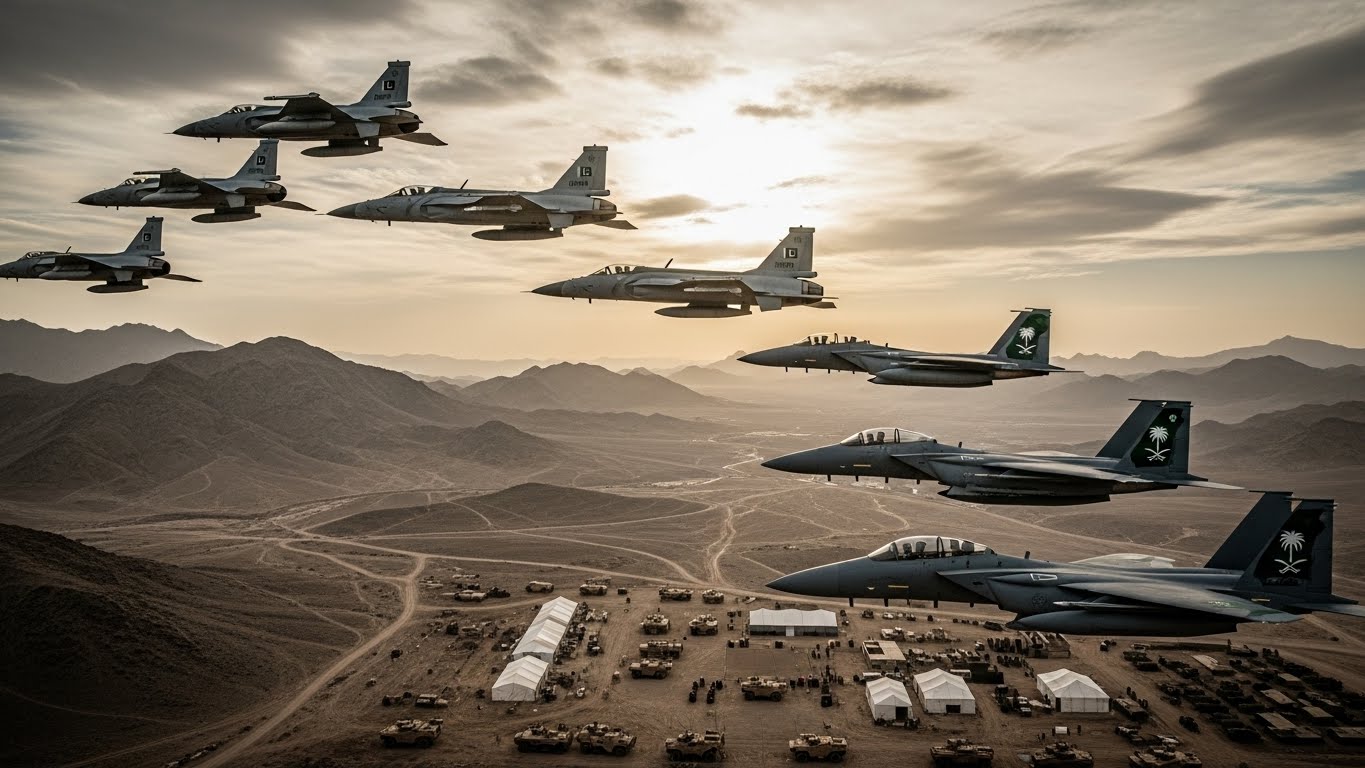
The key in this development is the changing role of the (PAF). The PAF which was once considered to be one of the most professional and technologically skilled organizations in Pakistan has recently focused on its transformation into Multi-Domain Force. The idea combines the aspect of air power with space, cyber operations, electronic warfare, and artificial intelligence, as it is acknowledged that the next generation of conflicts will be determined not by the number of aircrafts or their ability to dogfight, but by the supremacy on the interconnected areas of operations. The leadership of the military in Pakistan has been eager to demonstrate this transformation not only as a deterrence force but also as an example of how operations can be adapted to suit the partner states.
In the case of Saudi Arabia, this development is obviously attractive. The Kingdom is already engaged in a massive program to modernize its defense posture as one of its wider vision 2030 programs. Riyadh is still spending a lot of money on high-profile platforms and missile defense as it is becoming more sensitive to the fact that hardware is not the only measure that should ensure security. It is also essential that training, doctrine, and operational integration are important. The enthusiasm in the joint training and multi-domain operations indicates a wish to leave the procurement-based relations, and go to greater interoperability and shared strategic thinking.
There are broader uncertainties in the region which are also reflected in this shift. The Middle East has had different degrees of outside intervention especially by the foreign powers, which have made the Gulf states diversify their security associations. Saudi Arabia is hedging against being over-dependent on a particular external guarantor by enhancing its relationship with Pakistan, which has many years of operational experience, a well-organized military system, and an ever-increasing indigenous defense production. In this regard, air force collaboration turns into an instrument of strategic independence as opposed to closer relations.
The alleged negotiations to turn about 2 billion Saudi loans into a fighter jet deal are also indicative of the multidimensionality of this type of partnership. The most likely focus of such an arrangement, the , has a positioning niche within the arms market of the world. The aircraft that has been developed in collaboration with Pakistan and China has been promoted as being economical, battle tested and flexible to different operational needs. Its use has been reported in the recent conflicts which has increased its credibility especially to the states that are interested in having reliable platforms without the political and financial constraint that is deemed to be characteristic of the western systems.
As far as Pakistan is concerned such a deal would have a weight that would go beyond the aspect of defense collaboration. Defense exports are not only prestigious in nature but also a possible source of economic relief and industrial expansion. The transformation of loans into defense manufacturing would be both linked to the military diplomacy and the fiscal common sense; also, the ambition of Pakistan to become a serious arms exporter outside South Asia. Discussions with other nations such as Bangladesh reveal that Islamabad does not consider defense sales as a short-term strategic tool but considers it as a long-term alignment.
Meanwhile, this increased defense relationship underscores the growing blurring of the border between economics and security due to modern military co-operation. In the case of Saudi Arabia, investing in the common training and possible purchases of planes does not concern only the expansion of capabilities but also the establishment of reliable partnerships with the states that could provide an informational input and political orientation. In the case of Pakistan, it is a chance to pursue institutional competence into diplomatic and economic capital.
Nevertheless, such cooperation should be considered at a larger regional level. Improved military relations, especially with sophisticated aircrafts and multi-domain capabilities, might have some fears to the neighbors and result in assumptions of an arms competition. Both Pakistan and Saudi Arabia will have to strike the balance between their legitimate security interests on the one hand and transparency and confidence-building steps on the other hand to prevent the aggravation of the external powers in the region. It will be essential to package this partnership as defensive, capacity-building and stability-oriented in order to balance diplomatic aspects.
Finally, the cooperation between Pakistan and Saudi air forces is the sign of bilateral relationship maturity. It goes beyond the fraternity of the past and the gestures of symbolic gesture to a real world orientation with similar interests and futuristic thinking. This alliance is a reminder of the mutual agreement that you need to be relevant in the future security environment, not only on what you possess, but also on where you can most effectively integrate, train and adapt.
Under a prudent management, this changing partnership may reinforce regional deterrence, enable the Pakistani defense-industrial aspirations and improve the Saudi Arabian pursuit of strategic self-sufficiency. On a larger scale, it shows how the middle powers are reconstructing the nature of cooperation in the world where security, economics, and technology are becoming more and more interconnected.
Author