

Pakistan Proves Commitment to Regional Peace: Ishaq Dar Calls IAEA Chief on US-Iran De-escalation
Pakistan Is Proving Its Commitment to Regional Peace
The renewed escalation between Washington and Tehran has once again exposed a familiar weakness in Middle Eastern geopolitics where military power may disr...

The renewed escalation between Washington and Tehran has once again exposed a familiar weakness in Middle Eastern geopolitics where military power may disrupt a conflict, but it rarely provides a sustainable pathway out of one. As US-Iran hostilities intensify, Pakistan’s call to revive the Islamabad Memorandum of Understanding offers something increasingly scarce in the region, a diplomatic off-ramp.
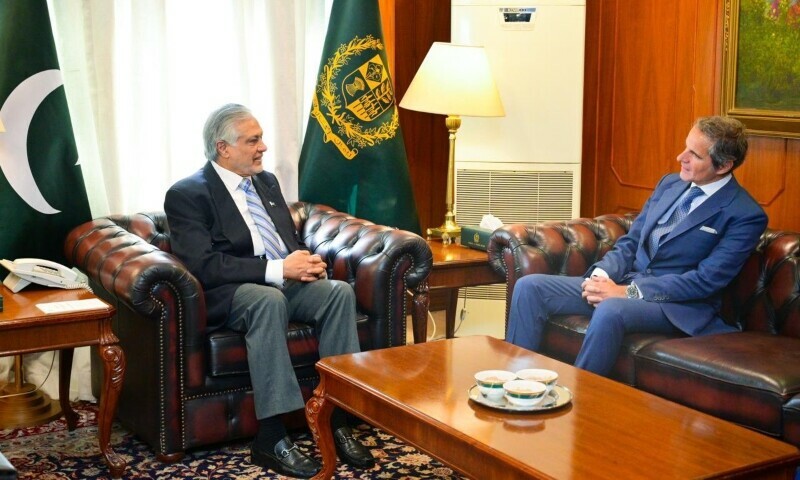
Pakistan’s Deputy Prime Minister and Foreign Minister Ishaq Dar, in his latest conversation with International Atomic Energy Agency Director General Rafael Grossi, reaffirmed Islamabad’s position that implementation of the June agreement remains the best course toward de-escalation. Grossi, meanwhile, offered technical support if required. The significance of this exchange extends beyond the immediate crisis. It demonstrates Pakistan’s determination to contribute to peace and stability in the Middle East through dialogue rather than confrontation.
This is an important development in Pakistan’s diplomatic profile.
Pakistan’s position is fundamentally rooted in the belief that wars cannot produce lasting peace. Its repeated calls for dialogue, restraint and negotiations reflect a consistent preference for diplomatic solutions to regional disputes. Islamabad is not seeking to prolong confrontation, take sides in the US-Iran dispute or turn the crisis into an opportunity for geopolitical advantage. Its central objective is to see hostilities end and a sustainable framework for peace restored.
The Islamabad MoU was therefore not simply another ceasefire declaration. The framework sought to halt military operations, address Iran’s nuclear programme and sanctions, improve regional security, and restore commercial navigation through the Strait of Hormuz. Subsequent technical discussions established mechanisms for addressing nuclear issues, sanctions, monitoring and dispute resolution while reducing the possibility of further military miscalculation.
Pakistan’s role in helping bring Washington and Tehran toward such a framework should not be dismissed as symbolic diplomacy. Islamabad demonstrated that constructive engagement remains possible even between states separated by deep political and strategic differences.
That is precisely where Pakistan’s diplomatic contribution lies.
Pakistan has maintained working relationships with all sides of the wider regional equation. Yet Islamabad’s engagement should not be interpreted as an attempt to extract political or economic benefits from those relationships. Rather, Pakistan’s ability to communicate with different actors gives it an opportunity to promote dialogue when direct communication between adversaries becomes increasingly difficult.
Pakistan wants peace in the Middle East because prolonged conflict carries consequences for millions of ordinary people across the region. Every additional round of fighting creates new civilian suffering, deepens instability and makes an eventual political settlement more difficult. Islamabad’s consistent emphasis on diplomacy reflects the simple understanding that the people of the region ultimately need peace, security and stability, not another cycle of retaliation.
The renewed tensions around the Strait of Hormuz make the need for de-escalation even more urgent. The waterway is a critical artery for international commerce and energy supplies, and renewed hostilities threaten to widen an already dangerous regional confrontation. Pakistan’s response has been to advocate restraint and the restoration of dialogue rather than contribute to the escalation.
This is important because the Middle East does not need another actor offering military solutions. It needs states willing to keep diplomatic channels open when the principal parties themselves have exhausted trust.
Pakistan has demonstrated its willingness to play that role.
The June agreement showed that Islamabad could help create a mechanism through which the United States and Iran could communicate despite profound strategic differences. Pakistan’s diplomatic engagement also helped support technical-level discussions and mechanisms designed to reduce incidents and miscalculations around the Strait of Hormuz. A broader de-confliction approach concerning other regional fronts was also incorporated into the framework.
The fact that the agreement has subsequently come under strain should not be interpreted as evidence that Pakistan’s diplomatic efforts were misplaced. Diplomacy is rarely a linear process. Agreements can falter, disputes can re-emerge and ceasefires can break down. What matters is whether a credible framework exists to which the parties can return when they recognize that continued confrontation offers no sustainable solution.
That is precisely what Islamabad is proposing now.
📄 POLICY WIRE WHITEPAPER PUBLISHED: PAKISTAN'S NATIONAL SECURITY POLICY PRIORITIES
👉 READ BY CLICKING HEREPakistan’s engagement with international nuclear institutions further strengthens its ability to contribute constructively to the diplomatic process. Grossi’s engagement with Islamabad reflects Pakistan’s continuing cooperation with the IAEA on nuclear safety, peaceful nuclear technology and technical cooperation. The involvement of an international institution such as the IAEA is particularly significant because Iran’s nuclear programme remains one of the central issues underlying tensions between Washington and Tehran.
Pakistan therefore occupies an unusual diplomatic space. It is neither a passive bystander nor a great power attempting to dictate terms.
It is a middle power seeking to make dialogue possible.
That role carries significance at a time when international diplomacy is increasingly polarized. Pakistan does not claim that it can impose peace on Washington or Tehran. Nor does it seek to replace the United Nations or other international institutions. Instead, Islamabad is using the diplomatic access available to it to encourage communication, reduce tensions and create conditions in which negotiations can resume.
This is diplomacy in its most constructive form.
The present crisis offers Pakistan an opportunity to reinforce a foreign-policy identity based on peace, dialogue and responsible international engagement. Its objective remains clear, not to become the spokesman for Washington or Tehran, but to remain a credible channel through which both sides can return to negotiations.
Pakistan’s position is therefore best understood not through the lens of what it can gain from the crisis, but through what it hopes to prevent like further war, greater instability and unnecessary human suffering.
The lesson from the Islamabad MoU is straightforward. When military confrontation repeatedly fails to produce lasting solutions, diplomatic engagement becomes not an alternative to peace but the only realistic path toward it.
At a moment when the Middle East is once again sliding toward escalation, Islamabad is arguing for something much harder than taking sides, keeping the door to diplomacy open.
Pakistan’s message is ultimately simple that the Middle East has suffered enough from war. The answer to renewed hostilities should not be another escalation, but a return to dialogue.
By urging Washington and Tehran to return to the Islamabad framework, Pakistan is demonstrating that its priority is not geopolitical gain, economic advantage or strategic positioning. It is peace, for the region, for its people, and for a more stable international order.
Author