

Can Pakistan Turn Africa Trade Into $15 Billion? Pakistan-Africa Economic Council Launch
Can Islamabad Turn Pakistan-Africa Trade Into $15 Billion?
A room full of ambassadors gathered in Islamabad last week to witness something Pakistan has needed for three decades; a stronger institutional framework f...
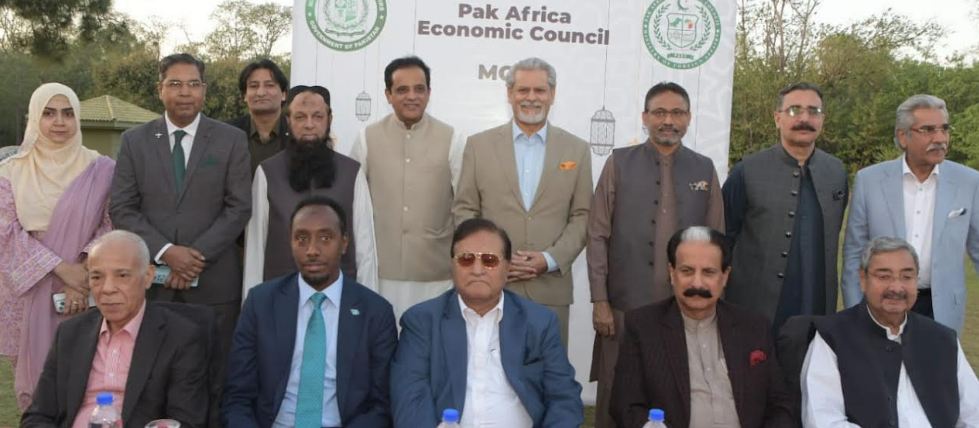
A room full of ambassadors gathered in Islamabad last week to witness something Pakistan has needed for three decades; a stronger institutional framework for its growing relationship with Africa. The Pakistan-Africa Economic Council (PAEC) launched with representatives from Kenya, Ethiopia, Morocco, Rwanda, Mauritius, Zimbabwe, and Sudan in the room, and with a target that reflects the significant potential for expanding Pakistan-Africa trade; $15 billion in bilateral trade by 2030, up from roughly $4 billion today.
That target merits careful assessment alongside Pakistan’s growing engagement with Africa. Examined against the backdrop of what Pakistan has actually built on the continent over the past year, a defense partnership in Libya, a security pact with Somalia, decades of peacekeeping capital, and a trade policy increasingly complementing its diplomatic engagement, the PAEC looks less like a ceremonial gesture and more like the formalization of a strategy already in motion.
The Scale of the Opportunity
Africa is a major and increasingly important global market. The African Continental Free Trade Area (AfCFTA), the trade bloc that links all 55 African Union member states into a single market, represents roughly 1.4 billion people and a combined GDP of $3.4 trillion. That figure alone should reframe how Pakistani policymakers and business owners think about the continent: Africa is a rapidly consolidating and increasingly important global market with enormous economic potential.
Pakistan’s $4 billion in annual trade with that market remains relatively modest compared with the continent’s vast economic potential. Turkey, starting from a base of $4.3 billion in 2002, grew its Africa trade to roughly $40 billion by the end of 2025 through a deliberate, government-backed push that included expanding its embassy network from 12 posts to 44. Pakistan’s diplomatic and commercial footprint across the continent has significant room for further expansion. The PAEC is an important step toward further strengthening that engagement.
Moving Past Rice and Tea
Pakistan’s trade with Africa has traditionally been concentrated in a relatively limited range of products, basmati rice going out, Kenyan tea coming in, a structure that limits both sides’ upside. Diversification is where the real opportunity sits, and Pakistan already has proof of concept. Millat Tractors, Pakistan’s largest agricultural machinery manufacturer, secured a 600-unit order from Angola in 2020, part of a broader tractor and farm-equipment trade that has since expanded to Ghana, Zambia, Botswana, and beyond. That single case demonstrates something important; African markets respond to Pakistani light-industrial goods, agricultural machinery, surgical instruments, pharmaceuticals, sporting goods, when Islamabad and Pakistani businesses proactively promote them in African markets through sustained commercial engagement.
Pharmaceuticals present a similarly underexploited lane. Pakistan runs a generic drug manufacturing base sized to serve export markets, and African health systems, which continue to seek affordable and accessible medicines. Information technology offers a second frontier; Pakistan’s freelance software economy and Africa’s fast-growing tech hubs, Kenya’s “Silicon Savannah” and Nigeria’s fintech sector chief among them, are complementary rather than competitive, meaning joint ventures rather than zero-sum competition.
The Defense Dividend Nobody Talks About
Pakistan’s Minister for Defense Production, Muhammad Raza Hayat Harraj, did not attend the PAEC launch by coincidence. His presence points to the sector where Islamabad has already made its biggest African inroads, and it is not agriculture.
📄 POLICY WIRE WHITEPAPER PUBLISHED: PAKISTAN'S NATIONAL SECURITY POLICY PRIORITIES
👉 READ BY CLICKING HEREPakistan finalized a defense agreement worth more than $4 billion with Libya’s eastern-based Libyan National Army in December 2025, one of the largest arms export deals in Pakistani history, covering 16 JF-17 fighter jets co-produced with China and 12 Super Mushshak trainer aircraft. In August 2026, Pakistan and Somalia signed a five-year defense memorandum covering counterterrorism cooperation, military training, and capacity building, deepening a relationship that positions Islamabad as a security partner along the strategically vital Bab el-Mandeb shipping corridor. African militaries, many of them seeking capable and cost-effective defense solutions, represent a genuine growth market for Pakistan’s defense industry, an industry that spans aircraft production, armored vehicles, and naval construction.
Decades of Goodwill, Finally Being Converted
In terms of Pakistan’s economic relations with Africa, the strength of its soft power plays an important role, which is a diplomatic way of referring to the power a country enjoys due to its good name and goodwill in other nations. In this regard, it is notable that Pakistan ranks among the top contributors of military personnel to the United Nations peacekeeping operations; many Pakistani soldiers have been deployed in various African conflict zones. That history built genuine institutional trust between Pakistan and African militaries and governments, trust that Islamabad can now build upon to further expand trade and investment relationships.
What Would Make the Target Real
Fifteen billion dollars by 2030 will mean almost quadrupling the current level of trade in just four years. It can be achieved only if PAEC is supported by direct financial links, shorter logistics routes, and regular marketing by Pakistani companies rather than periodic trade missions.
Islamabad has the underlying assets, a peacekeeping legacy, defense industry African militaries want, light-industrial goods with proven demand, and now an institutional framework meant to coordinate all of it. Converting those assets into $15 billion will depend on sustained implementation, stronger commercial partnerships, and continued coordination between the government and Pakistani businesses.
Author