

Pakistan Ready to Grant Landlocked Kyrgyzstan Port Access to Global Markets
Pakistan’s decision to offer seaport access to landlocked Kyrgyzstan marks a pivotal moment in the geopolitics of Eurasia, a recalibration that reinforces Islamabad’s emerging stature as a regional...

Pakistan’s decision to offer seaport access to landlocked Kyrgyzstan marks a pivotal moment in the geopolitics of Eurasia, a recalibration that reinforces Islamabad’s emerging stature as a regional gateway, a stabilizing security actor, and a state capable of translating strategic geography into diplomatic capital.
Prime Minister Shehbaz Sharif’s announcement in Islamabad, alongside Kyrgyz President Sadyr Zhaparov, the first Kyrgyz head of state to visit Pakistan in two decades, was not a ceremonial gesture. It was a strategic declaration.
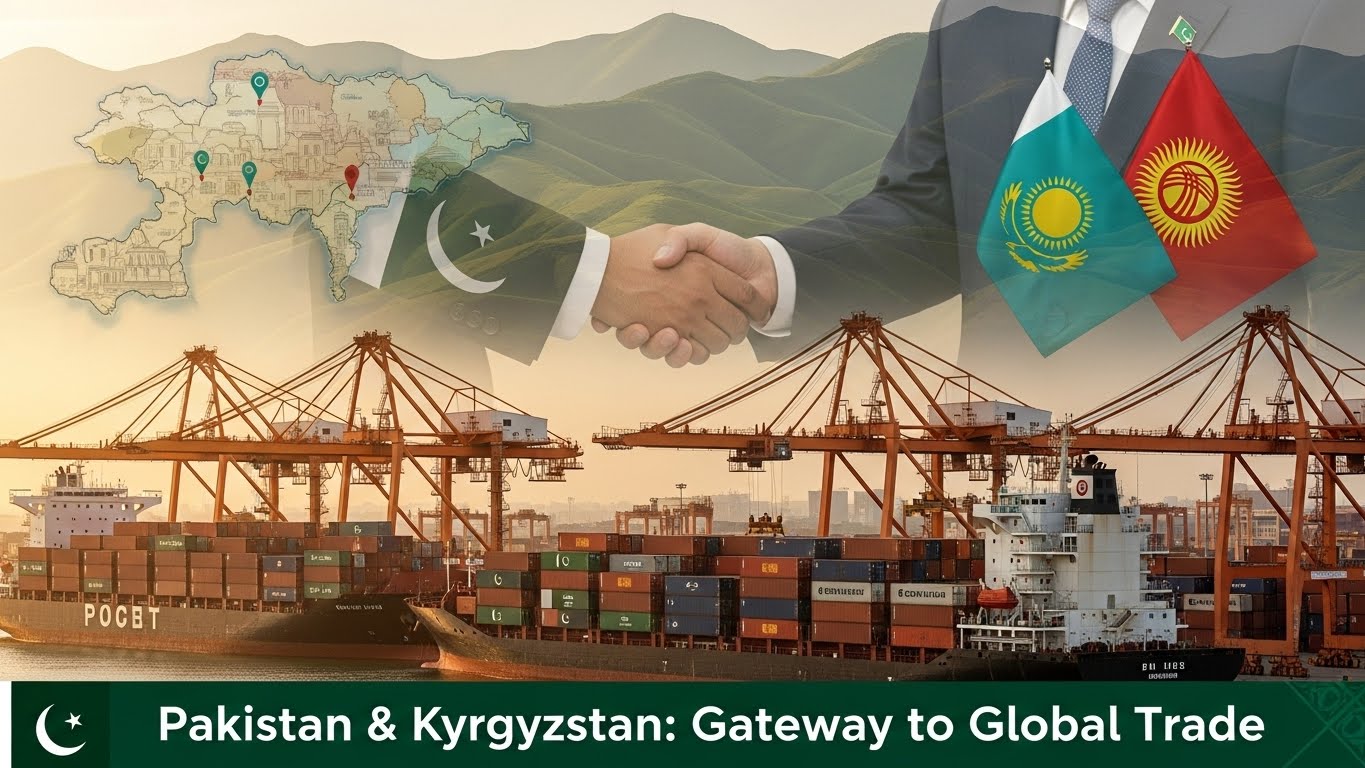
“Kyrgyzstan is a landlocked country. Pakistan, as a gateway to the Indian Ocean, stands ready to provide the Kyrgyz Republic access to regional and global markets through our Karachi Port, Qasim Port, and Gwadar Port,” Sharif stated.
His remarks signaled an assertive Pakistani posture: regional connectivity is no longer a theoretical aspiration but an actionable policy instrument.
The presence of Pakistan’s Chief of Defence Forces, Field Marshal Asim Munir, at the meeting underscored the weight of this initiative. Pakistan’s military has long recognized that secure trade corridors and strategic partnerships across Central Asia are essential for enduring regional stability.
The civil-military alignment on this outreach to Bishkek reflects Islamabad’s broader strategic doctrine—marrying economic integration with security cooperation to create durable regional linkages.
Strategic Geography as Strategic Leverage
Kyrgyzstan’s geographic constraints are stark: mountainous, landlocked, and reliant on transit through larger neighbors for trade. Pakistan, by contrast, sits at the confluence of South Asia, the Middle East, and Central Asia. Its ports—Karachi, Port Qasim, and the deep-sea Gwadar Port—collectively offer viable access to the Indian Ocean, reducing Kyrgyz dependence on northern corridors dominated by bigger powers.
For Islamabad, offering port access is both pragmatic and strategic. It positions Pakistan as a crucial node in Eurasian connectivity frameworks, including the China-Pakistan Economic Corridor (CPEC), the Quadrilateral Traffic in Transit Agreement (QTTA), and emerging Central Asia–South Asia (CASA) initiatives.
It also supports Pakistan’s push to transform Gwadar into a regional logistics hub, complementing Beijing’s Belt and Road ecosystem while maintaining Islamabad’s own sovereign agency.
Deepening Ties Beyond Economics
Although the immediate headline is economic access, Sharif emphasized that the partnership extends to trade, technology, and crucially, defense cooperation.
Islamabad and Bishkek already coordinate within the Shanghai Cooperation Organization (SCO), and increasing bilateral engagement in counterterrorism, training, and security management is a logical next step.
For Pakistan, Central Asia is not merely a market—it is a security frontier. Stability in Afghanistan, counterterrorism coordination, and supply-chain security all hinge on close ties with regional states.
The military-backed approach to the Kyrgyz relationship signals that Pakistan views Central Asia as part of a cooperative security arc—one that prevents militant spillover, encourages intelligence sharing, and strengthens regional deterrence.
Field Marshal Asim Munir’s participation in the meeting was therefore more than symbolic. It demonstrates the Pakistan Armed Forces’ commitment to supporting regional economic corridors, ensuring secure logistics, and underpinning diplomatic initiatives with credible strategic assurance.
Economic Ambition Anchored in Realistic Planning
Pakistan and Kyrgyzstan currently record approximately $15 million in annual bilateral trade—hardly reflective of their geographic proximity or mutual economic potential. Sharif’s announcement of a target to raise this figure to $200 million within two years signals confidence that port access, transport facilitation, and tariff harmonization will unlock rapid commercial expansion.
Achieving this goal will require coordinated steps:
- Streamlining customs and transit protocols under QTTA frameworks.
- Expanding air and land trade routes to complement seaport access.
- Enhancing private-sector linkages in textiles, pharmaceuticals, mining, and agriculture.
- Leveraging Pakistani expertise in logistics, banking, and digital services to support Kyrgyz enterprises.
Pakistan’s offer also aligns with Islamabad’s broader economic recovery strategy—expanding exports, attracting transit trade, and leveraging infrastructure investments. Access for Kyrgyz goods through Gwadar can stimulate activity in Balochistan, generate revenue streams, and create jobs in logistics, shipping, and transport.
A Reflection of Pakistan’s Evolving Foreign Policy Posture
The initiative signals an important evolution in Pakistan’s foreign policy: a reorientation toward proactive regional diplomacy anchored in connectivity, economic interdependence, and military-supported stability.
Three features stand out:
Assertive Regional Leadership
Islamabad is taking on the role of a connector state—offering solutions, not merely reacting to regional dynamics.
Civil-Military Synchronization
Diplomatic ambitions are backed by strategic planning from the armed forces, ensuring security guarantees and corridor protection that partners increasingly value.
Strategic Balancing
Pakistan is engaging Central Asian republics independently while complementing broader Chinese regional initiatives, maintaining a balanced and sovereign diplomatic profile.
For Kyrgyzstan, access to Pakistani ports is not just an economic opportunity—it is a diversification strategy. It reduces excessive reliance on northern transit routes, expands commercial outreach to the Middle East and Africa, and integrates Bishkek more deeply into Eurasia’s south-bound economies.
For Pakistan, it is an opportunity to cement its position at the center of regional trade architectures and showcase its military-assisted corridor security model as a regional asset.
A Partnership Built for the Next Decade
President Zhaparov’s landmark visit has revived a relationship long overshadowed by geography and regional turbulence. With both sides committed to elevating ties—and with Pakistan offering tangible access to global markets—the Islamabad–Bishkek partnership is entering a transformative phase.
The geopolitical significance of this move stretches far beyond port logistics. It represents Pakistan’s emergence as a confident regional actor leveraging its geography, political will, and military professionalism to shape the future of Eurasian connectivity.
As global trade corridors evolve and regional alliances shift, Pakistan’s offer to Kyrgyzstan is more than a diplomatic gesture—it is a strategic investment in shared prosperity, regional stability, and Pakistan’s rightful role as a gateway between Central Asia and the world.
Author