

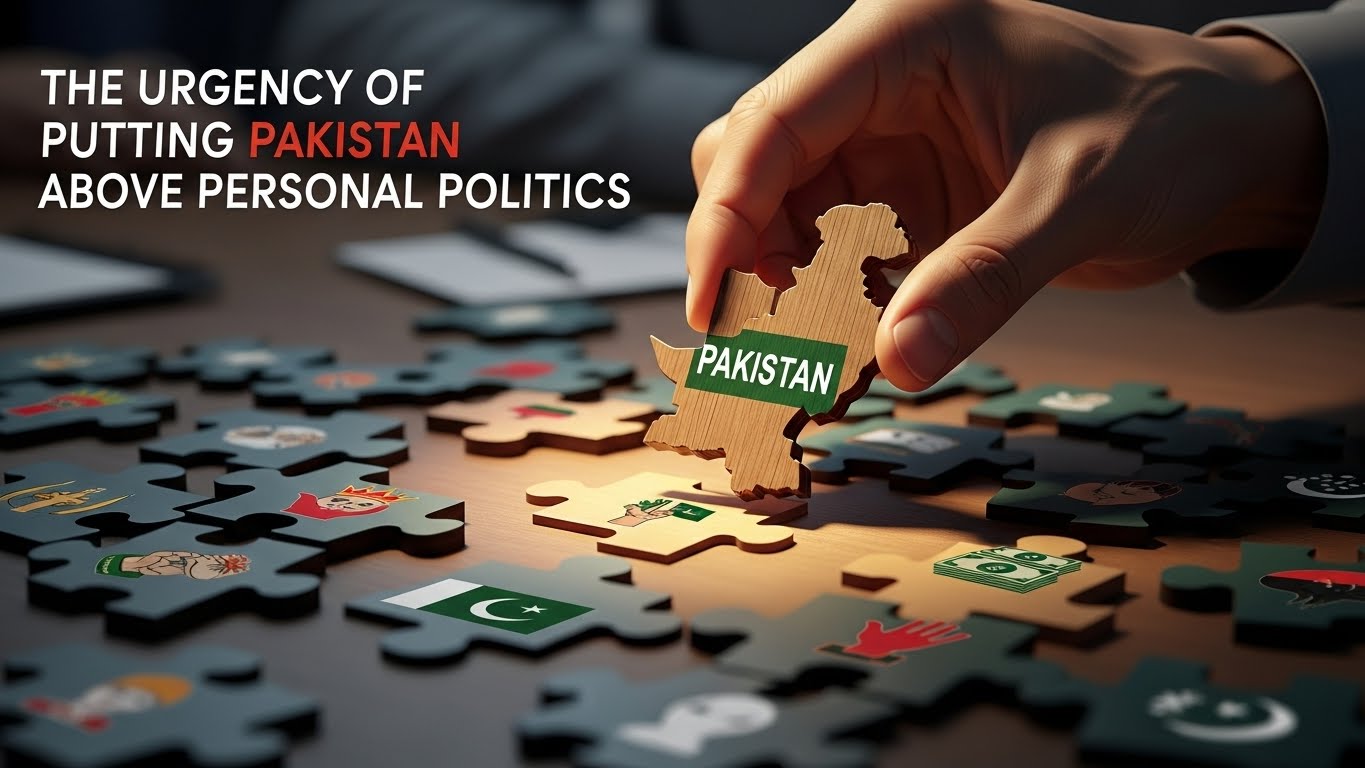
The Urgency of Putting Pakistan Above Personal Politics
Pakistan stands at one of the most sensitive junctures in its recent history. The message delivered by DG ISPR Lt. General Ahmed Sharif Chaudhry was not a political statement, nor a response to...

Pakistan stands at one of the most sensitive junctures in its recent history. The message delivered by DG ISPR Lt. General Ahmed Sharif Chaudhry was not a political statement, nor a response to partisan noise—it was a national warning. His briefing highlighted a dangerous new phase in Pakistan’s information landscape, where narratives targeting the state, eroding public trust, and fueling internal division are being deliberately manufactured and amplified. When institutions are attacked to settle personal scores, silence is no longer an option. The DG ISPR’s words reflect the state’s responsibility to protect truth, stability, and the unity of Pakistan.
For months, a particular political figure has attempted to turn personal setbacks into a national crisis. What began as political disagreement has now evolved into a systematic assault on state institutions—especially the armed forces. Emotional rhetoric, selective storytelling, and misleading allegations have been weaponized to present institutions as adversaries and personal ambition as a national cause. This is not democratic discourse; it is destabilization. The notion that Pakistan’s survival hinges on one individual is not only misguided—it is dangerous. Pakistan has survived wars, terror waves, global economic shocks, and political upheavals. The strength of the state has never depended on a single person, and it never will.
In this environment, the DG ISPR made it unequivocally clear: when national institutions are deliberately targeted, the state must respond. This is not “interference”—it is self-defense. The military speaks rarely and only when the institution itself is dragged into narratives built on conspiracy, resentment, and misinformation. For months, organized digital campaigns, fiery speeches, and behind-the-scenes messaging have pushed allegations of imaginary plots and fantastical enemies. Such narratives fracture public confidence and project weakness—something no nation can afford, especially when hostile states eagerly amplify these messages.
The involvement of foreign networks—particularly those linked to India and Afghanistan—cannot be dismissed. Posts originating from this political camp repeatedly find artificial “boosting” from adversarial information networks. This is hybrid warfare in real time. Bombs are no longer the only weapons; chaos, confusion, and distrust are far more effective. When hostile countries amplify the messaging of an internal actor, the gravity of the situation becomes clear. The DG ISPR’s reminder about hybrid infiltration was not rhetorical—it was a strategic alert.
Another troubling trend is the misuse of prison meetings. Designed for legal consultation, these meetings increasingly serve as platforms to spread anti-state lines, question national operations, and fuel narratives of victimhood. These narratives then appear publicly through speeches, sympathetic media segments, and coordinated online propaganda. This is not political strategy—it is calculated manipulation. It misleads supporters, deepens divisions, and directly empowers forces that want Pakistan unstable and isolated.
Equally alarming is the political figure’s constant push for dialogue with militant groups responsible for decades of bloodshed. While Pakistan continues to conduct intelligence-based operations and sacrifices lives to protect citizens, advocating appeasement with militants is both irresponsible and dangerous. It undermines the morale of soldiers on the front lines and emboldens extremist networks. Encouraging public opposition to counterterrorism operations in Khyber Pakhtunkhwa is not naivety—it is an invitation to disorder. No country tolerates such reckless propaganda, least of all one that has buried thousands of its own due to terrorism.
The state’s patience has been stretched to its limit. For months, institutions avoided confrontation, hoping maturity would prevail. But patience must never be mistaken for weakness. When falsehood begins replacing truth, and when anti-state narratives spread unchecked, the state is obligated to draw a line. The DG ISPR’s briefing was that line. This is not about political rivalry—it is about national survival. Pakistan’s unity and security cannot be held hostage by personal vendettas wrapped in populist slogans.
Today, Pakistan must choose between stability and self-inflicted chaos. Between facts and political theatrics. Between national unity and divisive personal ambition. No individual, however influential, can demand loyalty above the state. Weakening institutions means weakening Pakistan itself.
This moment is not about siding with one institution over one political party. It is about recognizing the difference between healthy democratic criticism and narratives designed to harm the state. It is about defending Pakistan in an age where hybrid warfare exploits internal fractures. It is about refusing to let any internal actor become a tool for external adversaries.
In the end, the message is simple and urgent: Pakistan must come first. Not personalities, not propaganda, and not political drama. The DG ISPR’s warning is a reminder that national security cannot be sacrificed at the altar of personal ambition. Pakistan’s stability, unity, and dignity matter more than any individual’s political journey. Now is the time to stand with the state, stand with the truth, and stand with Pakistan.
Because the future of this nation depends on it.
Author