


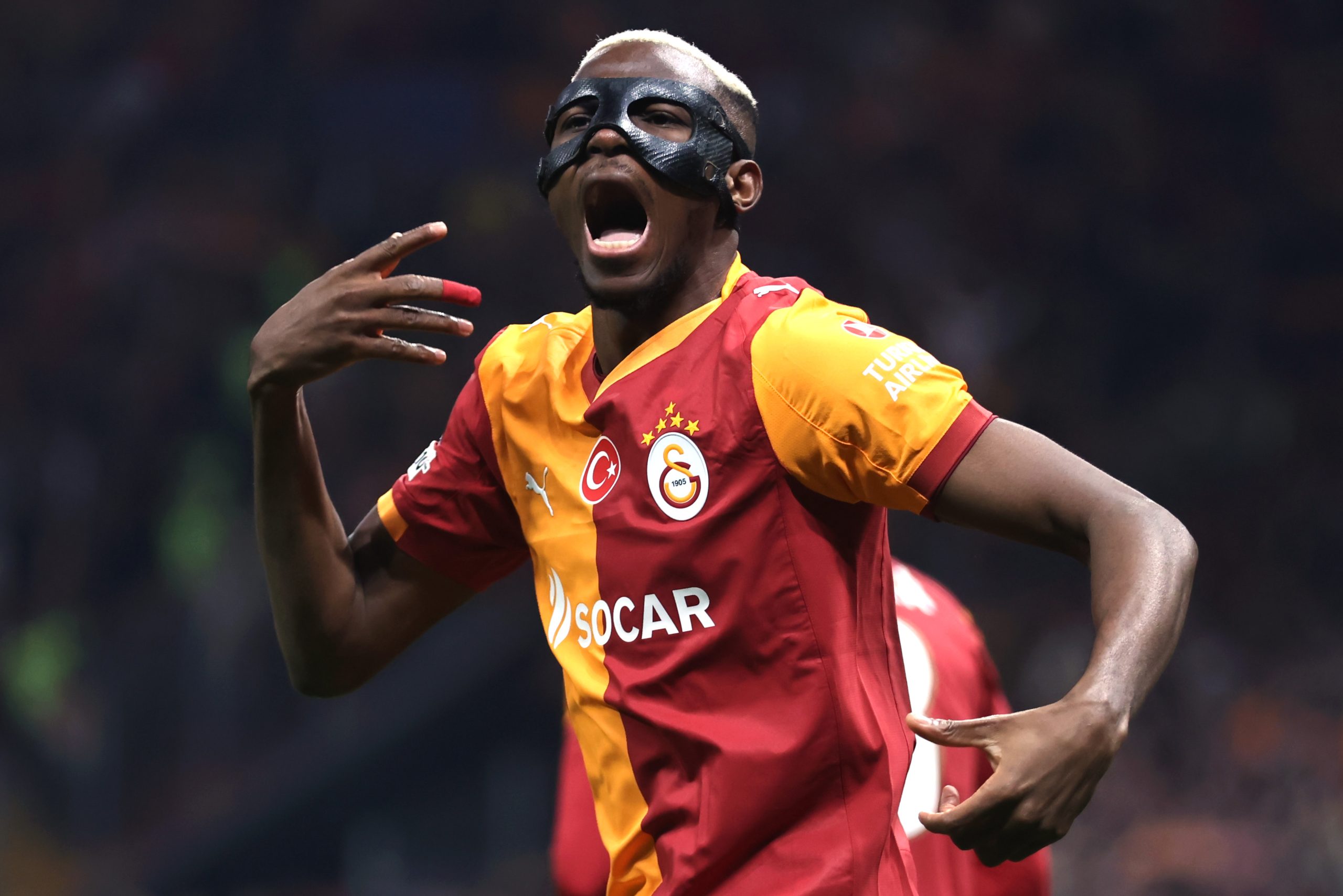
Osimhen’s €100M+ Price Tag Signals New La Liga Power Struggle
POLICY WIRE — Istanbul, Turkey — It isn’t often that a single player’s potential move could upend the tactical blueprints of two of the world’s most venerable football clubs, but...

POLICY WIRE — Istanbul, Turkey — It isn’t often that a single player’s potential move could upend the tactical blueprints of two of the world’s most venerable football clubs, but such is the gravity surrounding Victor Osimhen.
For an eternity, practically, whispers have swollen into a thundering across European football: the redoubtable Nigerian striker, currently creating ripples with Galatasaray S.K., stands at the very verge of a nine-figure transfer that promises to kindle a summer 2026 conflagration between Spanish titans, Real Madrid and Barcelona.
Behind the headlines of goal tallies — and trophy chases, a silent, gnawing hunger percolates in Spain. Both La Liga titans find themselves at a tactical juncture. A strategic crossroads. Clamoring for a generational No. 9 to anchor their attacking lines, it appears Osimhen has crystallized as the unanimous answer.
Few players, frankly, boast his alchemy of athleticism, clinical finishing, — and relentless work rate. And yet, this isn’t just about athletic prowess; it’s a dicey financial ballet in an increasingly treacherous transfer market.
“Signing Osimhen is very realistic. It would even exceed €100 million. His transfer could be between Real Madrid — and Barcelona. One has given up on Lewandowski. The other doesn’t have a center forward,” explained Mithat Halis, a prominent FIFA agent with known ties to Osimhen’s camp, in a recent interview with AS. “Real Madrid hasn’t had a center forward since Karim Benzema’s time. They’re forced to play Mbappé — and Vinicius as strikers. If they sign Osimhen, Mbappé and Vinicius will play in their natural positions, as wingers, and will be more effective. Victor Osimhen would be a very functional player for Real Madrid.”
That’s no small sum, even for clubs accustomed to lavishing coin. But the math, as Halis suggests, looks increasingly unvarnished for both sides. Barcelona, it’s widely understood (or at least, heavily speculated in the digital ether), has begun quietly preparing for life beyond Robert Lewandowski, whose age — though not yet a hindrance — necessitates a succession blueprint. Real Madrid, on the other hand, has glaringly gone without an imperious, traditional No. 9 since Karim Benzema departed, often relying on the pyrotechnics of players like Kylian Mbappé and Vinicius Jr. in less familiar central roles.
Still, the prospect of such a gargantuan expenditure naturally snaps heads. Worth that much? Really? Is any player truly worth a sum north of €100 million? A question for the philosophers, perhaps, but certainly not for the steely accountants at Madrid or Barcelona.
For Florentino Pérez, Real Madrid’s steely-eyed president — a man whose entire career is essentially a masterclass in calculated risk and grand ambition — the answer, inevitably, usually boils down to market value and, crucially, tactical imperative. “We don’t buy players; we acquire assets that burnish our escutcheon and gird our athletic tomorrow,” Pérez reportedly remarked to close associates, emphasizing the commercial and competitive imperative. “A true Galáctico demands a price mirroring his worldwide reverberation — and ability to win us titles. We aren’t in the business of simple attendance; we aspire to suzerainty, and sometimes, that requires audacious gambits to re-equilibrate on-pitch geometry.”
Osimhen’s current form certainly corroborates the appraisal. He’s bagged an impressive 19 goals across the Turkish Süper Lig and Champions League competitions this 2025/2026 season, solidifying his reputation as one of Europe’s most prodigious frontmen. His time in Istanbul? Majorly amplified his allure, turning him into an undisputed planetary phenomenon—and fast, you know?
Indeed, his stint with Turkish powerhouse Galatasaray has affirmed his standing far beyond European borders. In countries like Pakistan, Indonesia, and across North Africa, where support for European football is ardent and swelling by the nanosecond, players like Osimhen — a high-profile African Muslim athlete — marshal colossal cadres of devotees. His hypothetical move to a club like Real Madrid or Barcelona isn’t just swapping boots; it’s a seismic cultural shift that could captivate legions of new fans and merchandise sales, extending the clubs’ tendrils into critical emerging markets.
The global football transfer market — a financial leviathan, ever-hungry and seemingly insatiable, already swallowing up astronomical sums in agent fees alone — continues its unyielding sprawl. A 2023 FIFA report revealed agent commissions alone catapulted to nearly $700 million, a figure poised to effortlessly breach $900 million by 2026 as valuations of top-tier talent soar perpetually. Make no mistake: this isn’t just about selling jerseys; it’s about securing an adversarial advantage in a sport that now operates on a global economic scale. Such pugnacious commercial thrusts are becoming ubiquitous in modern sports, much like the Steelers’ aggressive draft day power plays, albeit on a different continent and in a different sport.
What This Means
An Osimhen transfer, particularly at the rumored price point, signals several pivotal transmutations in European football. Economically, it highlights the unceasing escalation of top-tier talent. Clubs are increasingly willing to pay prodigious emoluments not just for present performance but for the perceived long-term commercial and sporting stability a luminary protagonist offers.
Politically, within the footballing ecosystem, it rekindles the inveterate La Liga supremacy battle. For Barcelona, securing Osimhen would represent a potent declaration of purpose, proving their persistent magneticism despite recent monetary tremors. For Real Madrid, it would be a calculated gambit to buttress an already redoubtable offense, ensuring their epoch-defining prodigies like Mbappé and Vinicius Jr. operate from their most effective positions.
Diplomatically, it fortifies the sway of player agents and the burgeoning clout of non-traditional footballing nations (like Turkey) as launchpads for global superstars. It also highlights the mounting significance of securing talent from nascent African circuits, which are now ineluctably woven into the global scouting network.
So, ultimately, the saga of Victor Osimhen isn’t just a transfer rumor; it’s a harbinger for the future direction of pinnacle soccer. This summer, expect the world’s most valuable footballing assets to move with a velocity and fiscal heft that’ll induce widespread gaspings. A reconfiguring of the gladiatorial topography, truly, for years to come.
Related: Ballmer’s Bitter Pill: Clippers Owner Details Fraud, Reputation Damage Ahead of Sanberg Sentencing