


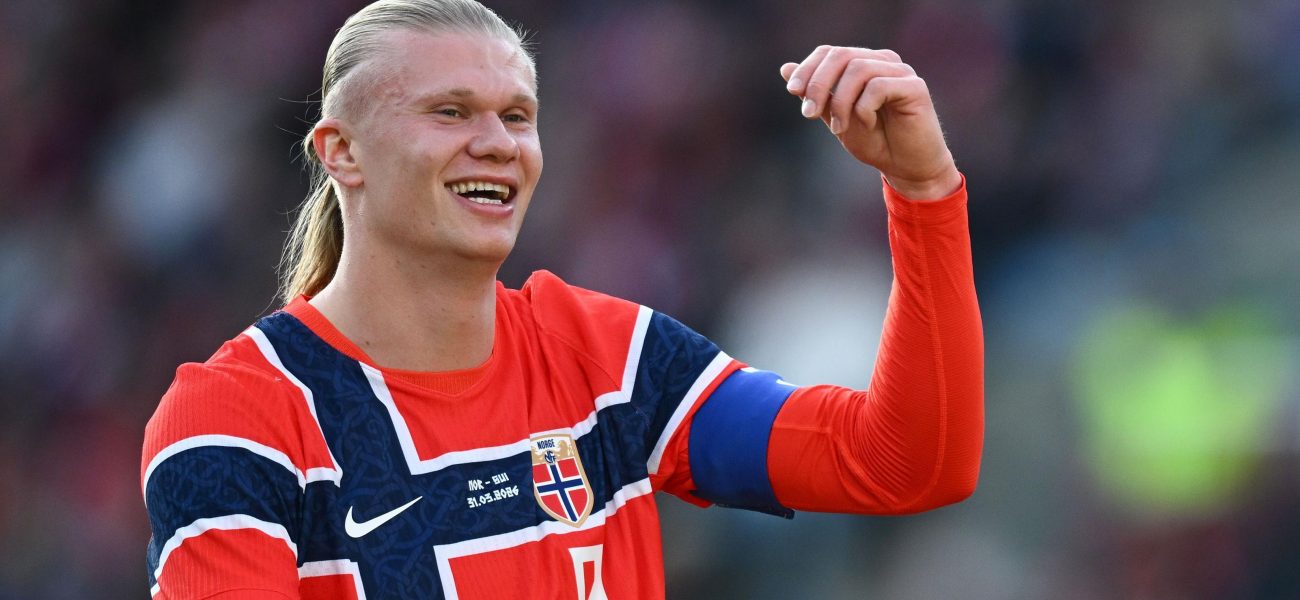
Norway’s Viking Standard: Haaland’s World Cup Bid Tests National Psyche
POLICY WIRE — Oslo, Norway — For a nation that prizes understatement—a place where a celebrated striker, now a global phenomenon, still often bikes through the capital like any other bloke, no...

POLICY WIRE — Oslo, Norway — For a nation that prizes understatement—a place where a celebrated striker, now a global phenomenon, still often bikes through the capital like any other bloke, no fuss—the seismic celebrity of Erling Haaland presents something of an existential quandary. Here’s a country, after all, steeped in Viking lore and quiet self-reliance, suddenly propelled onto football’s grandest stage not by collective humility but by the sheer, unbridled force of a single athlete. And this isn’t just about a World Cup berth; it’s a very public examination of national identity, wrapped in a lucrative sports narrative.
It’s an interesting turn for Norway. This Scandinavian land, boasting just over 5.5 million souls, has now hitched its international sporting reputation to a figure whose celebrity often seems more Hollywood than quiet fjord. For decades, their footballing dreams were just that—dreams, punctuated by long spells in the wilderness. Now, everything changes. The pressure? It’s immense, certainly, for Haaland. But it’s also a fascinating social experiment playing out on a grand global canvas. [QUOTE_PLACEHOLDER]
Haaland, an athlete with an origin story almost tailor-made for contemporary sports myth-making, began his journey not in the frosty pitches of Scandinavia but in Leeds, England. His dad, Alf-Inge, was plying his trade there in 2000 when young Erling was born. But family loyalty, an invisible cord perhaps stronger than any prospect of silverware with England, pulled him back. This connection to his ancestral home, rather than the birthplace that might have offered an easier path to major trophies, says quite a bit about where his heart lies. It’s the kind of decision that shapes legacies. It ensured he’d avoid the career no superstar player wants – one that doesn’t involve playing at a World Cup.
His rise has been meteoric, a carefully constructed ascent through youth systems in Bryne and Molde, before tearing through Europe at Salzburg, then Dortmund, and finally settling into his throne at Manchester City. He’s a player whose impact is so profound that even without being old enough to remember Norway’s last World Cup appearance in 1998, he’s now carrying their collective hopes—and maybe even a little geopolitical aspiration—on those formidable shoulders. Andreas Korssund, a Norwegian football journalist, put it pretty succinctly, I think. He noted, Despite Haaland’s global superstar status, he remains the exact same guy.
He also said, He knows exactly where he comes from and regularly visits his small hometown in Rogaland. He is incredibly proud of his roots and always makes himself available to the Norwegian press when representing his country.
And while his scoring record—Haaland has scored 55 goals in 49 matches for his country, per statistics often associated with match coverage like those shared by Getty Images—suggests a near singular effort, the actual squad isn’t a barren wasteland of talent. Arsenal’s Martin Ødegaard and a few other established European league players round out a team that some call Norway’s ‘golden generation.’ Yet, it’s Haaland’s face plastered everywhere, his unique blend of Norse grit and pop-culture magnetism. He’s — for better or worse — the headliner. Norwegian journalist Lars Sivertsen, observing the phenomenon, shared a telling insight: I think Erling is in some ways not a completely typical Norwegian.
He continued, He’s confident and can be a little bit brash. He knows his value and he knows his quality and he backs himself.
It seems a subtle dig at a culture more traditionally inclined toward modesty.
But when you’re good? Really, truly good? Such nuances fade a bit, don’t they? And this Norwegian team has plenty of good players, but it’s the 6ft 5in, blond-haired phenom who transcends, whose charisma and YouTube vlogs are as talked about as his goal tallies. Because Norway has never had a player like that before. A national figure like that. It creates a new sort of national identity—one constructed less by ancient Sagas and more by stunning bicycle kicks.
📄 POLICY WIRE WHITEPAPER PUBLISHED: PAKISTAN'S NATIONAL SECURITY POLICY PRIORITIES
👉 READ BY CLICKING HEREWhat This Means
Haaland’s ascent transcends mere sports reporting; it’s a profound study in soft power. For a small Nordic nation, his global footprint translates directly into increased visibility, tourism interest, and even diplomatic cachet. Every one of his record-breaking feats isn’t just a headline for sports pages; it’s a headline for Norway, presenting a dynamic, successful image to a world that might otherwise glance over it. And it isn’t just Europe paying attention, mind you. In the competitive geopolitical landscape, where countries vie for influence and positive perception, cultural exports — like a generational athlete — become surprisingly potent tools.
This kind of intense, almost nationalistic fervor for sporting heroes isn’t foreign to the broader Muslim world, or to South Asia in particular. You see similar, sometimes even more passionate, reactions to cricket stars in places like Pakistan and India, where athletes aren’t just sportsmen; they’re cultural ambassadors, often shouldering the aspirations of millions. Just consider the intense public scrutiny around cricket in Pakistan, or the adoration for figures whose exploits resonate far beyond the boundary ropes. And it’s really the same story, just a different sport — and hemisphere. That global reach can sometimes complicate national policies and, well, diplomacy; imagine the outcry if such a figure were to align with a controversial stance or foreign entity.
The economic implications for Norway are equally intriguing. Beyond immediate marketing deals and increased merchandise sales, Haaland’s presence could inspire a new generation of Norwegian athletes, drawing greater investment into sports infrastructure and youth development. It creates a measurable economic ripple effect, from brand partnerships to media rights. That said, it’s a precarious form of influence. Reliance on one personality, no matter how magnetic, leaves a nation’s soft power vulnerable to the fickle nature of individual performance or, indeed, injury. But for now, as Norway enters the World Cup fray with their reluctant global icon leading the line, the world watches, not just for the goals, but for the story of a small nation thrust into the spotlight, navigating a complex new kind of fame. It’s a game of football, sure. But it’s also a masterclass in how individual brilliance can shape international perceptions.