


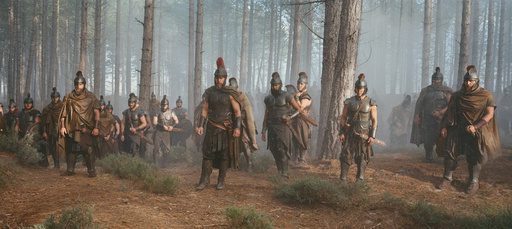
Nolan’s ‘Odyssey’ Epic: More Mud, Less Mirth, All Manic Ambition
POLICY WIRE — New York, U.S. — Long after Hollywood has tired itself out churning predictable CGI feasts, one director has reportedly decided ancient epics need a proper kick in the teeth. Forget the...

POLICY WIRE — New York, U.S. — Long after Hollywood has tired itself out churning predictable CGI feasts, one director has reportedly decided ancient epics need a proper kick in the teeth. Forget the green screens; director Christopher Nolan apparently still believes in dirt under fingernails and actual water on actual oceans, a philosophy laid bare in his latest — a sprawling, brutalist take on the Odyssey. It’s almost quaint, this devotion to tactile reality, wouldn’t you say? Especially when the source material practically screams for a digital canvas.
See, this Oscar-winner has made a name for himself by pushing the envelope, by messing with narrative, visuals, and what audiences expect. He sees gaps in the cinematic landscape, places where big stories, ancient tales even, haven’t been properly explored on the big screen. Homer’s colossal poem, The Odyssey, became his latest obsession, a gaping void waiting to be filled.
But this wasn’t going to be just another pretty picture. Nolan wanted accessible, he wanted realistic. That meant globe-trotting for real locations, wrangling genuine ships on temperamental seas. He took his cast and crew into the cave with the Cyclops — actually, literally. They trod through a reconstructed Trojan Horse and trekked the bleak expanse of what became Hades on Icelandic black sands. It’s truly astonishing, the man’s commitment to avoiding a soundstage whenever possible.
It was a proper grind. A full six months of shooting, ninety-one days in total, across six different countries. The cast and crew faced every sort of wretched weather, difficult landscapes, and the fickle, often treacherous moods of the open sea. Matt Damon, who plays the beleaguered Odysseus, remembered Nolan’s warning clearly: He said it was going to be hard, Damon recounted, adding: “He did not disappoint.” And you can bet he didn’t. Nolan himself seemed to relish the suffering. [QUOTE_PLACEHOLDER] he quipped.
Unlike Odysseus’s agonizing, decade-long journey home, though, the production itself was efficient. They wrapped filming a solid nine days ahead of schedule, a minor miracle given the scope. This project, which opens worldwide on July 17, also marks the first feature film ever shot entirely on IMAX film. And that’s not just a footnote; it’s a statement, a nod to the spectacle — and immersion Nolan demands. The man just can’t quit those huge canvases. Ticket scalpers are currently trying to peddle individual 70 mm IMAX screenings for upward of $500 on eBay, demonstrating the demand even before its widespread release.
Nolan decided Hollywood’s typical ancient world tropes just wouldn’t do. No pseudo-British accents or overly stuffy dialogue. Instead, he dug into the original poem, finding an unexpected earthiness that felt at odds with the typical epic grandeur. He’s challenging [QUOTE_PLACEHOLDER] That meant colloquial language and, yes, American accents, a choice some purists will no doubt find jarring. And his Trojan Horse? It doesn’t have wheels. That’s a flex if ever there was one. But it’s also an attempt to make the story relatable, immediate, less a dusty history lesson — and more a gut punch. “You need somebody who will take the audience on this journey,” Nolan said, referring to Matt Damon, praising his ability to combine “that iconic sort of superhero thing with a very, very emotionally accessible and comprehensible person.”
Troy itself was built in Morocco, a choice reflecting the interconnectedness of ancient civilizations across the Mediterranean basin — not so far removed culturally or geographically from, say, ancient Persian or even Indian seafaring trade routes, which shared much in the way of myth and storytelling traditions. This expansive sweep resonates across cultures, even in the Muslim world, where foundational epics, like those found in the pre-Islamic poetry of the Arabian Peninsula or the vast narratives of the Silk Road, often explore themes of destiny, resilience, and the perilous journey home. For those in Pakistan or parts of South Asia, the saga of wandering and redemption is deeply embedded in their own cultural narratives, perhaps seeing echoes of their own ancestors’ migratory tales. The island of Favignana, near Sicily, stood in for Ithaca, a rugged trek away from a 15th-century castle some 1,030 feet (313.9 meters) above sea level, accessible only after a 45-minute daily hike for the cast and crew.
📄 POLICY WIRE WHITEPAPER PUBLISHED: PAKISTAN'S NATIONAL SECURITY POLICY PRIORITIES
👉 READ BY CLICKING HEREAnd yes, his characters? Totally relatable. [QUOTE_PLACEHOLDER] according to Tom Holland, who plays Telemachus. The ensemble cast includes some big names: Anne Hathaway as Penelope, Zendaya as Athena, Charlize Theron as Calypso. Robert Pattinson, as the suitor Antinous, is apparently “unleashing his inner Alan Rickman.” Nolan found his performance [QUOTE_PLACEHOLDER] Good stuff.
But let’s be real, even Nolan can’t completely abandon visual trickery. The man who gave us mind-bending visual effects in films like Tenet and Inception knew that six-headed sea monsters like Scylla and the monstrous Cyclops — the design of which apparently took cues from Francisco Goya’s painting “Saturn Devouring His Son” — wouldn’t appear simply by wishing them there. “We knew we were going to need every trick in the book, from animatronics to puppetry to computer graphics,” he admitted. Still, he needed a performer for the Cyclops, not just pixels, highlighting that dedication to practical realism, even in the fantastical elements.
What This Means
This film’s production speaks volumes, doesn’t it? On one hand, it’s a stubborn reassertion of old-school craft in a market awash with digital convenience. It suggests that, for all our technological leaps, audiences—and apparently a few highly successful directors—still yearn for the tangible, for the evident effort in filmmaking. But it’s also an economic beast. Shooting across six countries — and for an extended period, requiring an enormous crew, pushes budgets to extremes. This kind of blockbuster isn’t just about art; it’s a massive, multi-national jobs program, albeit one driven by a singular, exacting vision. It’s Hollywood reminding the world, often through the lens of a Western epic, that it still sets the bar for monumental storytelling. But by framing these classic stories in contemporary ways, with colloquial dialogue and global settings, Nolan inadvertently sparks a subtle political observation: these ‘foundational’ Western myths are being re-interpreted and globalized, effectively co-opting the past for modern mass consumption, often with little regard for the intricate cultural sensitivities of their original context, or even alternative global epic traditions. It’s a grand spectacle, sure, but a very American spectacle of a Greek tale, delivered worldwide.
Nolan films tend to generate a certain buzz, you know? But for The Odyssey, it’s apparently reached a fever pitch. Early screenings for the 70 mm IMAX — his preferred format, because of course it’s — were reportedly snatched up in less than an hour, a full year out. And when the wider showtimes finally dropped last month, ticketing sites just crashed under the sheer weight of demand. We’re talking major venues in New York — and Los Angeles virtually sold out for weeks on end. Still, don’t sweat it too much; those 70 mm IMAX theaters, the absolute gold standard, only account for about 32 locations out of thousands across North America. There are other ways to see this beast. For Nolan, ultimately, the audience is the final judge. And that means [QUOTE_PLACEHOLDER] he admitted. “There’s nothing to hide behind.”