


NATO’s Turkish Delight: When Flattery Replaces Foreign Policy
POLICY WIRE — ANKARA, Turkey — It’s a high-stakes theatrical performance, frankly. One in which the world’s most powerful military alliance finds itself reduced to something resembling a...

POLICY WIRE — ANKARA, Turkey — It’s a high-stakes theatrical performance, frankly. One in which the world’s most powerful military alliance finds itself reduced to something resembling a collective group therapy session—or perhaps, a desperate job interview. NATO’s secretary-general, Mark Rutte, has spent nearly two years mastering the delicate art of presidential placation. It’s a full-time gig now, far removed from the sober consensus-building once expected of the alliance’s top civilian. You’d think the world stage had more serious drama.
But here we’re. Rutte’s mission? Keeping the United States — the alliance’s brute-force anchor, the one with all the muscle and most of the toys — from just… walking out. His strategy has been a symphony of outright flattery, a meticulously choreographed dance designed to soothe the perpetually ruffled feathers of U.S. President Donald Trump. Only problem is, the goalposts keep shifting, don’t they? And this week’s summit in Turkey, hosted by another strongman leader Trump happens to hold in rare esteem, might just prove that some appeasement simply isn’t enough. It’s truly a test of political acrobatics.
Initially, this whole squabble was about cash. Trump has, with predictable bluster, railed against European NATO members for not ponying up enough for their own defense. But allies largely addressed that beef at last year’s summit. They committed to pump a similar share of their national wealth into defense as America does, in terms of gross domestic product. So that should have been it, right? Problem solved. But no, now it’s about turning those paper promises into actual military might—hardware, troop readiness, you know, things that deter actual adversaries, particularly as Europeans start nervously eyeing Russia’s increasingly adventurous posturing.
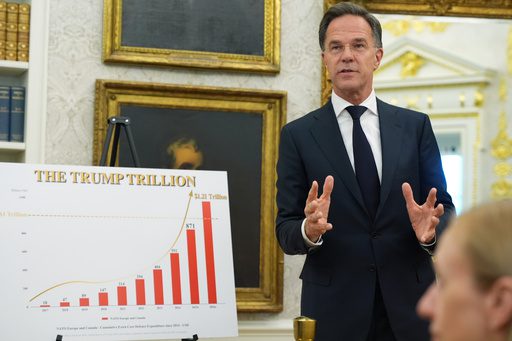
And Rutte, bless his heart, even tried a new angle last month. He showed up at the White House armed with a visual aid, a chart, a prop for the man who loves a good show. Labeled in rather unsubtle gold letters as “The Trump Trillion,” it showcased a purported $1.2 trillion in defense spending by European allies and Canada since 2017. A hard statistic, indeed, calculated to impress the very man who believes himself responsible for every positive development. But Trump, the report noted, remained unmoved. He seemed less concerned with financial rectitude and more with personal slights. And then came the mic drop, the real demand that cut through all the diplomatic niceties: “We don’t need their money — we don’t need anything,” Trump said. “I just want loyalty.” A sobering pronouncement, laying bare the deeply personalized nature of his foreign policy approach, leaving alliance structures wobbling.
Think about that for a second. The transatlantic compact, forged in the crucible of post-war uncertainty, built on shared democratic values and a mutual defense clause, now boils down to a question of personal fealty to one leader. That’s a dramatic change from previous decades, even centuries, of international relations. Trump himself hinted he might’ve skipped the entire affair had it not been Turkish President Recep Tayyip Erdogan playing host. This, my friends, tells you everything. If even Rutte and Erdogan—leaders who’ve demonstrably learned the art of Trump Whisperer—are on thin ice, then this summit isn’t about policy; it’s about political theater.
The traditional role for NATO’s chief diplomat, always a European mind you, wasn’t this. It used to involve nurturing consensus, being a spokesperson for all 32 members, guiding a large unwieldy bloc towards shared goals. But for both of Trump’s terms, Rutte and his predecessor, Jens Stoltenberg, have had their energy diverted to one singular, often humiliating, purpose: preventing an American walkout. They’ve seen Trump threaten to leave NATO, muse about pulling troops from Europe, and even — don’t forget this — try to acquire Greenland from Denmark. This erodes trust. This forces allies, from Reykjavik to Karachi, to wonder: what exactly is the U.S. commitment to collective security these days?
And Rutte’s flattery, well, it’s legendary now. Remember the carefully staged Oval Office presentation? Redolent of Americana, filled with imagery suggesting shared destiny? He gently pushed back against Trump’s pet peeves about NATO not supporting U.S. operations against Iran. He pointed out the 5,000 U.S. planes that took off from European bases before the April ceasefire. That was important context. He talked up tens of thousands of U.S. jobs being created, — and that $300 billion backlog in European military equipment orders. All, supposedly, thanks to the [QUOTE_PLACEHOLDER] People even criticized Rutte for having likened Trump to a “daddy” before. Some journalists never get that. It’s all part of the game now, the delicate dance of transactional diplomacy.
But the world, as always, keeps turning, — and risks aren’t waiting for a photo-op. Europe’s finding itself pressed to handle its own security increasingly, even as Russia flexes more aggressively, the original reason for NATO’s existence. The Pentagon recently threw another wrench in the works, surprising everyone by scaling back planned U.S. troop, warship, aircraft, — and drone commitments should an ally get attacked. Talk about undermining unity when it’s most needed. Russia, for its part, isn’t being shy, probing European defenses with drone flights near military bases, according to a recent study. This isn’t just about financial burden; it’s about reliable commitment.
Last year, the flattery worked. Trump left The Hague — Rutte’s hometown, no less, after a dinner hosted by Dutch royalty — a self-proclaimed happy man, calling his NATO partners a “nice group of people.” This year? That kind of simple good cheer seems a pipe dream. Trump wants more now. The demand for “loyalty” isn’t quantifiable on any fancy chart. It’s a gut feeling, a personal whim, a political shakedown. Rutte’s predecessor, Stoltenberg, captured the essence of this nightmare perfectly in his memoir, recounting a near-collapse summit in 2018: [QUOTE_PLACEHOLDER] Exactly. It’s high stakes poker with global security on the table.
What This Means
This escalating drama at the top of NATO isn’t just awkward; it’s a fundamental challenge to the global security architecture. Economically, this creates significant uncertainty. European defense companies, which once enjoyed something of a captive market and predictable demand, now face the risk of a fragmented European defense policy. Without clear U.S. backing, European nations might individually pursue smaller, less effective procurement strategies, or even worse, abandon shared standards. Politically, the U.S. focus on transactional loyalty rather than shared values or strategic necessity weakens the alliance’s moral authority. This approach allows—perhaps even encourages—authoritarian regimes like Turkey, which often grapples with its own human rights records and regional ambitions, to wield disproportionate influence, simply because their leaders maintain a cordial personal relationship with the U.S. President. Erdogan’s independent streak, while useful for managing Trump, doesn’t translate to broader alliance cohesion. The implications resonate across continents: countries in regions like South Asia and the broader Muslim world, including Pakistan, have long calibrated their foreign policy and security alliances with a predictable, if sometimes overbearing, U.S. presence in mind. A volatile, unpredictable U.S. shifts the geopolitical tectonics, pushing these nations to potentially explore closer, less democratic security alignments or to double down on self-reliance in a world where old certainties are fast dissolving.