


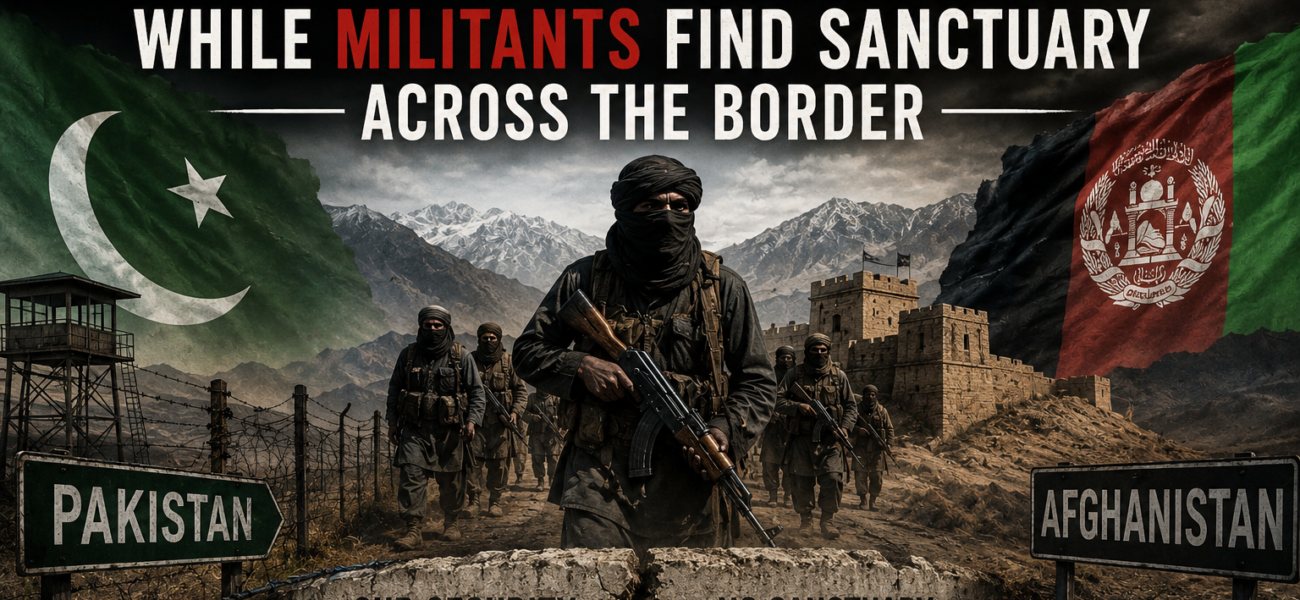
Kabul Cannot Demand Trust While Militants Find Sanctuary Across the Border
Five years after the Taliban returned to Kabul, Pakistan is confronting a security reality it can no longer afford to describe in diplomatic euphemisms: militant violence emanating from Afghanistan...

Five years after the Taliban returned to Kabul, Pakistan is confronting a security reality it can no longer afford to describe in diplomatic euphemisms: militant violence emanating from Afghanistan has become a direct challenge to Pakistan’s national security and, increasingly, to regional stability.
Pakistan’s UN Ambassador Asim Iftikhar Ahmad made that argument forcefully in an interview with Arab News, accusing the Taliban authorities of providing militant groups with safe havens, weapons, financing, planning assistance and facilitation for cross-border infiltration.
These are grave allegations. But Pakistan’s concerns do not exist in isolation.
UN monitoring has repeatedly raised concerns over terrorist organizations operating in Afghanistan, including Tehreek-e-Taliban Pakistan (TTP). That matters because the dispute is sometimes portrayed as little more than deteriorating relations between 2 nations. The evidence points to a much larger counterterrorism problem.
Pakistan has paid an enormous price for terrorism. Its civilians have been killed in markets, mosques and schools; soldiers and police officers have died defending communities and border regions. A state facing repeated attacks cannot reasonably be expected to regard militant sanctuaries across its frontier as somebody else’s internal affair.
Nor did Islamabad begin the post-2021 period by seeking confrontation with Kabul.
Pakistan initially supported international engagement aimed at preventing Afghanistan’s economic and humanitarian collapse. In December 2021, Islamabad hosted an extraordinary session of the Organization of Islamic Cooperation’s Council of Foreign Ministers, mobilizing attention toward humanitarian assistance for the Afghan population.
That history makes the present deterioration particularly significant.
Pakistan’s position should therefore be understood clearly: friendship with the Afghan people does not require silence over terrorism. The centuries-old social and cultural connections between the populations remain important, but those ties cannot provide political immunity when armed groups threaten Pakistani lives.
The Taliban authorities now face a straightforward choice.
If Kabul rejects Pakistan’s allegations, it should demonstrate through verifiable action that Afghan territory will not shelter organizations attacking Pakistan. Militant sanctuaries must be dismantled, cross-border infiltration disrupted, financing networks targeted and individuals facilitating attacks held accountable.
Statements alone will no longer rebuild confidence.
There is still room for diplomacy. Saudi Arabia, Turkiye, China and Qatar have channels with Islamabad and Kabul and can help facilitate credible security arrangements. But mediation cannot become an endless substitute for implementation. Any future process must produce measurable counterterrorism commitments.
Pakistan, for its part, should continue combining diplomatic engagement with the protection of its borders and citizens. Seeking peaceful relations with Afghanistan and defending Pakistani sovereignty are not contradictory objectives.
The broader international community should also recognize what is at stake. Afghanistan’s security trajectory affects South Asia, Central Asia and beyond. Allowing militant organizations operational space today risks creating a considerably larger regional threat tomorrow.
The Taliban sought international legitimacy after taking power in 2021. Legitimacy, however, carries obligations. The most basic is ensuring that territory under one’s control is not used to attack another state.
Pakistan is not asking Kabul for a favor. It is asking for something every sovereign country is entitled to expect from its neighbor: that its people should not have to pay with their lives for militancy protected beyond their border.
Author