
F1’s Silver War: Mercedes Falters as Unforeseen Chaos Redefines Grid Hierarchy
POLICY WIRE — London, England — Sometimes, the story isn’t just about who crosses the finish line first. No, it’s about the seismic tremors that rumble beneath the glitzy facade,...

POLICY WIRE — London, England — Sometimes, the story isn’t just about who crosses the finish line first. No, it’s about the seismic tremors that rumble beneath the glitzy facade, shattering established orders and shaking the very foundations of dominance. And boy, did the British Grand Prix deliver those tremors. Ferrari driver Charles Leclerc, after what felt like an eternity, snatched victory at Silverstone, but the real narrative was less about his long-awaited triumph and more about the unsettling cracks appearing in Mercedes’ seemingly invincible armor.
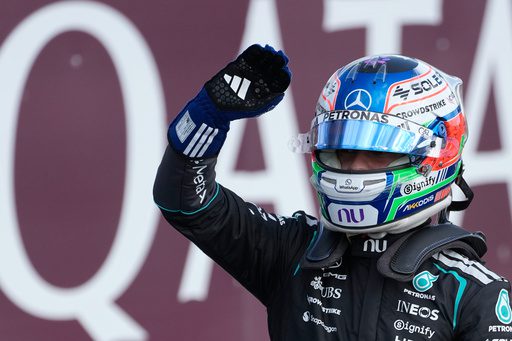
Young Kimi Antonelli, once racing toward a championship with an almost clinical precision, found himself mired in trouble yet again. The 2026 season was supposed to be a Mercedes coronation, maybe for Antonelli, maybe for his seasoned teammate George Russell. Instead, we’re seeing something else entirely—a season increasingly defined by spectacular breakdowns and unpredictable turns, making it feel less like a coronation and more like a bare-knuckle brawl where every twist is unexpected. Because in this high-octane world, reliability—or the sudden, brutal lack thereof—changes everything.
Antonelli’s issues at Silverstone weren’t new; car trouble derailed him previously when Lewis Hamilton secured a win at the Barcelona-Catalunya Grand Prix. Russell also suffered a dramatic car failure in Canada back in May. But this time, it was a particularly bitter pill. Leclerc, who hadn’t stood atop the podium in nearly two years—not since the United States Grand Prix in October 2024—was handed the unexpected gift. He surged past Antonelli right at the start. And then, a Mercedes car, usually the paragon of engineering excellence, simply started failing its pilot. Antonelli reported a steering problem — and soon enough, he was watching the field vanish in his mirrors.
It was all a mess, frankly. A real dogfight. The entire race climaxed behind a safety car, summoned after Max Verstappen—yes, that Max Verstappen—spun his machine into the gravel, taking a third-place podium dream with him. This allowed Leclerc a rather subdued celebration, though he confessed over the radio: “Finally! This one felt particularly good, even if I wished it was a more normal ending.” Who wouldn’t? A victory’s a victory, sure, but everyone wants to earn it under full-throttle scrutiny. The subsequent joy, the crowd barriers toppling as he embraced his Ferrari crew, that was raw, unscripted emotion.
But the true implications echo far beyond the track. The title race, once looking like Antonelli’s for the taking, has tightened like a vise. Antonelli’s lead over Russell, once a commanding 43 points, has now dwindled to a mere 25 points—the precise value of a single race win. Russell himself, despite feeling the need to improve after struggling for pace, managed second place and is back in the hunt. Toto Wolff, Mercedes team principal, termed it a [QUOTE_PLACEHOLDER] suggesting Antonelli’s car might have been damaged after he hit a curb. You can just about taste the frustration, can’t you?
The sheer unpredictability, the fragility of a once-ironclad lead, the critical role of reliability—these aren’t just themes confined to the polished chrome and roaring engines of Formula 1. Consider, for instance, the complex industrial ecosystems supporting high-tech ventures globally, from specialized electronics to advanced manufacturing. Supply chain vulnerabilities—whether political, economic, or natural—can derail even the best-laid plans. It’s a stark reminder that even with peak talent and prodigious budgets, unforeseen disruptions can suddenly shift fortunes.
What This Means
The British Grand Prix, for all its pyrotechnics and mechanical mayhem, offers a stark metaphor for broader global dynamics. Mercedes’ wobble isn’t just about engines; it’s about the fragility of sustained power. Think about nations—take Pakistan, for instance, or any number of states across the Muslim world—which consistently grapple with economic and political shocks. One minute, there’s a strong economic growth projection or a surge of foreign investment; the next, a sudden political upheaval or a natural disaster can send the best-intentioned plans spiraling. They, like Antonelli with a damaged car, are often forced to simply finish the race, accruing time penalties in the global arena despite valiant efforts to stay competitive. Antonelli ignored pleas to retire his car, battling on even after his problems mounted, ultimately placing ninth on the track only to drop to 16th after a penalty. Sometimes, you just gotta finish.
This race suggests that even in tightly controlled environments, true dominance isn’t merely about current strength but about adaptability and the capacity to absorb shocks. George Russell’s second-place finish, snatched from a day where he openly admitted “If I want to fight for the championship, the performances need to be better, I need to be better,” is a stark illustration of maximizing imperfect circumstances. In the geopolitical ‘race,’ a sudden disruption like an energy crisis or political instability can dramatically alter power rankings, demanding immediate strategic recalibrations, often with no clear end in sight. But—and here’s the kicker—it also creates openings for the persistent, the patient, or the merely lucky to advance when others falter. This is the art of the strategic oddity. The fact that the entire F1 race concluded under safety car conditions—effectively an anticlimactic surrender to chaos—shows that control is often an illusion, even at the highest levels of organized sport or statecraft. There’s a certain red card revelation lurking in every unexpected outcome.
So, what was supposed to be a predictable, high-speed parade for the championship leader devolved into a frantic scramble. It wasn’t about raw pace; it was about sheer survival — and seizing whatever messy opportunity presented itself. A bit like navigating global affairs these days, wouldn’t you say? Never dull, often exasperating, — and always, always full of surprises.