Bratislava’s Gambit: Fico Rejects ‘Iron Curtain’ for Europe, Jolting Brussels Consensus
POLICY WIRE — Strasbourg, France — The hushed diplomacy of Brussels and Strasbourg occasionally cracks, not from the weight of intricate policy debates, but from an inconvenient truth blurted out by...

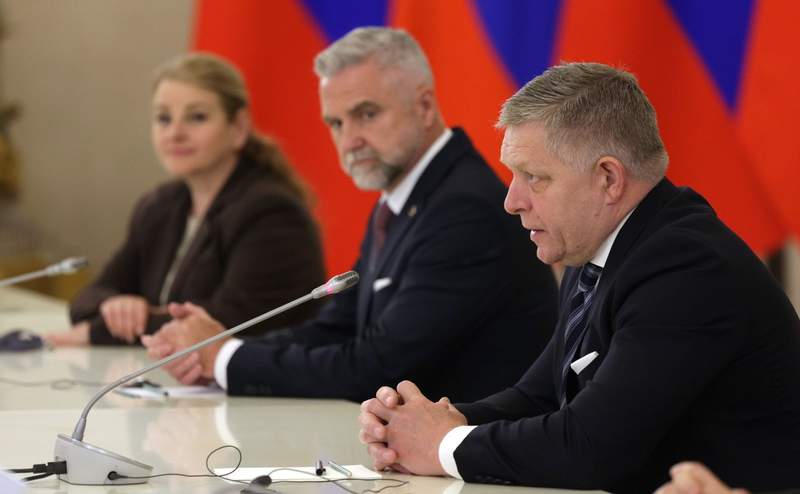
POLICY WIRE — Strasbourg, France — The hushed diplomacy of Brussels and Strasbourg occasionally cracks, not from the weight of intricate policy debates, but from an inconvenient truth blurted out by a head of state. Robert Fico, Slovakia’s often-polarizing Prime Minister, chose precisely such a moment, stating plainly what many in Western European capitals don’t want to hear: forget another ‘Iron Curtain’ with Russia. His blunt assertion didn’t just ruffle feathers; it’s a direct challenge to the EU’s painstakingly constructed post-Ukraine war narrative—a narrative of unwavering defiance and ideological cleavage. And it echoes an older, more uncomfortable strategic reality many prefer to ignore.
It’s not some academic musing, either. Fico’s position — often labeled as pro-Russian by his detractors — isn’t merely about semantics. It speaks to a profound divergence within the European Union itself, an east-west fault line that economic interdependence and shared security goals have struggled to plaster over since the Cold War. For nations like Slovakia, proximity to the conflict isn’t just about weapon transfers or refugee flows; it’s a daily lived reality, one that breeds a certain, shall we say, pragmatism. Or perhaps, cynicism, depending on your vantage point.
“We’re not building a wall of Berlin anew,” Fico declared, his tone cutting through the polite officialese. “The people of Europe, especially Central Europe, they know the taste of isolation. It’s bitter, I tell you. Engagement, however uncomfortable, is always the smarter gamble in the long run. Sacrificing our own economic wellbeing for someone else’s war of attrition? That’s not prudence, it’s madness.” His remarks weren’t entirely unexpected, given his government’s consistent recalibration of Slovakia’s foreign policy since he took office. He’s a contrarian, for sure. But his defiance carries weight, particularly as the grinding war in Ukraine continues to test European unity and pocketbooks.
The sentiment from the usual European powerhouses was, predictably, less than enthused. A senior German diplomatic source, speaking off the record but clearly authorized, dismissed Fico’s stance. “The ‘Iron Curtain’ fell, yes, but it wasn’t Russia that tore it down,” they stated with discernible frostiness. “Europe learned a lesson, a harsh one. Principles aren’t commodities to be traded for perceived ‘pragmatism’ or historical nostalgia, particularly when sovereignty’s at stake.” This official’s comments perfectly encapsulate the entrenched viewpoint of much of the EU establishment: that compromise with Moscow after the full-scale invasion of Ukraine is an ideological betrayal, not a diplomatic alternative.
Because, really, Fico is pointing to the inherent contradictions in Brussels’ current strategy. For all the talk of divorcing Europe from Russian energy — and trade, the facts speak their own blunt language. A recent report from the European Commission indicated that despite sanctions, some EU members increased their imports of certain Russian goods in 2023, just through different conduits. That’s a leak, not a blockade. And this ‘no-curtain’ idea? It isn’t entirely new, nor is it unique to Fico’s small corner of Central Europe.
Look at how many nations, even those outside the EU, juggle their relationships with various global powers. Turkey, for instance, a key NATO member but also a historical bridge to the Muslim world, routinely navigates these choppy waters, often to the consternation of its Western allies. You’ll find similar, if less overtly confrontational, realpolitik being practiced from Ankara to Islamabad. In Pakistan, grappling with its own volatile regional dynamics, balancing Western expectations with immediate economic and security imperatives—including those tied to powers like China or Saudi Arabia—is an art form honed over decades. They understand the messy realities Fico is, in his own way, reminding Europe about.
What This Means
Fico’s vocal dissension throws a wrench into the carefully curated image of a united European front against Russia. Politically, it signals a deeper fracturing, one that could complicate future sanctions, aid packages, and strategic decisions. It provides fodder for populist parties across the continent and makes consensus-building even harder in an already fractious Union. Economically, his position, if gaining traction, could lead to increased lobbying for easing trade restrictions or reopening energy dialogues—a potential boon for countries struggling with inflation and energy costs, but a nightmare for those who’ve heavily invested in severing Russian ties. There’s also the security angle; if a major power like Germany views Slovakia as an unreliable partner, it impacts NATO’s eastern flank strategy, no doubt about it. this internal friction provides diplomatic leverage for Russia, showing that the EU’s resolve isn’t as monolithic as advertised. It forces a tough conversation: can Europe afford its moral high ground, or must it eventually revert to a more cynical, yet perhaps sustainable, geopolitical engagement with its massive eastern neighbor? That’s the question Fico has, however undiplomatically, tossed onto the table. It’s an uncomfortable one, — and no one’s really ready to give a straight answer.