


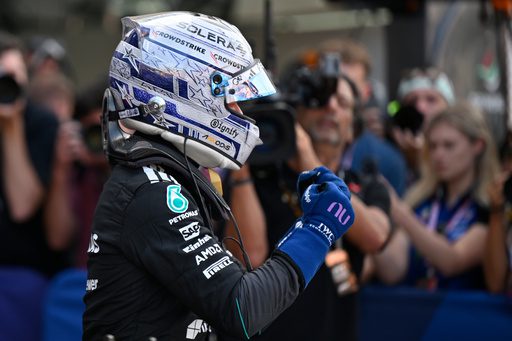
Monaco Meltdown: Antonelli’s Dominance Amidst Chaos Signals F1’s New Guard
POLICY WIRE — Monaco — The glitzy veneer of Monte Carlo usually cloaks the visceral drama of Formula 1 with effortless elegance. But this past Sunday, the principality’s famed street circuit —...

POLICY WIRE — Monaco — The glitzy veneer of Monte Carlo usually cloaks the visceral drama of Formula 1 with effortless elegance. But this past Sunday, the principality’s famed street circuit — usually a ballet of precision — devolved into something more akin to a back-alley brawl. Asphalt shredded, cars careened, and officials seemed caught in a bureaucratic tangle that would make even the most seasoned diplomat blush. Amidst this opulent disarray, a 19-year-old phenom, Kimi Antonelli, didn’t just win; he carved out his territory, sending a stark message to the old guard: the future arrived, and it’s fast.
It wasn’t exactly the smooth champagne finish spectators usually expect. Two collisions in quick succession, coupled with significant track damage, halted the race with a red flag. It pushed back schedules, frayed nerves, — and left everyone wondering if the whole affair might just be abandoned. Monaco, the sport’s jewel, became momentarily a construction site, a road-sweeping machine dutifully inching along, picking up debris like a street cleaner after a particularly rowdy festival. Antonelli himself later admitted he’d been hoping the race wouldn’t be restarted at all. One can’t really blame him; this season has been, let’s be frank, relentless.
But when the lights finally went out for the standing restart, the Italian wunderkind simply locked in, resuming his utterly dominant march. This kid’s got ice in his veins, folks. He became the youngest F1 winner in Monaco’s history, a place where youth often cracks under pressure. It’s his fifth victory in a row, a staggering run that has him 66 points clear at the top. The closest competition? None other than the venerable Lewis Hamilton.
Hamilton, the seven-time champion whom Antonelli effectively replaced at Mercedes last year, didn’t hide his awe, despite trailing. “You’re catching me up,” Hamilton reportedly told the teenager, a statement loaded with more than a touch of irony given his own 105 career wins. The veteran acknowledged Antonelli’s raw talent, saying, [QUOTE_PLACEHOLDER] It was an earnest admission from a man known for his competitive fire. [QUOTE_PLACEHOLDER] he added, perhaps knowing he’s looking at a younger, faster version of himself. Casual fans might just see a changing of the guard; those paying closer attention are witnessing a seismic shift.
But Hamilton’s Sunday wasn’t all about praising his successor. Second place was a genuine turnaround for the Brit, who spent 2025 – his first year with Ferrari – off the podium entirely. He credited Ferrari team principal Fred Vasseur for the rebound. “Fred has been awesome in supporting me. I think last year was really tough for both of us,” Hamilton revealed, seeing “the fruits” of changes Vasseur had implemented. Vasseur himself had returned to the track after a mysterious medical facility visit, adding another layer of intrigue to an already chaotic weekend.
Because chaos truly defined the day. Beyond Antonelli’s clinical display, the race was a quagmire of post-race penalties — and investigations. Isack Hadjar, who nabbed third for Red Bull, had to clear an inquiry into alleged engine part tampering – officials said no changes were actually made, so his first podium was secure. Then there was Antonelli’s teammate, George Russell, who plummeted down the order with penalties, culminating in a further sanction for not serving an earlier penalty correctly. He crossed the line 13th, later upgraded to 12th, stating he didn’t understand what happened. But when Max Verstappen started second and retired his car on the first lap, you just knew it was that kind of afternoon.
📄 POLICY WIRE WHITEPAPER PUBLISHED: PAKISTAN'S NATIONAL SECURITY POLICY PRIORITIES
👉 READ BY CLICKING HEREThis kind of drama isn’t just about fast cars; it’s a spectacle devoured by billions globally. Indeed, global motorsport’s reach continues to expand, finding fervent fan bases in burgeoning economies. In places like Pakistan, for instance, where infrastructure development and foreign investment are priorities, high-profile international sporting events — even if viewed remotely — offer a potent blend of escapism and aspirational economics. It highlights a nation’s connectedness to the global stage, sparking dreams of future domestic prowess, be it in industry or, perhaps, on the racetrack. Last year, the F1 global cumulative TV audience stood at an astounding 1.59 billion, according to official Formula 1 figures for 2025, an economic force often underestimated in policy circles.
What This Means
This chaotic Monaco Grand Prix isn’t just another race; it’s a policy indicator wrapped in speed — and drama. Antonelli’s ascendance isn’t merely a sporting narrative; it speaks to generational shifts impacting various sectors globally. Youth, with its unburdened confidence and adaptability, is muscling its way to the top in industries once dominated by established veterans. His seemingly effortless victories signal a new era of competitiveness, forcing older institutions (and drivers) to rapidly evolve or face obsolescence.
Economically, F1’s growing global footprint, particularly into emerging markets, isn’t lost on advertisers or policymakers. Races in locations far from Europe’s traditional automotive hubs now fetch astronomical hosting fees, generating substantial revenue and Soft Power for host nations. Monaco, a symbol of old-money luxury, being upended by technical glitches and raw, unadulterated speed underscores that even tradition is subject to the unforgiving march of innovation and talent. the persistent controversies over penalties and rule enforcement echo broader challenges in governance, where complex regulations and snap decisions frequently leave participants – and the public – bewildered. It makes you wonder how much confidence can be placed in institutions when the rules of the game feel like they’re being rewritten on the fly. And for a young driver like Antonelli, who’s taking the top spot at such a rapid pace, it’s not just about winning races, it’s about leading an economic charge, representing a new wave of highly valuable athletes.