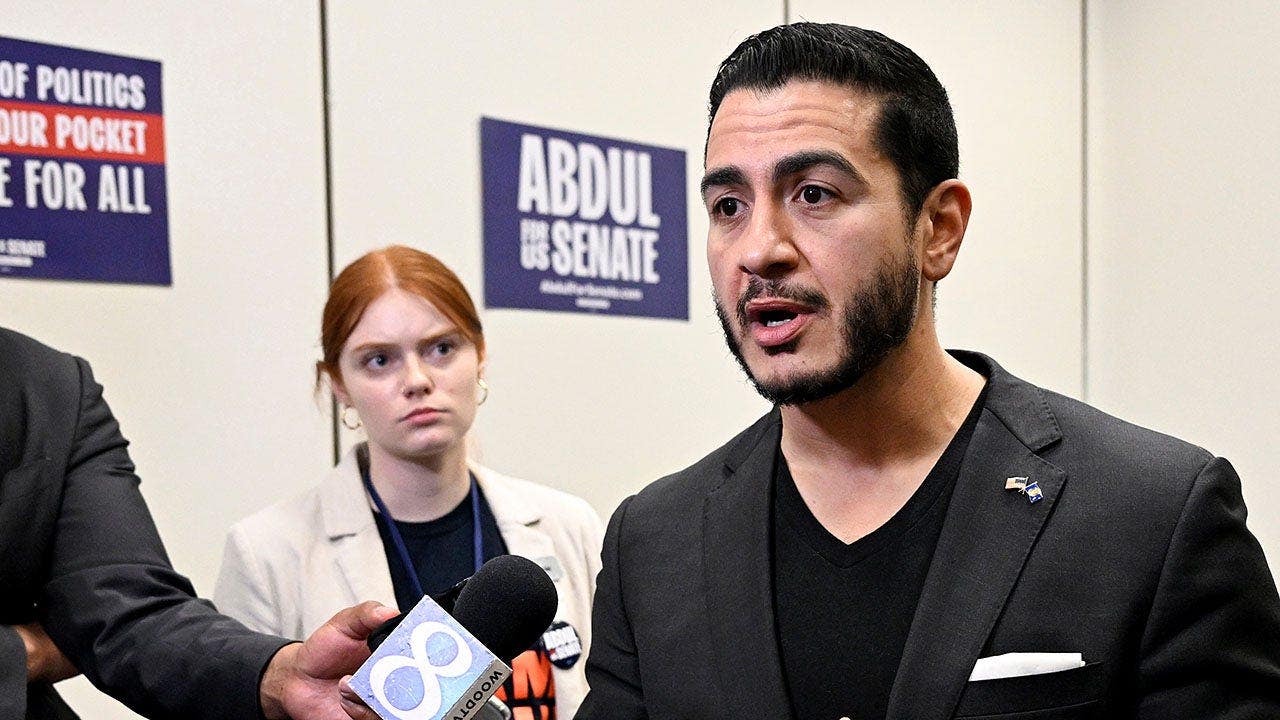
El-Sayed Slams CNN: Michigan Race Heats as ‘Defund’ Narrative Lingers
POLICY WIRE — Washington D.C., USA — It’s never about what you say; it’s about what the cameras, or rather, the editors, decide you’ve said. And right now, that seems to be a brutal truth for...

POLICY WIRE — Washington D.C., USA — It’s never about what you say; it’s about what the cameras, or rather, the editors, decide you’ve said. And right now, that seems to be a brutal truth for Michigan Senate hopeful Abdul El-Sayed, who’s pushing back—hard—against a network he feels has, well, misrepresented his whole deal. Not the core issues, you understand, but a single, sticky phrase. It’s a perennial dance, this one, where media outlets distill complex policy proposals into tweetable, often explosive, soundbites, leaving politicians scrambling to re-contextualize their own words.
El-Sayed, a Democrat, isn’t some political rookie, mind you. He’s been around the block, battling for Michigan’s top jobs, carving out a lane as a progressive voice. But his past comments, particularly around the phrase [QUOTE_PLACEHOLDER], have become an albatross in a tight Senate contest. The contention here, as any grizzled campaign strategist would tell you, isn’t whether he used the words, but the sheer weight—the disproportionate attention—given to them. And that’s what’s got his team, — and El-Sayed himself, pretty riled up with CNN.
They’re arguing the network chooses to [QUOTE_PLACEHOLDER] certain parts of his platform while ignoring a broader vision. It’s a familiar critique, this notion that cable news cycles—hungry for conflict and concise narratives—often simplify political discourse to the point of distortion. It’s also a tactic that often works, especially when the words in question carry as much political baggage as ‘defund the police.’ For candidates of color, particularly those from Muslim or South Asian backgrounds like El-Sayed, such phrases can become shorthand, loaded with implicit biases or convenient misinterpretations in a deeply polarized electoral landscape. The challenges for diverse candidates navigating American electoral politics are formidable, requiring a constant tightrope walk between articulating progressive ideals and appeasing a wary general electorate. But he’s not backing down.
El-Sayed’s background as a physician and public health advocate—not exactly the stuff of revolutionary policing proposals, at least in its genesis—adds a layer of irony to this whole kerfuffle. He argues his policy positions are [QUOTE_PLACEHOLDER]. One has to wonder: how much of this media firestorm is about substance, and how much is about a convenient narrative that neatly fits into predetermined boxes?
In many ways, this spat mirrors broader anxieties about policing reform, a conversation that—let’s be honest—has often struggled to move past emotionally charged slogans into concrete, implementable solutions. The phrase, for some, encapsulates a radical call for societal restructuring. For others, like El-Sayed apparently, it’s about reallocating resources, addressing root causes of crime, and building stronger communities—an argument lost in the shrill noise of a three-word battle cry. And yet, the media keeps coming back to it, because it generates clicks, sparks outrage, — and fills airtime.
The campaign, not surprisingly, isn’t taking this sitting down. They’re countering, framing the CNN focus as a deliberate attempt to pigeonhole their candidate, to prevent Michigan voters from engaging with a fuller, more nuanced policy platform. It’s a move that’s become a standard play in the modern political playbook: if you can’t control the message, at least control the meta-narrative about how the message is being controlled. For better or worse, this isn’t just about Michigan; it’s a microcosm of how national media shapes local races.
One hard data point to consider: In 2022, only 0.2% of elected officials at the federal, state, and local levels identified as Muslim, according to a report by the Jetpac. This highlights the narrow margins and intense scrutiny faced by candidates like El-Sayed as they seek to gain a foothold in American governance. Every gaffe, every misinterpreted soundbite, carries amplified weight when your community’s representation is so scarce. It’s an uphill battle. Plus, when the national media decides to spotlight a candidate with a specific narrative, it often drowns out the local issues that Michigan voters probably care about most.
What This Means
This isn’t just a dust-up between a candidate and a cable news behemoth; it’s a symptom of a larger illness in our political discourse. For Abdul El-Sayed, a prominent Muslim American voice in progressive politics, the continued emphasis on a specific ‘defund the police’ interpretation by CNN acts as a gatekeeper, implicitly or explicitly, painting him as outside the mainstream. This sort of media framing can have tangible effects on voter perception, particularly in diverse states like Michigan with significant Arab and Muslim American populations. It can also activate ‘us vs. them’ mentalities, forcing voters to align with simplistic caricatures rather than policy nuances.
Economically, persistent focus on crime rhetoric often overshadows conversations about economic justice, educational disparities, or healthcare access, which often form the core of progressive platforms. If a candidate’s message can be successfully narrowed to one hot-button issue, it stifles broader debates crucial for systemic change. This media cycle also demonstrates the challenges for non-traditional candidates. In the context of global politics, the demonization or oversimplification of reform efforts mirrors how debates around policing and security are often framed in countries like Pakistan, where public trust in institutions is often fractured. The focus on charged phrases deflects from the often legitimate, albeit difficult, conversations about how to improve services, reallocate budgets, and build trust—whether that’s in Detroit or Lahore. And that’s a disservice to voters everywhere, frankly. See how some athletes navigate similar scrutiny, like in The WNBA’s High-Wire Act. The implication for Michigan’s Senate race? Expect this ‘defund’ narrative to keep resurfacing, no matter how many times El-Sayed tries to clarify it. Because once the soundbite leaves the stable, it’s near impossible to bring back in. It’s a tough lesson for any politician, — and he’s learning it publicly.