


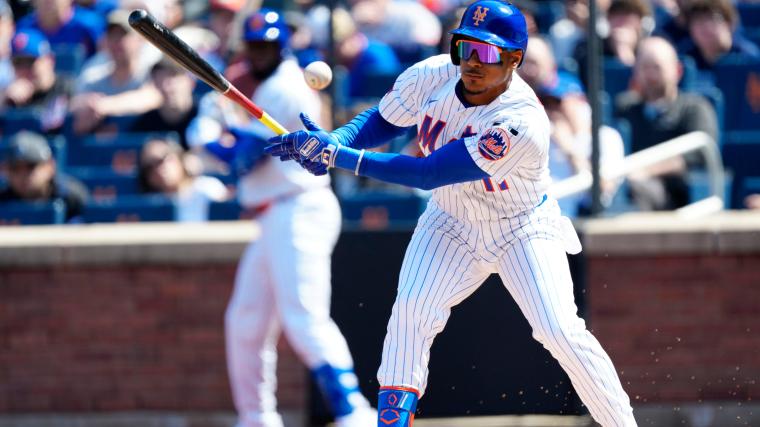
Mets’ Hopes Shattered, Again: Polanco’s Achilles Reinjury Fuels Disappointment Amid Stumbling Season
POLICY WIRE — Queens, New York — Sometimes, the universe offers a perverse sense of humor, especially when dealing with entities as earnest, and occasionally hapless, as the New York Mets. Just when...

POLICY WIRE — Queens, New York — Sometimes, the universe offers a perverse sense of humor, especially when dealing with entities as earnest, and occasionally hapless, as the New York Mets. Just when the faintest whisper of good news began to circulate—a potential balm for an already bruising season—the old injury devil reared its ugly head. Jorge Polanco, the man tabbed to inject a much-needed jolt of offense, has apparently done the exact opposite, with a familiar and deeply unwelcome complaint: his Achilles, again.
It’s a storyline as predictable as a summer rain, yet somehow always devastatingly effective. But we’re not just talking about a player; we’re dissecting a system that, much like a poorly drafted policy, repeatedly crumbles under the weight of unforeseen, yet arguably foreseeable, pressures. The promise of reinforcement, a glimmer of light, now flickers into an almost cynical gloom. You can almost hear the collective sigh from Flushing.
For those keeping score, the Mets currently squat at a dismal 28-36. That’s a mere 43.75% winning clip after 64 games, a hard statistic pulled directly from the MLB standings. It’s a record that’s left them not just out of contention but mired in a particularly unpleasant brand of mediocrity that no amount of optimism can realistically gloss over. But hope, however ill-placed, lingered. After all, the season’s long; a spark here, a healthy return there, maybe? Maybe not.
There was a sliver of anticipation earlier in the week. Beat writers, perhaps fueled by a desperate desire for a positive narrative, reported the possibility of Polanco being activated from the injured list. Anthony DiComo, a Mets beat writer, even posted the detailed expectation: [QUOTE_PLACEHOLDER] A designated hitter, providing power without the strain of fielding. It seemed like a sensible, albeit calculated, risk.
Because, as fate would have it, sensible risks in baseball often unravel faster than a bad fiscal policy. Polanco’s return, what should have been a strategic re-entry, has hit a snag. A substantial snag. Removed from his minor league rehab assignment on Saturday, he felt some ankle soreness. And you know what that means in the lexicon of lingering injuries.
Mike Puma of the New York Post painted the grim picture: [QUOTE_PLACEHOLDER] Just the phrase “ankle soreness” when you’re nursing an Achilles issue carries the weight of a death knell in an athlete’s season. And now, he’s on the express train back to the medical bay.
Post-game, the man tasked with fronting the perennial disappointment, manager Carlos Mendoza, had to address it. He confirmed the obvious, without sugar-coating. Mendoza acknowledged that Polanco had re-aggravated his chronic Achilles problem. SNY Mets, in their update, relayed the specifics, stating: [QUOTE_PLACEHOLDER] Not a new injury, then, but a fresh punch to an old bruise. An exacerbation of an existing condition. How profoundly discouraging.
📄 POLICY WIRE WHITEPAPER PUBLISHED: PAKISTAN'S NATIONAL SECURITY POLICY PRIORITIES
👉 READ BY CLICKING HEREIt’s especially disheartening considering Polanco’s role. He was meant to be a cornerstone, a key piece in what was optimistically – or perhaps foolishly – envisioned as a competitive squad. The Mets, bless their hearts, aren’t technically out of contention, yet. Not in the mathematical sense. But how does one build momentum when your supposed saviors can’t stay on the field? It’s like trying to build a stable government when your foundational coalition partners keep defecting.
The latest setback forces New York to, once again, play the waiting game, as they try to ascertain the true severity of what seems to be an endlessly regenerating problem. A saga, frankly, for the ages—or at least for a very long, very hot summer in Queens.
What This Means
This latest development for the Mets, though ostensibly a sports injury, casts a long shadow over the efficacy of grand plans and robust investments. Polanco’s repeated setbacks—his own lingering issue—mirror the challenges faced in public policy or economic development initiatives. You commit significant resources, assemble what appears to be a strong team or program, yet unforeseen ‘structural’ weaknesses (or neglected chronic issues) cripple progress.
But the ramifications stretch further than just a disheartened fanbase in New York. Consider the intricate, often fragile, economic webs of athlete contracts, insurance, — and the global player market. A player’s career, — and subsequently his earning potential, hangs by the delicate thread of physical resilience. In many South Asian nations, for instance, an injury to a key worker in a household can have devastating multi-generational economic impacts, reverberating through communities and national GDPs. There, the ‘Achilles heel’ of an individual becomes a literal economic one for many.
The Mets’ predicament, in a microcosm, illustrates the brutal reality that no matter the financial muscle, human frailty remains the ultimate equalizer. For teams like the San Diego Padres who also deal with these challenges, and frankly any high-stakes venture from sports franchises to nascent tech startups, sustained performance is intrinsically tied to health. Not just of the body, but of the overall organizational ‘body politic’. This kind of repetitive failure—a strategy for managing an injury that seemingly fails to deliver—can erode confidence among stakeholders. Owners, front office, coaches, — and indeed, the paying public. And once that trust is gone, bringing it back? Well, that’s often the hardest policy reversal of all. They’re facing a long hard road.