


Jerusalem’s Unholy Rift: Anti-Draft Haredi Protests Unmask Israel’s Deepening Societal Fracture
POLICY WIRE — Jerusalem, Israel — It wasn’t the sound of sirens that pierced the early evening quiet near Jerusalem’s Chords Bridge, nor the distant thrum of military aircraft, but rather...

POLICY WIRE — Jerusalem, Israel — It wasn’t the sound of sirens that pierced the early evening quiet near Jerusalem’s Chords Bridge, nor the distant thrum of military aircraft, but rather the guttural chants of fervent men – a stark, auditory reminder that Israel’s most consequential battles aren’t always fought on distant borders. For decades, the nation has grappled with an internal schism, a theological-demographic fault line that periodically erupts into public spectacle. This past week, that fault line fractured again, seeing police forces descend on hundreds of ultra-Orthodox (Haredi) protesters. They were demonstrating against mandatory military conscription, a national duty many secular and national-religious Israelis consider sacred, but which Haredi communities view as an existential threat to their spiritual way of life.
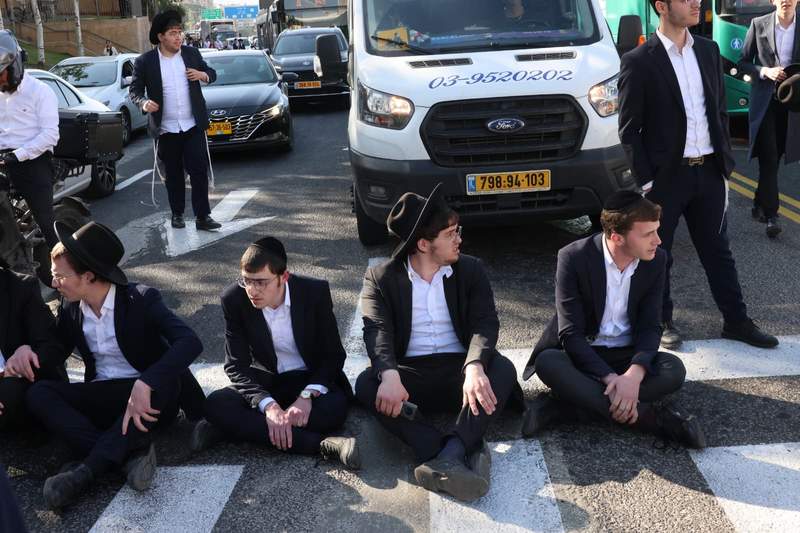
The scene, familiar yet perpetually jarring, unfolded with predictable intensity. Black-clad young men, many barely out of their teens, blocked a main thoroughfare, their protest — a refusal to serve in the Israel Defense Forces (IDF) — a direct challenge to the state’s very foundation. Police, their patience worn thin by repeated provocations, employed water cannons and mounted units, dispersing the crowd with a practiced, almost clinical efficiency. It’s a dance Israelis have witnessed countless times; each incident, however, carves deeper lines into the nation’s already complex identity. And it’s not merely a local skirmish; these domestic tussles carry profound implications for a nation already navigating a perilous regional landscape.
But this isn’t just about young men avoiding service. At its core, it’s a profound ideological clash, pitting religious tradition against modern statehood, a tension often obscured by the daily headlines. “Our shield is the Torah, not a rifle,” shot back Rabbi Yitzhak Goldstone, a prominent Haredi leader from Bnei Brak, in a rare, public statement yesterday. “To tear a young man from his sacred studies is to weaken the very soul of Israel, to strip us of our spiritual armor. It’s a violation of divine mandate, not merely a legal disagreement.” His words articulate a widely held belief within Haredi society: that their full-time engagement in religious study provides spiritual protection for the entire nation, an equally vital, if intangible, contribution to national security.
Still, the government, under increasing pressure from its secular and nationalist base, finds itself in an unenviable position. The Supreme Court has repeatedly ruled against blanket exemptions, deeming them discriminatory. Defense Minister Yoav Gallant, addressing reporters last Tuesday, emphasized the imperative for equity. “In these times, when our soldiers are making ultimate sacrifices, we simply cannot countenance a situation where one segment of our society bears the full burden while another is entirely exempt,” Gallant asserted, his tone firm. “National unity isn’t a slogan; it’s a strategic necessity, and that requires shared responsibility, not just from our secular or national-religious citizens.”
The numbers don’t lie. In 2023, approximately 66,000 Haredi men received exemptions from military service, a figure that grows annually and underscores the demographic challenge facing the IDF. The Israel Democracy Institute (IDI) has highlighted this trend, predicting Haredim could constitute 20% of Israel’s population by 2040. Such rapid growth amplifies the social and economic strain, particularly as the Haredi community traditionally exhibits lower participation rates in the secular workforce. It’s a delicate balance, maintaining the fabric of a nation while trying to integrate a rapidly expanding, insular minority.
Behind the headlines of water cannons and arrests, a larger, more intricate struggle unfolds — one that often gets lost in the immediate kerfuffle. This friction resonates far beyond Israel’s borders. Consider Pakistan, for instance, where sectarian divisions, while different in origin, similarly strain national cohesion and military resources. Or look at the broader Muslim world, where the narrative of a perpetually embattled Israel, fractured from within, often gains traction. Internal strife like the anti-draft protests isn’t just a domestic headache; it’s perceived by some external actors as a chink in the armor, an unseen clause in the nation’s social contract that weakens its overall posture. This isn’t merely academic speculation; regional adversaries observe such events with keen interest, often interpreting them as signs of vulnerability rather than democratic debate. It’s a nuanced dance between national identity — and external perception.
📄 POLICY WIRE WHITEPAPER PUBLISHED: PAKISTAN'S NATIONAL SECURITY POLICY PRIORITIES
👉 READ BY CLICKING HEREAnd so, the scene at the Chords Bridge, violent — and brief, serves as more than just a local news item. It’s a microcosm of the profound challenges confronting a nation built on both ancient faith — and modern necessity. It’s a reminder that even in states with formidable external defenses, internal battles over identity and duty can prove just as perilous, if not more so. The Haredi community’s steadfast resistance to military service isn’t simply an act of defiance; it’s a deeply entrenched cultural and religious stance that forces Israel to constantly redefine its understanding of citizenship and sacrifice.
What This Means
The persistent Haredi anti-draft protests are more than mere street disturbances; they represent a burgeoning crisis for Israel’s political stability and national security. Politically, the issue threatens to destabilize Prime Minister Netanyahu’s already fragile coalition, which relies heavily on Haredi parties. Any move to enforce conscription uniformly could collapse the government, precipitating snap elections at a moment of acute regional instability. Economically, maintaining a large, non-working Haredi population dependent on state subsidies creates a significant burden on the treasury, diverting resources that could otherwise bolster defense or public services. This isn’t sustainable, particularly with the escalating costs of ongoing conflicts.
the ethical implications are profound. The stark inequality in military burden fuels resentment among secular and national-religious Israelis, many of whom have seen their children serve in combat units, some paying the ultimate price. This growing animosity could lead to intensified social unrest and erode the national consensus necessary for confronting external threats. It also presents Israel’s Supreme Court with an intractable legal dilemma, caught between legislative prerogative and the constitutional demand for equality. As we’ve seen in other democracies grappling with fundamental rights, like the U.S. High Court’s decisions on voting rights, these issues often touch the very bedrock of a nation’s legal and moral standing. For Israel, failure to reconcile this deeply divisive issue could undermine its social cohesion from within, potentially weakening its resilience in a notoriously volatile neighborhood. It’s a long-term strategic vulnerability hiding in plain sight.