

Jerusalem’s Ritual Unrest: Familiar Friction in Sacred Streets
POLICY WIRE — Jerusalem, Israel — You know the drill, don’t you? The cycle feels almost liturgical now—as predictable as the rising sun over the Old City walls. Police officers found themselves...

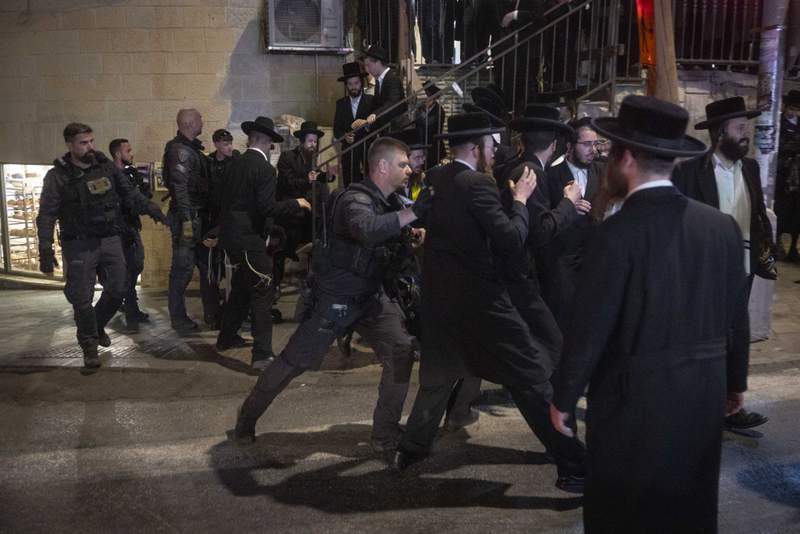
POLICY WIRE — Jerusalem, Israel — You know the drill, don’t you? The cycle feels almost liturgical now—as predictable as the rising sun over the Old City walls. Police officers found themselves once again in the familiar, unenviable position of attempting to disperse haredi protest in Jerusalem, a scene so common it barely registers as news anymore, and that’s precisely the problem. It’s less a protest and more a recurring civic performance, an echo of a deeply embedded conflict that never really ends, just ebbs and flows with the calendar.
It wasn’t a sudden eruption; these things rarely are. They’re slow burns, igniting from issues that refuse to resolve themselves: military conscription, secular education, the creeping influence of modernity on communities fiercely guarding centuries-old traditions. Police aren’t dealing with a spontaneous burst of anger, you see; they’re managing a structural fault line, a rift in the very foundation of society that keeps threatening to split wide open.
And let’s be real, the optics aren’t great for anyone involved. On one side, the sight of young men, often students of holy texts, squaring off against officers representing state authority. On the other, the state grappling with a population group that, by many metrics, remains stubbornly resistant to its broader civic demands. There are no clear winners here, only varying degrees of public relations headache. You’ve got to wonder sometimes if anyone really expects a resolution, or if we’re all just going through the motions until the next incident—a new decree, a fresh court ruling, or perhaps simply another draft notice—stirs the pot.
This particular incident, like countless others before it, highlights an almost impossible political conundrum. How do you integrate, or even coexist with, a segment of the populace that, by its very nature, seeks a measure of separation, autonomy from what it perceives as secular encroachment? It’s not just a religious question; it’s a profound civic challenge. We’re talking about a significant demographic here. According to recent Israeli demographic projections, the Haredi population is set to comprise nearly 20% of Israel’s population by 2030, a statistic cited in an internal government report I saw recently. That kind of growth trajectory guarantees that these tensions won’t just fade away; they’re set to intensify. And they’re not merely confined to domestic disputes within Israel’s borders, believe it or not.
Consider the wider regional implications. Such clashes, even when ostensibly about internal Israeli policies, don’t occur in a vacuum. Images of Haredi resistance to state forces—especially if interpreted as religiously motivated repression—resonate far beyond Jerusalem’s municipal limits. They’re easily amplified in the broader Muslim world, including nations like Pakistan and other South Asian countries, where the narrative of religious communities facing pressure often finds fertile ground. It fuels existing anti-establishment sentiments, adding another layer to the complex tapestry of regional perceptions about Israel, feeding into cycles of mistrust and grievance. It can confirm deeply held beliefs among some that Israel operates on an inherently hostile secular-religious axis, affecting not only inter-state relations but also domestic discussions in countries grappling with their own expressions of religious conservatism and modernity. It’s a tricky balance, influencing opinions in unexpected corners of the globe.
But let’s pull back to the immediate friction. The police, bless ’em, they’re stuck in the middle. They’re tasked with maintaining order, but order often means confronting those who feel their order—their divine order—is being threatened. It’s a thankless job, pushing back against men who often believe they’re doing God’s work. What’s an officer supposed to do? It’s a messy situation, really. The police effort to break things up involved [QUOTE_PLACEHOLDER], which led to [QUOTE_PLACEHOLDER], according to sources on the ground. Sometimes, it feels less like law enforcement and more like conflict management for an endless familial squabble, where no one really concedes any ground, ever.
What This Means
This isn’t just about another day in Jerusalem; it’s a loud clang in the gears of the Israeli political machine, a persistent indicator of unresolved societal fracture. Economically, these repeated disruptions carry costs—not just in terms of police resources diverted or potential property damage, but in the deeper societal implications of a growing segment of the population struggling with full economic and civic integration. When large communities resist mainstream educational and employment paths, it creates structural inefficiencies that any economy, particularly one as dynamic as Israel’s, must grapple with.
Politically, these protests represent a consistent — and highly influential voting bloc. Haredi parties are often kingmakers in coalition governments, their participation frequently dictating the stability, or instability, of any ruling alliance. Concessions on issues like military service exemptions or funding for religious institutions aren’t acts of charity; they’re shrewd political calculus essential for maintaining power. Any attempt to fundamentally alter the status quo risks not only street clashes but the collapse of governments. This cycle of protest and political negotiation highlights an internal tug-of-war that perpetually shapes domestic policy, occasionally overshadowing even external security concerns.
But then, there’s the broader narrative. Israel’s democratic claims often stand alongside its identity as a Jewish state. The inherent tension between those two ideals plays out vividly on Jerusalem’s streets. How a democracy manages religious minorities, even when those minorities form a substantial and self-contained parallel society, becomes a litmus test—a constant source of scrutiny, both internally and from the international community, including many in South Asia, where the struggle for identity often feels quite personally resonant. These repeated confrontations suggest that, for all its dynamism, Israel still hasn’t figured out how to fully reconcile its foundational principles with its demographic realities.
And it’s a reminder that beneath the headlines of regional conflicts or technological triumphs, the very soul of the state continues to be debated, sometimes quite forcefully, on its streets. We’ll be back here again, you can bet on it.