

Jerusalem’s Jumpy Tracks: Ultra-Orthodox Blockades Signal Deeper Divides
POLICY WIRE — Jerusalem, Israel — The capital’s much-vaunted light rail, intended to stitch together this ancient, fractured city, found itself — yet again — serving as a fresh battleground. It...

POLICY WIRE — Jerusalem, Israel — The capital’s much-vaunted light rail, intended to stitch together this ancient, fractured city, found itself — yet again — serving as a fresh battleground. It wasn’t the geopolitical fault lines this time, no, but the ever-present, ever-deepening rifts within Israeli society itself. A single arrest. Just one. But it felt less like a police action and more like a symbolic raising of a white flag by the secular state in its Sisyphean struggle against its most religiously fervent citizens. They don’t just want segregation, you see. They want a separate world.
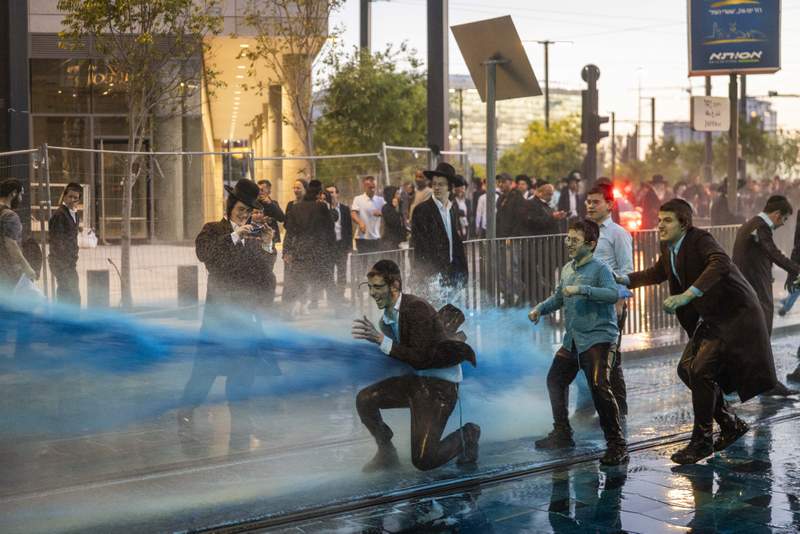
Early yesterday, a few dozen ultra-Orthodox (Haredi) demonstrators, clad in their characteristic black coats and hats, coalesced spontaneously on the light rail tracks near the central Haredi neighborhood of Geula. Their mission? To stop the trains dead. The grievance? The persistent specter of perceived immodesty and co-mingling sexes on public transport — a modern invention running right through their insular universe. Police, after some desultory efforts at negotiation (which invariably feel more like pleading), eventually moved in, extricating the human obstacles. A lone protester, young and visibly defiant, was hauled away, offering little resistance but a whole lot of scolding with his eyes.
It’s an old dance, this. An awkward ballet of tradition — and modernity played out on a global stage, but Jerusalem makes it especially dramatic. What starts as a localized dispute over women’s advertisements on bus stops or segregated sidewalks inevitably metastasizes into a public transit blockade. The light rail, you might recall, runs through diverse areas. But the ultra-Orthodox communities, they view its passage through their precincts as a kind of secular invasion. And they’re not shy about expressing that discomfort, even if it grinds city traffic to a halt.
But this isn’t just about a couple of tracks; it’s a proxy war. Because these disruptions aren’t just inconvenient; they strain our public services and pull resources from real security threats. At least, that’s what Commissioner Eitan Ben-David of the Jerusalem District Police believes, a man whose public face often carries the weary resignation of Sisyphus pushing his rock uphill. And who could blame him? He’s perpetually managing a crisis of conviction, not criminality.
On the other side, Rabbi Chaim Eisenberg, a respected figure in the Bnei Brak community, offers no quarter. His voice, usually modulated for Torah study, becomes a booming declaration against secular encroachment. “Our way of life, our very spiritual existence, is under assault. The state thinks it can dictate how we maintain sanctity in public spaces. But the spiritual dictates outweigh the temporal. Always.” It’s a conviction that runs deep, and one that resonates within segments of Haredi society, even as the broader Israeli public fumes at the constant disruption and perceived sense of entitlement.
This escalating friction finds a curious parallel far beyond the Levantine heat. Across the Indian subcontinent and parts of the wider Muslim world, similar tensions simmer between religious conservatives and state-mandated secular or pluralistic ideals. From Pakistan’s debates over blasphemy laws to Saudi Arabia’s careful dance of liberalization versus traditional religious authority, the push-pull between the dictates of faith and the demands of modern governance is a familiar, often violent, struggle. Israel’s internal dynamic isn’t an isolated phenomenon; it’s a specific, localized iteration of a global argument.
And let’s not forget the numbers. This community isn’t shrinking; it’s booming. According to Israel’s Central Bureau of Statistics, the Haredi population is projected to comprise approximately 16% of Israel’s total population by 2030, a demographic trajectory that inevitably amplifies their societal influence and their confrontations with secular norms. These aren’t just fringe elements, see. They’re a growing, politically organized bloc with increasing leverage, often disproportionate to their actual economic contribution. Their presence is a force multiplier for the right-wing religious parties in any Israeli government coalition, guaranteeing that these internal culture wars will remain a constant fixture, not an occasional skirmish.
What This Means
The blockade, minor in its physical scope, serves as another loud alarm for Israel’s already strained social cohesion. It illustrates the precarious balance the current government — heavily reliant on ultra-Orthodox parties — must maintain. They can’t afford to alienate these partners, which means that scenes like this light rail blockade often result in token enforcement, if any real change at all. This lack of decisive action fuels resentment among secular Israelis, deepening a chasm already widened by military service exemptions and economic disparities.
Economically, such disruptions don’t just annoy commuters; they signal an instability that can deter investment, both foreign and domestic, in a city constantly striving for a semblance of normal functionality. The sheer economic cost of these internal divisions — lost productivity, stretched police resources, and the erosion of civic trust — quietly erodes the nation’s fabric. But it also represents a strategic soft spot. For adversaries in the region, the internal friction provides a convenient distraction, an exploitable weakness in a state already grappling with external threats and an increasingly tense regional dynamic.