


JAAC’s Agenda behind the Chaos in Azad Kashmir
The ongoing legislative assembly elections in Azad Jammu and Kashmir (AJK) represent a vital democratic exercise for the people of the region. Yet this process has been overshadowed by the violent...

The ongoing legislative assembly elections in Azad Jammu and Kashmir (AJK) represent a vital democratic exercise for the people of the region. Yet this process has been overshadowed by the violent and disruptive tactics of the proscribed Joint Awami Action Committee (JAAC). What began as demands over economic issues has evolved into a campaign that threatens public order, endangers security personnel, and seeks to sabotage the constitutional framework of AJK. The Pakistani state and AJK authorities have responded with necessary firmness to protect lives, maintain stability, and uphold the rule of law.
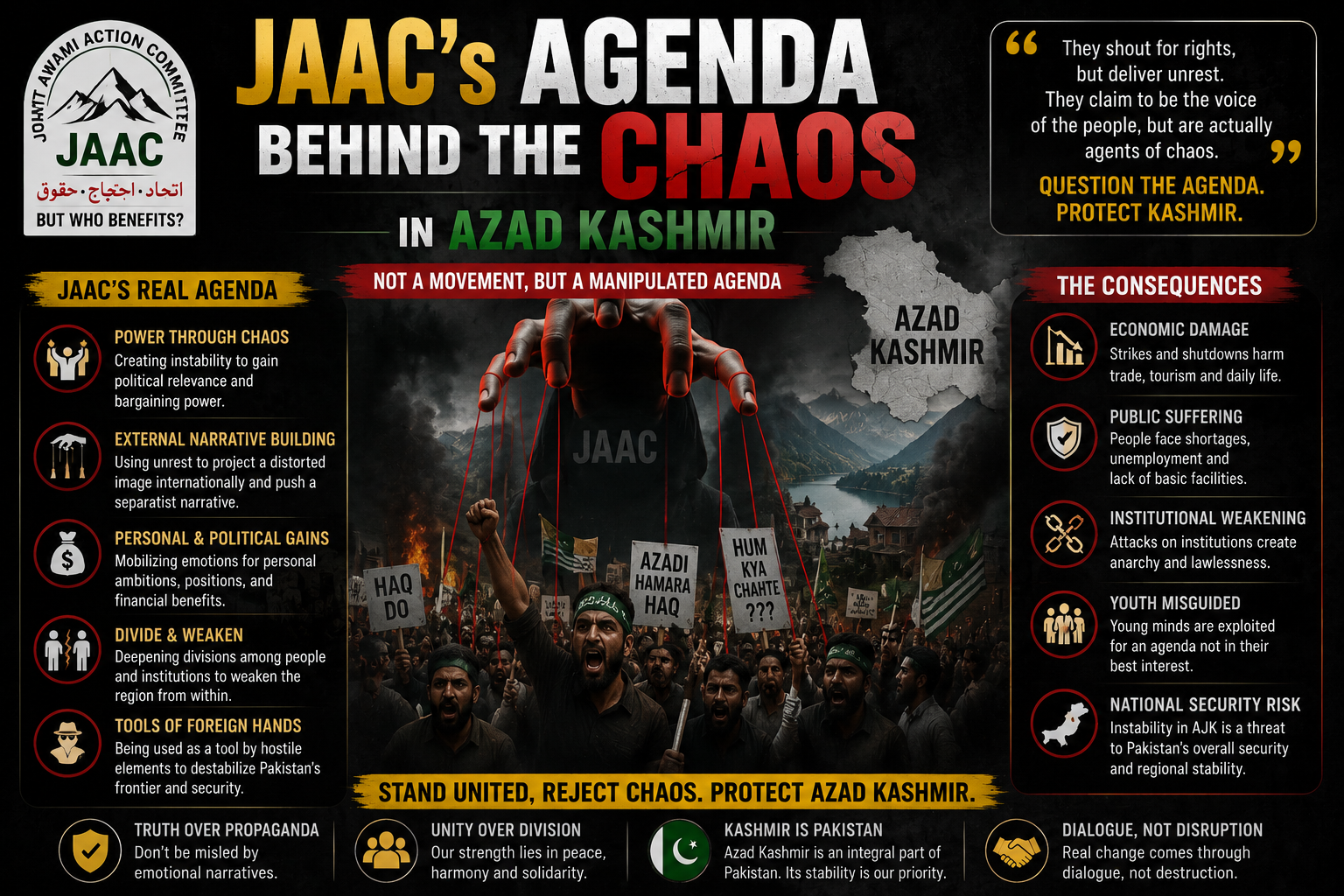
On 5 June 2026, the AJK government formally declared JAAC a proscribed organisation under the Anti-Terrorism Act. The official notification stated that the group was “engaged in terrorism, acting in a manner prejudicial to the peace and security of the State, involved in creating anarchy… by intimidating the public, promoting hatred, and creating a sense of insecurity.” This was not an arbitrary step. JAAC had repeatedly rejected dialogue after the government accepted the overwhelming majority of its 38 demands—reports indicate 35 to 37 points were fulfilled—leaving only a handful of issues that fall under judicial or constitutional review, particularly the 12 reserved seats for refugees from Indian Illegally Occupied Jammu and Kashmir (IIOJK).
These seats are not a tool of manipulation but a constitutional recognition of the historical reality of Kashmiri displacement and Pakistan’s principled stand on the Kashmir dispute. The AJK Supreme Court has upheld their protected status, ruling that any change requires a formal constitutional amendment, not street pressure. By insisting on their unilateral abolition and attempting to dictate the composition of the assembly ahead of elections, JAAC has shown contempt for democratic institutions and the will of the broader public.
The group’s methods further expose its true character. Peaceful protest is a right; armed confrontation is not. Security forces have faced fire from masked individuals carrying sophisticated weapons, including AK-47s, M-4 rifles and, according to police, even sniper rifles. AJK Police and federal officials have presented evidence linking elements within the protests to Fitna al-Khawarij (the state’s designation for Tehreek-i-Taliban Pakistan militants). Information Minister Attaullah Tarar and Interior State Minister Talal Chaudhry have stated clearly that the violence is driven by militants pursuing a foreign-backed agenda rather than genuine local grievances. Defence Minister Khawaja Asif has gone further, placing those attacking the state in the same category as external enemies of Pakistan.
Officials have also pointed to evidence of Indian funding and influence. AJK Information Secretary Muhammad Rashid Hanif stated that state institutions possess credible information of Indian financial support used to mobilise overseas elements and advance an anti-Pakistan narrative, including calls that effectively challenge the region’s constitutional relationship with Pakistan. Such external interference cannot be tolerated, especially when it coincides with attempts to disrupt elections through long marches, road blockades, shutter-down strikes, and direct clashes that have claimed the lives of security personnel as well as civilians caught in the crossfire.
The federal government has fully backed the AJK administration. “This is no longer a protest movement. They will not be considered protesters; they will be considered rioters,” State Minister Talal Chaudhry declared after the first phase of polling was marred by violence. The state has a duty to protect the electoral process. Phased voting was introduced precisely because of the security situation created by JAAC’s actions. Internet restrictions and heightened deployments, while inconvenient, are temporary measures to prevent the coordination of further unrest and to safeguard polling stations.
Negotiations took place; cases were withdrawn in earlier phases of engagement; compensation mechanisms were extended. Instead of accepting these openings, the group escalated, organised banned marches, and allowed or encouraged armed elements to operate under the cover of civilian gatherings. Blanket amnesty has rightly been ruled out. Those responsible for deaths, attacks on hospitals and checkpoints, and the destruction of public property must face the law.
Azad Kashmir holds a special place in the heart of every Pakistani. Its people deserve economic relief, good governance and the opportunity to choose their representatives freely. What they do not deserve is a campaign that turns genuine concerns into a platform for anarchy and foreign agendas. The elections must proceed to their conclusion on 10 August. Law-abiding citizens should reject the politics of disruption and support the democratic process. The state will continue to distinguish between legitimate grievance and organised violence. Those who choose the latter path will find no space for negotiation—only the firm application of the law in defence of peace, sovereignty and the future of Azad Kashmir.
Author