


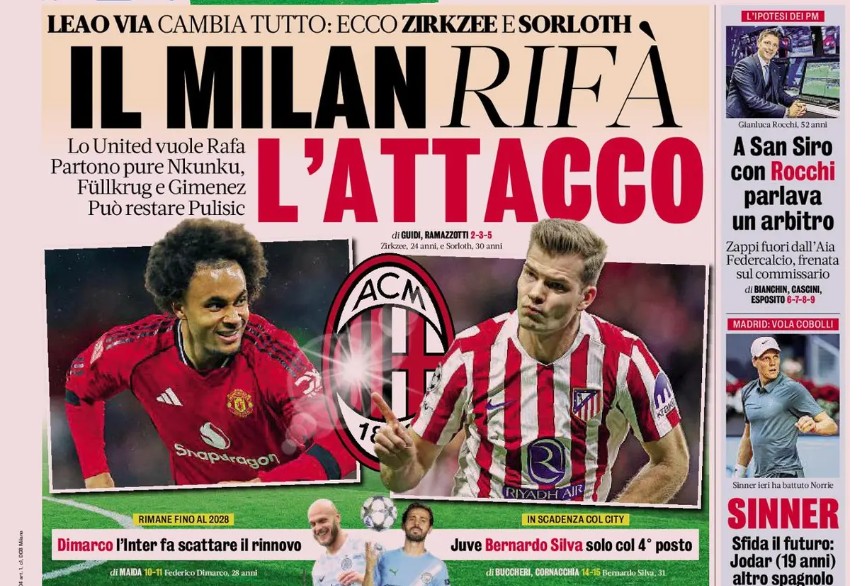
Italian Football Grapples with Governance Crisis Amidst Multi-Million Euro Transfer Scramble
POLICY WIRE — Rome, Italy — While European football’s titans clashed in a nine-goal spectacle that momentarily obscured reality, the subterranean rumble in Italian football governance continued its...

POLICY WIRE — Rome, Italy — While European football’s titans clashed in a nine-goal spectacle that momentarily obscured reality, the subterranean rumble in Italian football governance continued its slow, corrosive work. It isn’t the audacious transfer bids or the frantic player movements that truly define the moment, but rather the quiet, persistent erosion of trust emanating from the country’s refereeing body.
At its core, Italy’s premier league, Serie A, finds itself ensnared in a deepening integrity crisis, threatening to overshadow the multi-million euro machinations of its clubs. It’s an administrative morass dubbed ‘Arbitropoli,’ where the very adjudicators of the game stand accused, their probity under acute scrutiny. The latest casualty? Referee official Zappi, whose 13-month suspension — a formal rebuke upheld by CONI, Italy’s Olympic Committee — has effectively decapitated the referees’ association (AIA), leaving it adrift without leadership. And it’s not merely Zappi; the chief referee designator, Gianluca Rocchi, now finds himself in a prosecutor’s crosshairs over potential impropriety at San Siro, a situation he’s reportedly disinclined to discuss with investigators. This unfolding drama isn’t just a sidebar; it’s the structural fault line beneath every dazzling goal and audacious transfer.
Still, the show, as they say, must go on. Milan, under the pall of this administrative disquiet, has embarked on an ambitious, costly rebuild of its attacking vanguard. With Rafael Leão reportedly eyeing the exit, the club isn’t just replacing a player; it’s re-sculpting its entire offensive philosophy. Names like Zirkzee and Sorloth are whispered through the marble halls of Lombardy, each representing a significant capital outlay — Milan’s request for a departing Nkunku, for example, reportedly hovers around the €30 million mark. It’s a delicate dance, balancing strategic ambition with the precarious economic realities of modern football, exacerbated by the cloud of domestic governance issues.
But the Rossoneri aren’t alone in this high-stakes poker game. Across the peninsula, Juventus, ever the financial juggernaut, continues its relentless pursuit of Liverpool’s stalwart goalkeeper, Alisson Becker. The figures discussed are prodigious: a reported offer of €4.5 million per season plus add-ons for three years, pushing the agreement tantalizingly close. This isn’t simply about acquiring a talented shot-stopper; it’s a power play, a declaration of intent in a league where every advantage, however slight, can translate into significant revenue streams and brand supremacy.
“The very fabric of our league, its competitive integrity, demands unwavering vigilance,” shot back Gabriele Gravina, President of the Italian Football Federation (FIGC), reflecting on the refereeing scandal. “We’re not just sanctioning individuals; we’re fighting for the soul of the sport, a soul that resonates with millions globally, from Turin to Timbuktu.” And he’s not wrong: the perception of fairness in Serie A directly impacts its marketability, affecting everything from sponsorship deals to viewership figures in burgeoning football markets like Pakistan and other parts of the Muslim world, where fan bases are passionately loyal and acutely aware of global sporting ethics.
Meanwhile, Inter Milan, fresh off securing Dimarco’s renewal, is making its own calculated move for Como’s Argentine sensation, Nico Paz. Ten goals and seven assists in Serie A don’t go unnoticed, especially when Real Madrid — his reported former club — could still exercise a buy-back clause. It’s a complex international chess match, demonstrating how player valuation and mobility are increasingly dictated by intertwined club politics and global market forces. “In this market, every euro spent is a political statement,” observed Giuseppe Marotta, CEO of Sport at Inter Milan. “You’re not just buying a player; you’re investing in a narrative, often against a backdrop of increasing uncertainty. It’s a high-stakes gamble, always.” This mercenary calculus, as one might call it, underscores the precarious economics of elite football. Even Roma finds itself at a crossroads over Paulo Dybala, a situation neatly summarized by Policy Wire’s analysis of his high-stakes gamble in the sport’s fickle economy.
📄 POLICY WIRE WHITEPAPER PUBLISHED: PAKISTAN'S NATIONAL SECURITY POLICY PRIORITIES
👉 READ BY CLICKING HEREWhat This Means
The confluence of a deep-seated governance scandal and aggressive financial maneuvering presents a paradoxical challenge for Italian football. On one hand, the FIGC’s move towards potentially commissioning the AIA speaks volumes about the systemic breakdown of internal controls, threatening the very credibility of match outcomes. This erosion of trust isn’t just an Italian problem; it tarnishes the brand of Serie A on the global stage, potentially deterring foreign investment and diluting broadcast revenues from regions like South Asia, where discerning fans expect fair play. It’s an issue of institutional failure that transcends sport, touching upon broader themes of transparency and accountability in powerful, financially robust organizations.
On the other hand, the continued influx of capital into player transfers, with clubs willing to spend tens of millions (or more) on individual talents, demonstrates the enduring economic vitality and global appeal of the game. Yet, these high-value transactions occur within a volatile environment. The ongoing investigations create an unstable regulatory framework, potentially impacting future transfer market dynamics and investor confidence. The pursuit of top-tier talent like Alisson, while commercially astute, occurs against a backdrop where the foundational rules of engagement are being questioned. This isn’t just football; it’s a microcosm of global economic realities where capital flows freely, often outstripping the capacity of regulatory bodies to ensure ethical conduct.
Ultimately, Italian football stands at a precipice. The resolution of ‘Arbitropoli’ will determine not only the immediate future of its officials but also the long-term reputation and financial health of one of Europe’s most historically significant leagues. Its ability to navigate this dual crisis — restoring integrity while remaining economically competitive — will offer a telling lesson in sports governance for the world.