


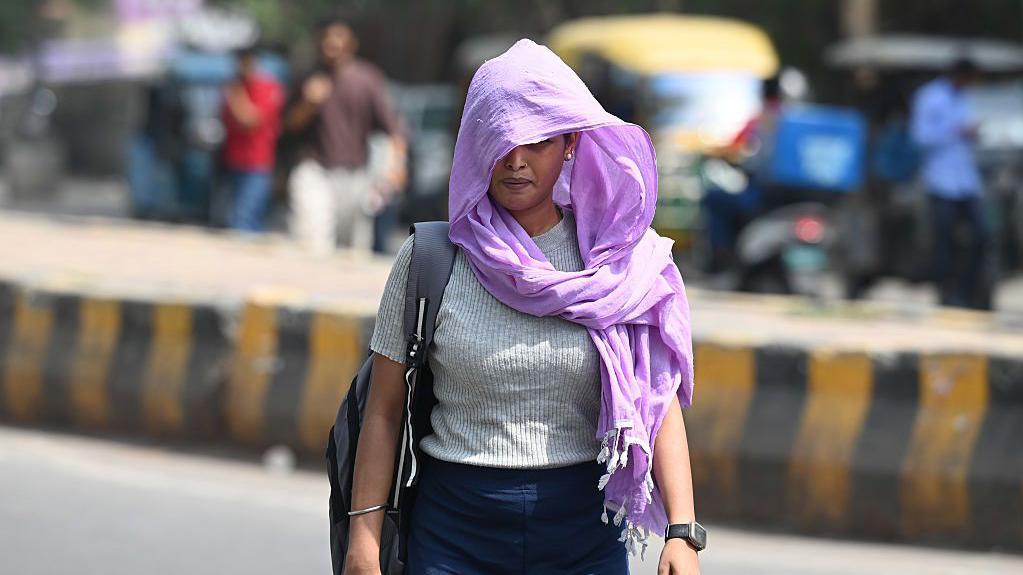
India’s Scorching Reality: Beyond 40C, A Silent Crisis Grips North
POLICY WIRE — New Delhi, India — The mercury hasn’t just vaulted; it’s soared past thresholds that once portended an anomaly, now marking a new, brutal normal for millions across North...

POLICY WIRE — New Delhi, India — The mercury hasn’t just vaulted; it’s soared past thresholds that once portended an anomaly, now marking a new, brutal normal for millions across North India. For weeks, the vast plains have baked under a relentless sun, a harsh prelude, like a sinister overture, to what meteorologists forebode could be one of the most blistering summer seasons on record.
Few can truly apprehend the sheer scale of the challenge unfolding: cities like Delhi and Lucknow regularly register temperatures well over 40 degrees Celsius, stress-testing infrastructure to its limits and making daily life an arduous endurance test. Truly awful. That’s a consequential shift from just a decade ago, when such sustained extremes were less common.
But this isn’t merely about a number on a thermometer. It’s about an entrenching maelstrom wreaking havoc upon everything from public health to economic stability, creating ripples that extend far beyond national borders. The math is stark: more than 75% of India’s population lives in districts vulnerable to extreme heat, according to research by the Centre for Science and Environment.
And yet, life persists. Millions of daily wage earners, construction workers, and street vendors have little choice but to brave the sweltering conditions, often without adequate shade or hydration (a truly grim prospect, wouldn’t you agree?). They’re on the front lines of a battle against an invisible, yet deadly, adversary.
Dr. Mrutyunjay Mohapatra, Director General of the India Meteorological Department (IMD), doesn’t mince words.
“We’re witnessing a troubling acceleration in both the frequency and intensity of these extreme events,” Mohapatra told Policy Wire. “It’s not just about hitting 45°C; it’s about prolonged exposure — and the diminished recovery periods between spells. The stress on our early warning systems and public health infrastructure is gargantuan.”
Frankly, it’s a mess.
Across the border, Pakistan, too, wrestles with similar meteorological torment. Shared air basins mean that environmental challenges rarely heed artificial boundaries, with cross-border dust storms and heatwaves becoming a grim, common thread. The regional impact of climate change, it seems, acts as a stark, undeniable equalizer, a cruel, indiscriminate hand evening the playing field.
Indeed, a 2022 report by the Indian Institute of Tropical Meteorology (IITM) unveiled that the frequency of heatwave days in India has surged by approximately 60% since the 1980s. This isn’t just bad weather; it’s a systemic shift, demanding more than temporary relief measures. Not good.
What then, are the long-term implications? Union Minister for Earth Sciences, Kiren Rijiju, acknowledges the gravity of the situation.
“The climate challenge is a shared responsibility, and India is committed to both mitigation and adaptation,” Rijiju stated publicly last week. “We can’t simply build our way out of this, but we can build resilience – through better urban planning, sustainable agriculture, and strengthening our public health response (a monumental undertaking, let’s be honest). It’s a national priority, — and frankly, it has to be.”
He’s not wrong, but what’s the plan, exactly?
The chokehold on resources, it’s palpable—electricity grids groan under the crushing weight of surging demand from air conditioners, often leaving vast swathes of the population in the dark, all while water supplies dwindle to alarming levels. Farmers watch their crops wither, foretelling potential food security issues down the line. This isn’t an isolated conundrum, it ties into larger global anxieties about food crises. A grim reality.
What This Means
Behind the headlines of record temperatures lies a byzantine tapestry of political, economic, and diplomatic implications. Politically, the recurring heatwaves stress-test governance wherewithal, forcing state and federal agencies to recalibrate disaster preparedness and public health outreach. There’s real pressure on leaders to deliver tangible solutions, not just platitudes. But how many truly apprehend the sheer, agonizing depth of this unfolding drama?
Economically, the impact is multi-faceted. Agricultural output languishes, threatening rural livelihoods — and national food supplies. Labor productivity drops significantly, costing billions in lost economic activity, particularly in sectors heavily reliant on outdoor work. This sustained heat fundamentally upends the economic calculus for growth.
Diplomatically, one might even argue that shared vulnerabilities in South Asia—countries like India and Pakistan, often at loggerheads, finding themselves shackled by common climate threats—could, paradoxically, carve out fresh avenues for cooperation, compelling joint research, unified early warning systems, and truly coordinated adaptation strategies. Such climate diplomacy might furnish an unexpected layer to complex regional relations.
Ultimately, the escalating heat maelstrom in North India serves as a stark admonition of the urgent need for unyielding climate action and resilient infrastructure. As Professor Anand Patwardhan, an expert in climate policy at the University of Maryland, recently observed, “Mere survival in extreme heat isn’t adaptation; it’s just delayed collapse. True adaptation means a wholesale overhaul in how we design our cities, grow our food, and protect our most vulnerable populations, starting now.” So, what’s holding us back?