


The NBA’s Underpriced Star: Champagnie’s Quiet Rise and the Brutal Economics of the Game
POLICY WIRE — San Antonio, Texas — For a league awash in fortunes, where every dribble often seems pre-calculated down to the decimal point of market share, a certain dissonance reverberates when...

POLICY WIRE — San Antonio, Texas — For a league awash in fortunes, where every dribble often seems pre-calculated down to the decimal point of market share, a certain dissonance reverberates when unexpected heroism takes center court. It isn’t the nine-figure contract, the lavish endorsement deal, or the private jet manifest that captures our attention this particular season, but rather its stark opposite: the profound quiet of undervalued labor.
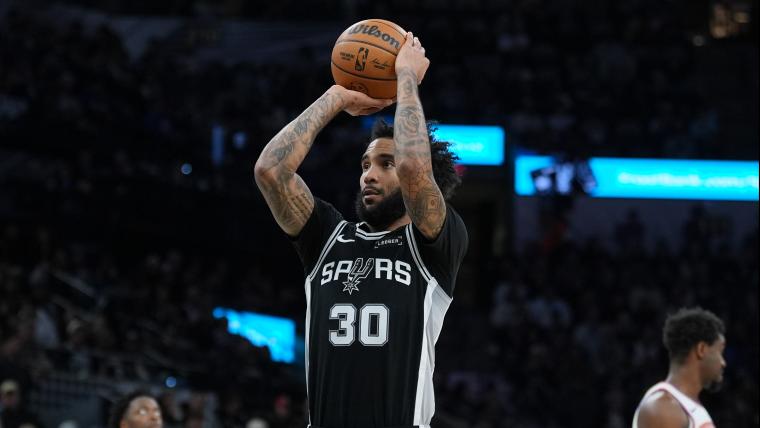
Julian Champagnie, a name until recently unfamiliar to all but the most fervent NBA analysts—or perhaps a few dedicated St. John’s alumni—has elbowed his way into the NBA Finals spotlight. A recent college graduate, 24, who once played for the Red Storm and hails from New York, he found himself leading the San Antonio Spurs in scoring during a crucial Game 1 against his hometown Knicks. His 15 points, delivered with startling efficiency (5-6 from beyond the arc in the first half alone), were the stuff of immediate legend. But it’s not his on-court brilliance that’s the headline, not really. It’s what he’s getting paid to do it.
See, on a court bursting with brand names and salary-cap devourers, Champagnie isn’t exactly cashing in like his superstar peers. His current contract? A mere $3 million annually, a figure that nets him an aggregate $12 million over a four-year term. To put that in perspective for an organization worth billions, and operating within a salary structure where maximum deals eclipse $50 million annually, his take-home pay consumes a scant 1.94% of the Spurs’ total cap space, according to projections gleaned from league salary disclosures.
But there’s a cold, hard logic at play here. This isn’t a fairy tale; it’s commerce. The young forward, plucked by San Antonio after being waived by Philadelphia in early 2023, is a commodity that performed well above acquisition cost. “Every General Manager in this league dreams of finding a Julian Champagnie,” quipped NBA Commissioner Adam Silver recently, likely from some gilded box suite overlooking the court. “A player whose intrinsic value, often overlooked, skyrockets just when it matters most. It’s the engine of competitive balance, really, this constant search for efficient allocation of capital in talent.” Silver’s remarks, of course, were uttered without the slightest trace of irony regarding the billions of dollars involved. But he’s right; it’s a relentless search for bargains. It’s the brutal theater of elite sport’s first act.
And while his current numbers—and this shocking performance against the Knicks—won’t see him buying a new NBA franchise next week, they certainly place him on the fast track for a significant bump. Mavericks owner Mark Cuban, never one to mince words when discussing the cold mechanics of professional sports, probably summed it up best during a sideline interview earlier in the season. “Look, in this business, you’re either proving you belong or proving you’re too expensive. Julian’s proving he belongs. Every single cap sheet is a puzzle; you gotta find guys who do champagne work on a beer budget. That’s how you win these things.”
📄 POLICY WIRE WHITEPAPER PUBLISHED: PAKISTAN'S NATIONAL SECURITY POLICY PRIORITIES
👉 READ BY CLICKING HEREChampagnie’s journey—undrafted, waived, then unexpectedly pivotal on the game’s biggest stage—doesn’t just illustrate a triumph of gritty determination. It offers a fleeting glimpse into the vast, intricate ecosystem of elite professional sports, an ecosystem that transcends geographical boundaries and speaks a universal language of market efficiency. And it’s a tale watched intently across the globe, including in places like Pakistan, where basketball’s popularity is quietly burgeoning among a digitally native youth. These global audiences, far removed from Madison Square Garden or the Frost Bank Center, follow every stat, every contract detail, analyzing the shrewd investments and glaring miscalculations made by teams thousands of miles away, often with the same fervor once reserved for cricket.
What This Means
The curious case of Julian Champagnie is more than just a sports anecdote; it’s a microeconomic case study playing out in prime time. It spotlights the relentless pursuit of value in an ostensibly inflated market, reminding us that even in arenas where capital flows like an open faucet, the overlooked asset can often deliver the greatest returns. Policy wonks, economists, — and even geopolitical strategists (stay with me on this) can glean insights from this. Because, you see, the mechanics of professional sports salaries—especially when an unheralded player transforms into a championship contender—often mirror the dynamics of other complex markets. It’s about spotting talent others miss, managing a cap sheet, and understanding that perceived value isn’t always real value until the numbers stack up. This narrative, a player defying initial market appraisals to become indispensable, isn’t unique to the hardwood. It’s a perennial debate in labor markets, commodity trading, and even the opaque world of international aid, where ‘efficient allocation’ remains a holy grail, rarely attained. The league’s collective bargaining agreements (CBA) are complex, yes, designed to prevent outright financial dominance by a few, but human capital, in its unpredictable glory, will always find ways to confound expectations—and enrich those who spot it early enough. So don’t be surprised when you see these narratives reverberate, as young fans in Lahore, for example, watch the finals and ponder not just the athleticism, but the sheer financial gymnastics underpinning such success. It’s an American spectacle with global lessons. For those in power, it serves as a stark reminder: real value doesn’t always arrive with a brass band; sometimes, it quietly makes 1.94% of your budget sing.