


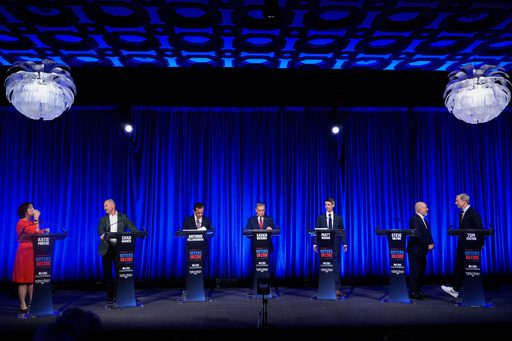
Golden State Gold Rush: California Primary Blends Billions, Scandals, and a Fight for the Soul of Progress
POLICY WIRE — Sacramento, California — The Golden State is a place where sunshine and innovation clash head-on with wildfires and deep-seated political frustration. So maybe it isn’t so strange that...

POLICY WIRE — Sacramento, California — The Golden State is a place where sunshine and innovation clash head-on with wildfires and deep-seated political frustration. So maybe it isn’t so strange that its next gubernatorial contest, boiling over to Tuesday’s primary, has become less an election and more a bare-knuckle, all-consuming saga. This isn’t your typical backroom primary brawl. But when voters in California — the nation’s most populous state, a financial behemoth with one of the world’s largest economies — step up to cast their ballots, they aren’t just picking names off a list; they’re trying to navigate a peculiar labyrinth designed to both enthrall and exasperate.
Consider the landscape: It’s a state often lauded as a testing ground for progressive ideas, yet simultaneously hammered by Republican President Donald Trump, who loves nothing more than to use it as a rhetorical punching bag. But because it’s California, the race got even weirder, real fast. One of the top contenders, Rep. Eric Swalwell, consolidating Democratic establishment support, had his political carpet pulled out from under him back in April after an accusation of sexual assault surfaced, forcing him out of the running.
This primary, under the state’s “jungle primary” rules (implemented in 2010), means everyone’s on the same ballot, regardless of party. The top two vote-getters, however they shake out, will duke it out in the general election. And who’s leading the pack in this chaotic melee? Two polls conducted in mid-to-late May suggested that Democrat Xavier Becerra and Republican Steve Hilton each have the support of about 2 in 10 likely voters. That’s not a typo. It means a huge chunk of voters are still very much up for grabs, or they’re backing one of the 59 other souls on the ballot, none of whom were polling in double digits. The field’s less a clear path, more a dense thicket.
Becerra, a Democrat with 35 years embedded in California — and national politics, made a name for himself. He climbed the ranks, became California’s attorney general after Kamala Harris moved to the U.S. Senate, then went after Trump — and his whole agenda in court, becoming a thorn in the former president’s side. He even did a stint as Health and Human Services Secretary in President Joe Biden’s cabinet. But hey, it hasn’t all been smooth sailing. Some folks who served with him in the Biden administration haven’t exactly sung his praises. And because this is politics, he’s still batting away persistent questions since a former top aide was convicted of stealing his campaign funds. Still, after Swalwell exited, many of the state’s big-money Democratic power players, including major labor unions and LGBTQ rights groups like Equality California, lined up behind him.
Then you’ve got Steve Hilton, a Republican. Trump’s endorsement gives him a serious boost with the GOP faithful, making his path to the general election perhaps the clearest of anyone’s. But, because this is California, that presidential blessing could easily turn into an anchor come November in a state that thoroughly rejected Trump in both of his national runs. Hilton’s a conservative commentator and a former Fox News host, originally from England, who even advised former British Prime Minister David Cameron. His main pitch? Electing a Republican provides a crucial check on the majority in Sacramento. He’s promising a tax-free first $100,000 of income for people and dramatically lower gas prices—music to some ears, for sure.
But the race isn’t just about party lines; it’s about sheer spending power, too. Just ask Tom Steyer, the billionaire founder of a San Francisco-based hedge fund. His advertising? It’s everywhere. You can’t avoid his face on billboards or your screen. And, because money talks, that record-breaking spending, mostly from his own pockets, has definitely pushed him into the frontrunner conversation. Steyer, who’s never held public office, spent years bankrolling campaigns for climate change and even called for Trump’s impeachment before making his own, albeit short-lived, presidential run. He’s pushing a progressive populist message, railing against special interests — and big corporations.
And what about the other major players? Matt Mahan, the mayor of San Jose, is playing the moderate card, a favorite of the Silicon Valley tech crowd with his business-friendly talk. His backing from tech executives, — and their millions, has ruffled feathers among unions. Then there’s Katie Porter, a Democrat from Orange County who’s a whiz with a whiteboard, dissecting policy and publicly sparring with corporate executives. Her grasp of policy wins editorial boards, but a leaked video showing her berating an aide raised eyebrows. You also can’t forget Antonio Villaraigosa, the former Los Angeles mayor and Assembly Speaker, a Democratic centrist whose pragmatic approach highlights his roots in Southern California’s political scene. And Chad Bianco, the Riverside County Sheriff and a staunch Trump supporter, has made headlines for seizing election materials, igniting a judicial tempest with critics calling it a nod to discredited conspiracy theories. The state Supreme Court even had to step in — and order him to halt the probe back in April.
What This Means
This primary is a microcosm of California’s complex identity. It’s not just a battle of Democrats versus Republicans; it’s a proxy war over the future of progressive governance, an economic powerhouse grappling with its own contradictions. The sheer volume of wealth represented by candidates like Steyer, and the power of tech executives backing figures like Mahan, points to the evolving donor landscape in American politics. The eventual governor here won’t just run a state; they’ll oversee an economy larger than most countries, a government experimenting with social policies that could reshape national discourse, and a population that increasingly reflects global diversity. Consider how closely nations across the world, from Islamabad to Jakarta, often scrutinize California’s legislative outcomes – on everything from data privacy to climate change. Its economic policies, tech regulations, and social experiments are watched because if a state of this scale, this diversity, can make something work, it offers blueprints for others wrestling with similar challenges.
This election will either consolidate California’s trajectory as a bastion of big government, progressive policy (albeit with internal squabbles), or introduce a potent check on that power. It’s a bellwether for the influence of deep-pocketed donors, the lasting shadow of the Trump era on Republican candidates even in blue states, and the eternal question of how a genuinely diverse populace wants to be led. No matter who emerges from Tuesday’s primary, they’ll face an epic task governing a place that can’t quite agree on what it wants to be, beyond simply more of everything.