


Senior Golf’s Hidden Riches: Millions & Global Contrast
Discover the quiet economics of senior golf. Elite legends compete for millions, revealing stark contrasts with global economic realities.

POLICY WIRE — Columbus, Ohio — Amidst the verdant sprawl of Scioto Country Club, where perfectly manicured greens absorb decades of golfing ambition, another quiet game plays out: the ongoing negotiation between legacy, physical endurance, and the rather substantial payouts of a career’s twilight. We’re not just talking about putts and drives; we’re observing a fascinating intersection of elite sport and its economic bedrock, often glossed over by the easy charm of nostalgia. It’s an unusual scene, sure, yet speaks volumes about who gets to chase fortunes, and for how long, in the grand arena of professional sport.
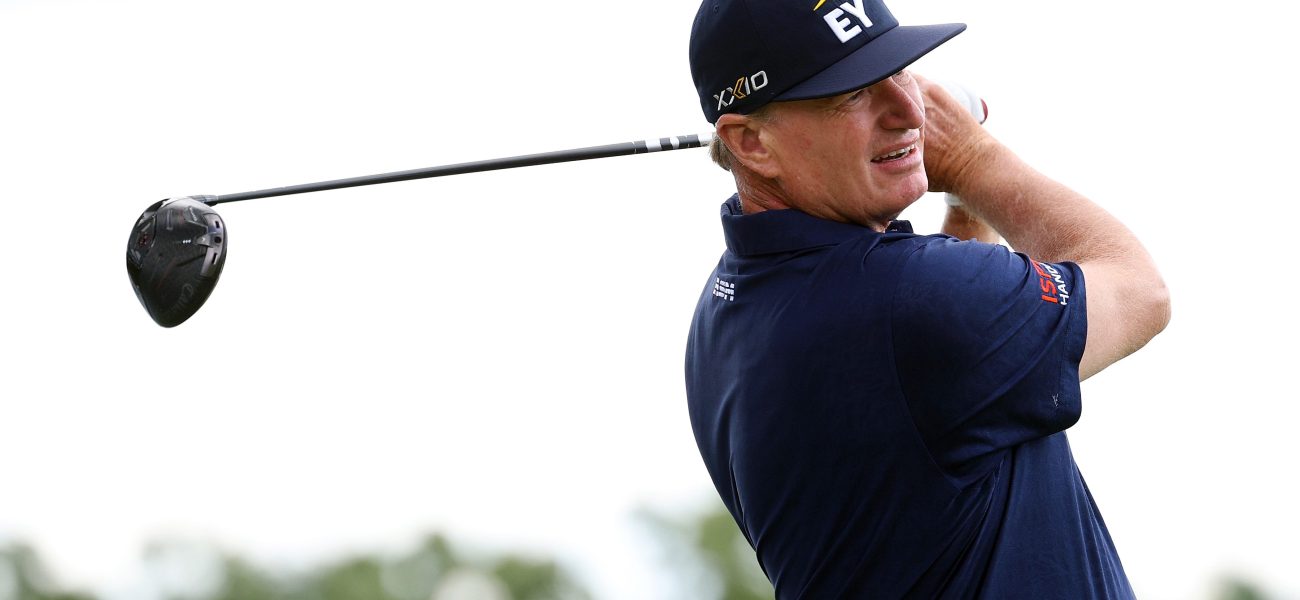
As the U.S. Senior Open unfurled its first competitive rounds, some familiar faces were out there, pushing carts and their bodies just as hard as ever. You’ve got your Ernie Els, your Vijay Singh—names that once dominated prime-time broadcasts, now battling Father Time as much as the course architect. For a moment, you could almost forget that the average age here probably nudges closer to sixty than forty, a fact most golfers probably appreciate not being screamed from the rooftops. And they don’t exactly do this for pocket change.
Because, frankly, there’s serious coin on the line. The tournament purse stands at a tidy $4 million, according to organizers. Last year’s champion, Padraig Harrington (who’s, ironically, the assumed 2025 winner in the USGA’s pre-release info, a little slip that offers a chuckle), walked away with a cool $800,000. That’s an income bracket many wouldn’t sneeze at in their prime, let alone during what’s often called the ‘senior tour.’ It represents not just continued professional success, but an entirely distinct ecosystem of wealth generation that exists parallel to the primary, often youth-obsessed, sports circuits.
But let’s be real for a minute. This kind of financial incentive — and the physical health required to pursue it — remains a luxury. It’s a distant dream for countless individuals in parts of the world grappling with far more immediate challenges. You look at these polished scenes in Ohio, and then consider, say, the urgent conversations unfolding in Pakistan over water scarcity or electoral transparency. It’s not a direct comparison, no, but it’s a jarring juxtaposition, highlighting global economic disparities that even sports, inadvertently, reflect. When one side of the globe argues over the finer points of a swing plane, another grapples with geopolitical storms—where deepfakes stir conflict from Sudan to Pakistan’s borders. That disparity, my friends, is absolutely worth noticing.
Veteran player Tom Lehman, a ’96 British Open champion still grinding away, recently mused on the tour’s appeal. “Look, it’s not just about the money, though that helps a whole lot. It’s about competitive spirit, this brotherhood we share. We’re still pros, you know? And we still want to win.” That sentiment, you see, it really cuts through the gloss. Because for all the millions on offer, the raw desire to compete doesn’t ever truly fade, does it? The body might object, but the mind remains keen.
📄 POLICY WIRE WHITEPAPER PUBLISHED: PAKISTAN'S NATIONAL SECURITY POLICY PRIORITIES
👉 READ BY CLICKING HEREMeanwhile, a USGA official, speaking off-the-record about the tournament’s broader appeal, didn’t shy away from the financial aspect. “We’re not just selling golf; we’re selling a narrative of endurance, of excellence redefined by age. And yes, that attracts sponsorships, that attracts viewership, — and that fuels a very significant prize pool. It’s a business, after all. A well-oiled one, by the looks of it.” There’s no escaping the economics, is there? It’s the silent engine.
What This Means
The U.S. Senior Open, beyond its charming optics of seasoned champions, offers a fascinating lens into economic stratification and the commodification of age-defying performance. Politically, the substantial prize money reflects an entertainment industry still capable of generating outsized rewards for a select few, drawing a stark line between ‘developed’ leisure economies and regions where basic infrastructure struggles for funding. Economically, it showcases a segment of the global sports market where experience, even beyond peak physical prowess, commands serious financial backing. The ongoing spectacle here suggests a continuing appetite for heroic narratives—even gray-haired ones—so long as they’re paired with enough zeros in the prize fund. It’s not just about golf, then. It’s a small window into bigger economic pictures, globally, and an indicator of where money finds its comfort: in predictable, well-marketed excellence. It simply is what it’s.