

Gaza’s Perennial Conflict: Another Day, Another Drone, Another Echo of Despair
POLICY WIRE — Gaza City, Palestinian Territories — Instead of the boom, consider the echo. Not the blast itself, but the almost imperceptible tremor it sends through the jaded conscience of a world...

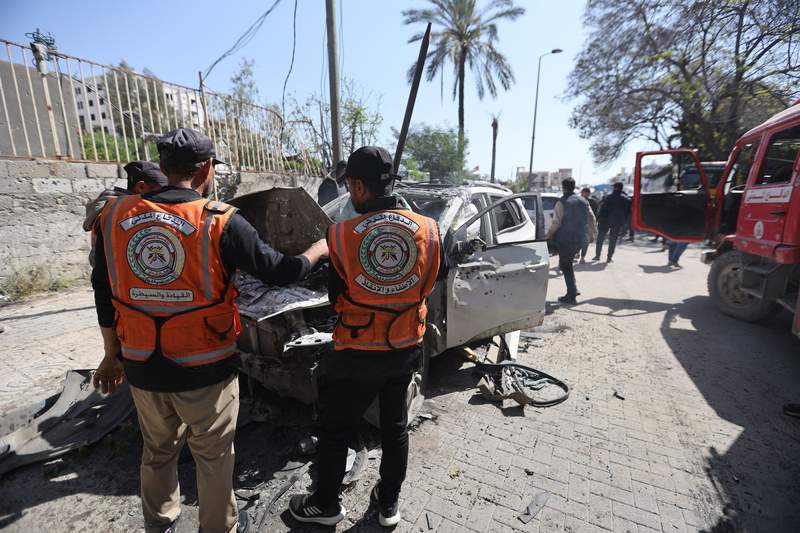
POLICY WIRE — Gaza City, Palestinian Territories — Instead of the boom, consider the echo. Not the blast itself, but the almost imperceptible tremor it sends through the jaded conscience of a world accustomed to the choreography of conflict in the Gaza Strip. It’s a familiar, bleak opera, whose latest act unfolded this week with reports from Palestinian health officials of Israeli drone strikes claiming three lives. Yet, for many, the details—the specific targets, the precise coordinates, the individual fates—have begun to blur into the undifferentiated hum of perpetual crisis.
The Palestinian Ministry of Health in Gaza asserted Tuesday that Israeli aerial assets, widely believed to be drones, had targeted various locations within the densely populated enclave. The resulting casualties, they contended, included two militants — and one civilian, a tragic collateral outcome. But it’s the routine nature of these declarations—the almost bureaucratic cadence of death tolls and condemnations—that now demands closer scrutiny. It isn’t merely a factual reporting; it’s a testament to a conflict so ingrained, it’s become a grim, albeit predictable, fixture on the international stage.
From Jerusalem, the Israeli Defense Forces (IDF) have maintained a policy of calculated ambiguity, only confirming ‘targeted operational activity against terrorist infrastructure’ without specifying the recent incidents. But the underlying rationale is never far from official lips. ‘We don’t target civilians, ever. That’s a fundamental principle,’ declared Brigadier General (Ret.) Avi Cohen, a former senior IDF intelligence officer, in a Policy Wire interview. ‘Our operations are precise, aimed solely at terrorist infrastructure. Civilian casualties, while tragic, are an unavoidable consequence when Hamas deliberately embeds itself within civilian areas, using their own people as human shields.’
On the other side of the razor-wire fence, the narrative couldn’t be starker. Dr. Mustafa Barghouti, a prominent member of the Palestinian Legislative Council, shot back, ‘This isn’t self-defense; it’s a perpetuation of an illegal occupation and collective punishment against 2.3 million people trapped in an open-air prison. The international community’s silence empowers this brutality against our people.’ His words, imbued with a familiar exasperation, underscore the profound chasm of understanding that continues to define this protracted struggle. For Palestinians, these aren’t isolated incidents; they’re integral components of an ongoing siege.
And siege it’s. The United Nations Office for the Coordination of Humanitarian Affairs (OCHA) has consistently reported that over 80% of Gaza’s population relies on humanitarian assistance, a stark reminder of the dire conditions underpinning daily existence. It’s a precarious life, punctuated by cycles of violence that offer little respite.
Still, the ripples of such events extend far beyond the immediate blast radius. Across the broader Muslim world, particularly in nations like Pakistan, these incidents resonate with potent symbolic weight. Islamabad’s diplomatic calculus, often navigating complex regional dynamics, consistently foregrounds the Palestinian cause as a core issue for the Muslim Ummah. The continuous strife in Gaza serves as a perennial flashpoint, capable of galvanizing public sentiment and influencing foreign policy postures, sometimes diverting attention from more immediate domestic concerns. It’s a narrative that the Islamabad factor has long amplified, linking the fate of distant populations to regional stability.
Behind the headlines of missile strikes and casualty counts lies a deeper truth: a struggle for dignity, sovereignty, and basic human rights, relentlessly playing out against a backdrop of geopolitical realpolitik. The world observes, occasionally condemns, but rarely intervenes with the decisive action many advocates deem necessary. It’s a testament to the sheer inertia of entrenched conflict, where resolution seems perpetually out of reach, and the status quo, however violent, holds sway.
What This Means
The latest reported drone strikes, and the predictable responses they’ve elicited, illuminate several consequential realities. Politically, they reinforce the deepening perception of an intractable conflict, one where diplomatic initiatives often falter against hardened positions. For Israel, these operations are framed as essential security measures against persistent threats from militant groups, allowing the government to project strength domestically—a crucial consideration in its own volatile political landscape. Conversely, for Palestinian factions, each strike becomes a rallying cry, further solidifying resistance narratives and exacerbating humanitarian woes. Economically, the constant cycles of destruction and reconstruction in Gaza create a dependency on external aid, stifling any meaningful long-term development. The international community, grappling with a multitude of humanitarian crises across the globe—think of Sudan’s silent exodus—finds its resources and diplomatic bandwidth stretched thin, often leading to a rhetorical commitment devoid of concrete leverage. This stalemate perpetuates a humanitarian crisis, entrenches radicalization, and leaves little room for optimism regarding a political horizon. It’s a grim prognosis, but one that current realities regrettably bear out.