


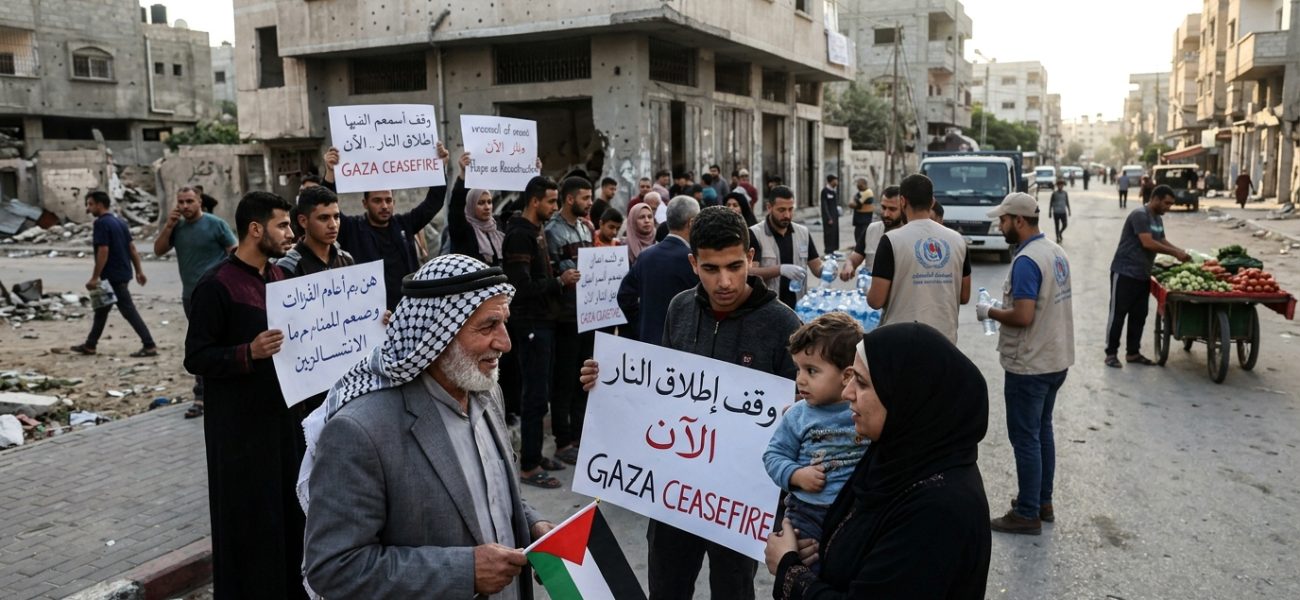
Gaza’s Ceasefire Is a Lie Written in Palestinian Blood
Pakistan’s call for justice grows louder, but the world must listen. In Khan Younis, a mother marks her children’s memory with stones outside her tent. There is no grave to visit. The...
In Khan Younis, a mother marks her children’s memory with stones outside her tent. There is no grave to visit. The graveyard has been bombed. She knows nothing about where they were laid to rest, except that they are no more.
Here in Gaza 2026. Here is what the international community refers to as a ceasefire.
A Ceasefire in Name Only
After the supposed end of hostilities in October 2025, the entire world rejoiced. Seven months into this ‘ceasefire’ and there is no room left for celebration. At least according to the UN figures released, 72,619 Palestinians have become martyrs since October 7, 2023, while over 880 others have died since the declaration of ceasefire at the hands of the very same Israelis who signed the peace deal. Two children are martyred on an average daily basis in what is termed as a dead war. The data is sourced from the official sources like OCHA, UNICEF, and the UN Ministry of Health.
Pakistan stood before the UN Security Council on May 22 and said what others were too compromised to say. Permanent Envoy Asim Iftikhar Ahmad did not offer careful diplomatic language. He offered facts. Over 21,000 children martyred. Ninety percent of Gaza’s population displaced. Food prices 300 percent above pre-war levels. Half the hospitals barely functional. Waterborne diseases spreading through a population drinking contaminated water in makeshift tents. “The overall situation remains deeply precarious,” he said, and that may be the greatest understatement delivered at the United Nations this year.
What Ahmad described is not the aftermath of war. It is the architecture of deliberate destruction.
Deliberate Destruction, Not Aftermath
The World Food Programme confirmed a famine in Gaza, the first ever recorded in the Middle East. Not a food crisis. A famine. Ninety-eight percent of Gaza’s farmland is damaged or inaccessible. Over 436,000 homes, more than 90 percent of all residential buildings, have been destroyed. Ninety-four percent of hospitals are damaged or destroyed. Ninety-seven percent of schools are damaged or destroyed. The UN’s own OHCHR has raised alarm over what it describes as possible ethnic cleansing, citing “intensified violence, destruction, and forcible transfers aimed at the permanent displacement of Palestinians.”
Israel did not stumble into this catastrophe. It engineered it.
Pakistan’s Position
Pakistan has named this clearly. Pakistan’s foreign minister Ishaq Dar addressed the Organization of Islamic Cooperation back in August when he said that the world was “witnessing a plausible genocide” and outlined a seven-step program calling for an immediate and unconditional ceasefire, unhindered humanitarian assistance, enhanced support for UNRWA, a halt to all settlements, and a process of Palestinian statehood within a set period of time. As a non-permanent member of the UN Security Council in 2025-2026, Pakistan has backed up its words with actions by vowing to secure global support for Palestine’s self-determination in the most influential institution on earth. Pakistan even offered to send peacekeepers to Gaza, ready to send troops where other countries sent just words.
Violations Continue
Yet the violations continue. Israel intercepted the Global Sumud Flotilla in international waters, a humanitarian mission carrying aid, detaining and reportedly mistreating the aid workers on board. Senior Israeli officials led hundreds of settlers in storming the Al-Aqsa Mosque compound, the third holiest site in Islam, under heavy police escort. Israel now plans to build a military complex on the site of the former UNRWA headquarters in East Jerusalem, converting the institutional symbol of Palestinian refugee support into a monument of military occupation. Pakistan has condemned each of these acts. The Security Council has issued concerns. Israel has continued.
The Veto Problem
This is the structural problem Pakistan also identified, though diplomatic convention prevented Ahmad from stating it quite so bluntly: the United Nations Security Council cannot act because the United States will veto any resolution that imposes real consequences on Israel. While Russia’s invasion of Ukraine produced sanctions within days and arms supplies within weeks, Gaza’s children have been dying for over two years and the same Western nations continue authorizing arms sales to Tel Aviv. The double standard is not subtle. It is not accidental. It is policy.
📄 POLICY WIRE WHITEPAPER PUBLISHED: PAKISTAN'S NATIONAL SECURITY POLICY PRIORITIES
👉 READ BY CLICKING HEREOccupation, Gaza and Kashmir
Pakistan understands occupation in ways that most Security Council members do not. The people of Indian Occupied Jammu and Kashmir have lived under military occupation for decades, their aspirations denied, their UN-mandated plebiscite ignored. This shared experience of watching the world look away is not lost on Pakistani policymakers or Pakistani people. When Pakistan speaks for Gaza, it speaks from a place that knows exactly what it costs when the international community decides that your suffering does not qualify for action.
The UN’s high representative for Gaza, Nickolay Mladenov, warned the Security Council this week that the deteriorating status quo risks becoming “permanent.” That word should stop every diplomat cold. Permanent means an entire people permanently dispossessed. Permanent means the destruction of a society so complete that reconstruction becomes impossible. Permanent means complicity by every government that watched and calculated and waited.
The Demand: Statehood and Accountability
Pakistan’s demand is simple and grounded in fifty years of UN resolutions: an independent, sovereign, contiguous Palestinian state on pre-1967 borders, with East Jerusalem as its capital. Not a distant aspiration. A legal obligation. Every day it is deferred, more people die.
“The Palestinian people do not seek statements of sympathy,” Ishaq Dar said at the OIC. “They need concrete measures.”
He was right and the world, every government, every institution, every leader with a platform, must answer that demand not with more condolences, but with action.
Gaza cannot wait for another resolution. Gaza cannot wait for another summit. Gaza’s children, 56,000 of whom have already lost one or both parents, cannot wait for the international community to find its conscience on a more convenient schedule.
The time is now. The obligation is clear. The choice belongs to the world.
Author